
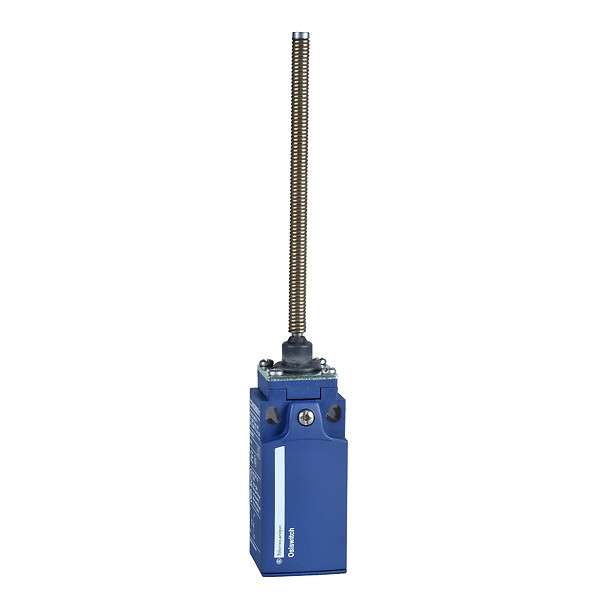
Telemecanique Sensors XCKN2127P20 Limit Switch: Thermoplastic Roller Lever Plunger with M20 Cable Entry
The Telemecanique Sensors XCKN2127P20 limit switch is an XC Standard compact model designed for reliable mechanical position detection in industrial automation. It is defined as a limit switch with a spring return roller lever plunger (thermoplastic), 1 NC + 1 NO contacts, and snap action switching, using an M20 x 1.5 cable gland entry.
When a machine requires a clear discrete signal at a specific travel point—end-of-stroke, clamp confirmation, carrier presence, or indexing position—a compact limit switch often delivers the simplest and most serviceable solution. The Telemecanique Sensors XCKN2127P20 limit switch is built around that philosophy: mechanical actuation on the outside, stable electrical contacts on the inside, and straightforward wiring so maintenance teams can replace the device quickly without redesigning the circuit.
Mechanical Configuration and Approach Direction
This model uses a fixed plastic body with a plunger head, and the operating head movement is listed as linear. The operator type—spring return roller lever plunger thermoplastic—is particularly useful in compact mechanisms where the actuating part approaches from above and presses the lever/plunger interface. The approach type is listed as vertical approach, 1 direction.
In engineering terms, vertical one-direction approach helps designers predict how the cam or striker must engage the actuator. It also helps technicians diagnose issues: if the mechanism is contacting from an unintended angle, the actuation point can drift. With the Telemecanique Sensors XCKN2127P20 limit switch, keeping a disciplined approach direction is the most direct way to protect repeatability over long cycles.
Contact System and Switching Behavior
The device is specified with 1 NC + 1 NO contacts and snap action contact operation. Snap action matters because it encourages a decisive state change even if the mechanical motion is slow. In PLC logic, that supports stable input interpretation and reduces nuisance states that can occur if a mechanism vibrates near the switching threshold.
Actuation Method in Real Machines
The switch actuation is specified as by 30° cam. In practice, a 30° cam profile can provide controlled engagement of the roller lever plunger, helping the switch transition cleanly without excessive mechanical shock. A well-finished cam surface also reduces wear on the thermoplastic roller/lever interface.
- Recommended: smooth cam face, stable overtravel margin, rigid mounting bracket
- To avoid: sharp-edge strikers, side loading, and minimal travel that hovers near the trip point
Wiring, Cable Entry, and Serviceability
The Telemecanique Sensors XCKN2127P20 limit switch uses screw-clamp terminals with clamping capacity 1 x 0.34…2 x 1.5 mm². Cable entry is specified as 1 entry tapped for M20 x 1.5 cable gland, with cable outer diameter 7–13 mm.These details are not cosmetic; they define how to preserve sealing and strain relief. If a cable is undersized for the gland, the sealing ring may not compress properly. If oversized, the jacket can be damaged during installation.
Electrical duty categories listed include A300 / AC-15 and R300 / DC-13, with Ithe 10 A referenced under the industrial control standard framework. This helps engineers map the device to appropriate control loads.
Telemecanique Sensors XCKN2127P20 Environmental Characteristics
The model is listed with IP65 protection and IK04 impact rating, plus shock and vibration resistance values. For consistent performance, the practical rule is simple: sealing depends on the cable gland installation quality, while mechanical repeatability depends on rigid mounting and consistent cam geometry.
For portfolio alignment across sensor projects, visit Telemecanique sensor.
Telemecanique Sensors XCKN2127P20 FAQ
1) What actuator type is used?
It uses a spring return thermoplastic roller lever plunger with linear movement.
2) What approach direction is specified?
Vertical approach in 1 direction is specified for this model.
3) What contacts are available?
It provides 1 NC + 1 NO contacts with snap action operation.
4) What cable entry does it use?
It uses 1 tapped entry for M20 x 1.5 cable gland, cable diameter 7–13 mm.
5) How is it intended to be actuated?
It is specified for actuation by a 30° cam.