
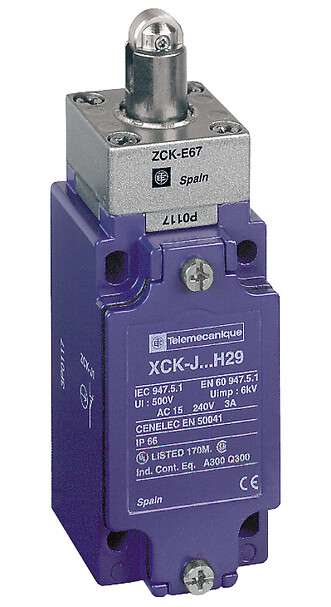
Telemecanique Sensors XCKJ167 Limit Switch: Reinforced Steel Roller Plunger for Lateral Cam Actuation
The Telemecanique Sensors XCKJ167 limit switch is an XC Standard device built for robust mechanical position feedback in industrial environments. The manufacturer’s reference description defines it as an XCKJ limit switch with a reinforced metal roller plunger, 1 NC + 1 NO contacts, snap-action switching, and a Pg13-class cable entry concept. This combination is typically selected when designers want rolling contact at the actuation point to reduce friction and improve repeatability in cam-driven mechanisms.
Mechanical Configuration and Why Reinforced Roller Plungers Matter
XCKJ167 is specified with a plunger head, linear operating head movement, and a spring return roller plunger metal reinforced operator type. Compared with a plain end plunger, a roller plunger can improve the cam interface by turning sliding friction into rolling contact. In many real machines—especially those with frequent cycles—this can help maintain a stable actuation profile over time by reducing wear at the contact surface.
Approach Direction and Cam Actuation
The device is specified for lateral approach in 2 directions and for 30° cam actuation. In practice, this supports mechanical designs where a cam plate or striker sweeps across the roller during travel, and where the same switch model may be used on mirrored assemblies or on mechanisms that engage from either side. Lateral, two-direction approach can simplify standardization because the same spare can serve multiple mounting orientations when bracket geometry is consistent.
Body, Materials, and Mounting Method
For industrial resilience, XCKJ167 is listed as a metal switch with Zamak body and head materials, a fixed body type, and “by the body” fixing mode. These characteristics support secure mounting on rigid machine frames, where preventing bracket flex is critical for consistent switching points. Mechanical drift is one of the most common causes of intermittent limit switch signals, so rigid mounting and stable striker geometry are operational priorities.
Contacts, Switching Behavior, and PLC Integration
The switch provides 1 NC + 1 NO contacts with snap-action operation. Snap-action switching is valuable in cam applications because it produces a rapid state transition even if the cam moves relatively slowly. In PLC input design, this helps reduce ambiguous mid-transition states and simplifies troubleshooting: a technician can often confirm state change by carefully moving the cam and monitoring the input.
Telemecanique Sensors XCKJ167 Wiring, Cable Entry, and Installation Discipline
XCKJ167 includes screw-clamp terminal wiring and a defined cable entry specification. Cable entry is listed as 1 entry tapped for Pg 13.5 cable gland with cable outer diameter 9–12 mm. Electrical connection is specified via screw-clamp terminals with clamping capacity 1 x 0.34…2 x 1.5 mm². From an installation perspective, these details drive the correct selection of gland hardware and cable jacket size—both essential to maintain sealing and to prevent strain from pulling on terminations during maintenance.
Telemecanique Sensors XCKJ167 Environmental Protection and Resistance Profile
For factory-floor deployment, the model lists IP66 degree of protection and IK07 impact protection. Shock resistance is specified as 50 gn for 11 ms, and vibration resistance as 25 gn (10–500 Hz) under IEC methods. These characteristics support use in environments with dust, spray, and vibration—provided the cable gland is correctly installed and the mounting does not allow the switch body to shift under load.
Telemecanique Sensors XCKJ167 Mounting and Cam Engineering Notes
To keep the actuation point stable and reduce wear, implement the cam interface with intent:
- Use a smooth cam surface: stable rolling contact supports repeatable switching.
- Set adequate actuation travel: push through the snap-action region rather than hovering near threshold.
- Control overtravel: excessive force can stress the actuator and mounting hardware.
- Maintain rigid mounting: bracket flex can shift tripping points and cause intermittent signals.
For broader standardization across sensor families and installations, you can review related options under Telemecanique sensor.
Telemecanique Sensors XCKJ167 FAQ
1) What actuator type is used in XCKJ167?
It uses a spring return reinforced metal roller plunger.
2) What approach directions are supported?
The switch supports lateral approach in 2 directions.
3) What contact configuration is provided?
It provides 1 NC + 1 NO contacts with snap-action switching.
4) What is the cable entry specification?
Cable entry is Pg 13.5 with cable outer diameter 9–12 mm.
5) What protection ratings are listed?
The model lists IP66 and IK07 ratings.
Keyword variations for consistent indexing: Telemecanique Sensors XCKJ167 limit switch, Telemecanique XCKJ167 limit switch, and XCKJ167 limit switch.