
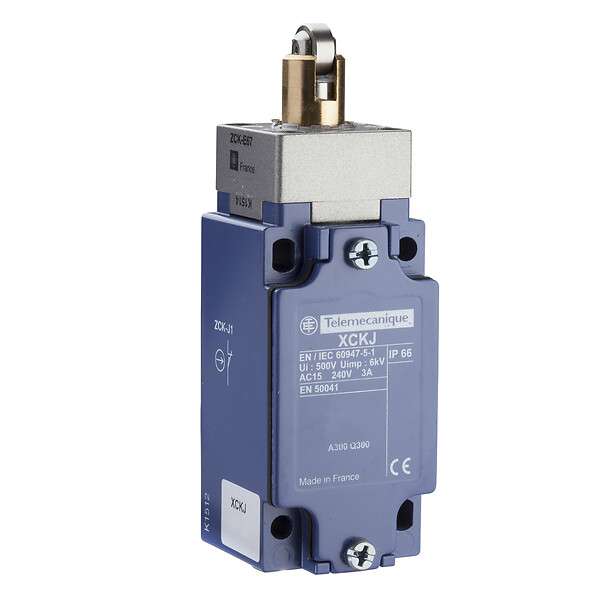
Telemecanique Sensors XCKJ161 Limit Switch: Metal End Plunger with Positive Opening and Pg13.5 Cable Entry
The Telemecanique Sensors XCKJ161 limit switch is a classic XC Standard-format device designed for reliable end-of-travel confirmation in industrial machinery. This model is specified as a metal end plunger limit switch with 1 NC + 1 NO contacts and snap-action operation, built on the XCKJ device short name and conforming to a CENELEC EN 50041 form factor approach used for standardized industrial limit switch geometry.
Telemecanique Sensors XCKJ161 Mechanical Design and Approach Direction
Mechanically, the XCKJ161 is a fixed-body limit switch with a plunger head and linear movement of the operating head. The operator type is listed as a spring return metal plunger, with a vertical approach in one direction and on-end actuation. This combination is a strong fit for guided actuators, stops, and mechanical strikers that can apply force axially to the plunger without introducing side loads.
From a machine design perspective, “vertical approach” matters because it sets expectations for how the striker must meet the actuator. If the striker arrives at an angle, side loading can change the effective actuation point and increase wear. A rigid bracket and controlled striker geometry are therefore essential for stable long-term operation.
Telemecanique Sensors XCKJ161 Materials and Housing Characteristics
The datasheet specifies metal construction with body and head materials listed as Zamak. Fixing mode is “by the body,” supporting secure mounting to machine frames or rigid brackets. These choices are typically favored where vibration exists and where plastic housings could shift over time under mechanical stress.
Electrical Contacts, Positive Opening, and Control Logic
The contact set is 1 NC + 1 NO with snap-action contact operation. The datasheet also states positive opening: with, which is important in applications where designers want a mechanically enforced separation of NC contacts under specified conditions. For commissioning and troubleshooting, snap-action behavior helps produce a crisp transition that PLC inputs interpret clearly, reducing the risk of “half states” in slow-moving mechanisms.
Forces, Speed, and Repeatability
One of the most useful aspects of the XCKJ161 datasheet is the clear mechanical force specification. Positive opening minimum force is specified as 50 N, and minimum force for tripping is 20 N. Maximum actuation speed is listed as 0.5 m/s. Repeat accuracy is specified as 0.1 mm on the tripping points with 1 million operating cycles, supporting stable switching performance in high-cycle equipment.
In practical terms, these values help you validate striker design. If the mechanism cannot reliably reach the needed tripping force due to weak springs or misalignment, intermittent signals may occur. Conversely, excessive force beyond what is needed can accelerate mechanical wear even if the switch continues to function electrically.
Telemecanique Sensors XCKJ161 Wiring, Terminals, and Cable Entry
The XCKJ161 uses screw-clamp terminals with clamping capacity specified as 1 x 0.34…2 x 1.5 mm². Cable entry is specified as 1 entry tapped for Pg 13.5 cable gland with cable outer diameter 9–12 mm. These details are central to installation quality: the correct gland size and correct cable diameter are what protect sealing integrity and reduce stress on conductor terminations.
Telemecanique Sensors XCKJ161 Environmental Ratings and Operational Envelope
For industrial deployment, the datasheet lists IP66 protection and IK07 impact protection. Shock resistance is listed as 50 gn and vibration resistance as 25 gn under IEC methods. The operating ambient temperature range is specified as -25…70°C. This profile supports use in demanding production environments, assuming the cable gland is properly installed and the switch is mounted securely to minimize mechanical drift.
If your goal is to keep a consistent sensing standard across machine families, you can review related options under Telemecanique sensor.
Telemecanique Sensors XCKJ161 FAQ
1) What actuator type does XCKJ161 use?
It uses a spring return metal end plunger with linear operating head movement.
2) What contact configuration is provided?
The switch provides 1 NC + 1 NO contacts with snap-action operation.
3) What are the key force specifications?
Minimum force for tripping is 20 N, and positive opening minimum force is 50 N.
4) What cable entry is specified?
It has a Pg 13.5 cable gland entry for cable outer diameter 9–12 mm.
5) What protection rating is listed?
The datasheet lists IP66 and IK07 ratings.