
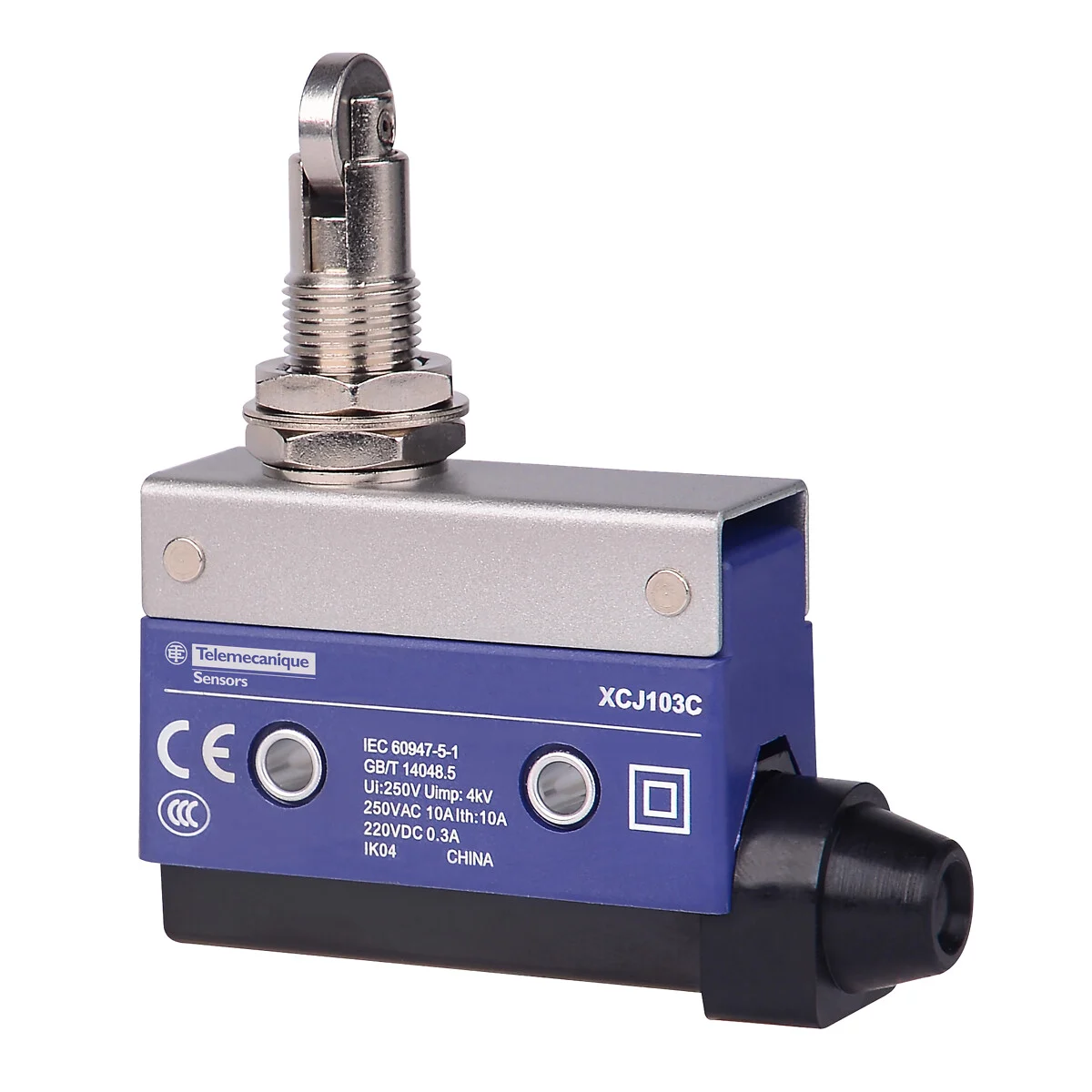
Telemecanique Sensors XCKD2121P16 Limit Switch: Thermoplastic Roller Lever Plunger with M16 Cable Entry
The Telemecanique Sensors XCKD2121P16 limit switch is part of the XC Standard range and is designed to provide dependable mechanical position detection in industrial automation. This model uses a fixed body with a plunger head and a spring return roller lever plunger in thermoplastic, supporting lateral cam actuation in compact machine assemblies. According to the manufacturer’s reference description, it is built around the XCKD device concept and follows a compact sensor design aligned with CENELEC practices for industrial limit switches.
Telemecanique Sensors XCKD2121P16 What the XCKD2121P16 Is Technically
From a mechanical engineering standpoint, the key identity of the XCKD2121P16 is the actuator style and approach direction. The switch is designed for a lateral approach in one direction and is typically actuated by a 30° cam. That means a shaped cam surface can sweep across the roller lever to generate a repeatable switching event without requiring a direct vertical strike. This is particularly helpful in conveyor diverters, packaging stations, and transfer modules where the moving part naturally passes the sensing point sideways.
Telemecanique Sensors XCKD2121P16 Core Construction and Contact System
In the XC Standard family, durability is strongly influenced by housing materials and contact mechanics. The XCKD2121P16 is specified with metal construction and a body/head material listed as Zamak, supporting solid mounting stability in vibration-prone machine frames. The internal contact set is 1 NC + 1 NO with snap-action operation, which is widely used to reduce ambiguous intermediate states during actuation and to provide a crisp electrical transition for PLC discrete inputs.
Telemecanique Sensors XCKD2121P16 Cable Entry, Termination, and Wiring Implications
Installation efficiency often depends on how the switch accepts cables and how conductors are terminated. The Telemecanique Sensors XCKD2121P16 limit switch uses screw-clamp terminals with a clamping capacity specified as 1 x 0.34…2 x 1.5 mm². Cable entry is a single tapped entry for an M16 x 1.5 cable gland, with a supported cable outer diameter of 4–8 mm. In practical wiring design, these parameters help you select the correct gland and jacket size so sealing integrity is maintained and conductor strain is controlled.
For control cabinets and machine-side junction boxes, snap-action switching is typically paired with input filtering or debounce settings when mechanical vibration exists near the trip point. However, the most reliable strategy remains mechanical: ensure the cam profile pushes the roller far enough into the stable switching region, rather than hovering at the threshold.
Telemecanique Sensors XCKD2121P16 Repeatability and Operational Consistency
Repeatability is one of the most valuable performance indicators in mechanical limit switches. For the XCKD2121P16, repeat accuracy is given as 0.1 mm on the tripping points with 1 million operating cycles. This figure is especially relevant for indexing systems and packaging timing, where small changes in switching point can accumulate into measurable process drift over time.
Telemecanique Sensors XCKD2121P16 Environmental Protection and Mechanical Robustness
The switch is rated for industrial protection levels, with IP66 and IP67 degrees of protection listed, and an IK06 impact protection rating. Shock and vibration resistance are also specified at 50 gn for 11 ms (shock) and 25 gn (10–500 Hz) (vibration). In operational terms, these characteristics support deployment in real production areas where washdown spray, dust, and machine vibration are part of normal conditions—provided the cable gland and mounting are installed correctly.
Telemecanique Sensors XCKD2121P16 Mounting Guidance for Cam-Actuated Mechanisms
To get consistent behavior from the roller lever actuator, treat the cam and the mounting bracket as a matched system:
- Use a smooth cam face: avoid sharp edges that can create impact loads instead of controlled rolling contact.
- Set a stable overtravel margin: enough travel to secure the snap-action transition, without excessive force that accelerates wear.
- Prevent bracket flex: rigid mounting protects the tripping point repeatability.
- Maintain sealing integrity: correct gland selection (M16 x 1.5) and correct cable diameter support IP performance.
To align this device with a wider sensing strategy across projects, you can review related options under Telemecanique sensor.
Telemecanique Sensors XCKD2121P16 FAQ
1) What actuator type is used in the Telemecanique Sensors XCKD2121P16 ?
It uses a spring return thermoplastic roller lever plunger intended for cam actuation.
2) What contact configuration does it provide?
The switch uses 1 NC + 1 NO contacts with snap-action operation.
3) What cable entry does the switch support?
It supports M16 x 1.5 cable gland entry, with cable outer diameter 4–8 mm.
4) What protection rating is listed for this model?
Protection is listed as IP66 and IP67, with IK06 impact rating.
5) Telemecanique Sensors XCKD2121P16 What repeat accuracy is specified?
Repeat accuracy is specified as 0.1 mm at tripping points with 1 million operating cycles.