
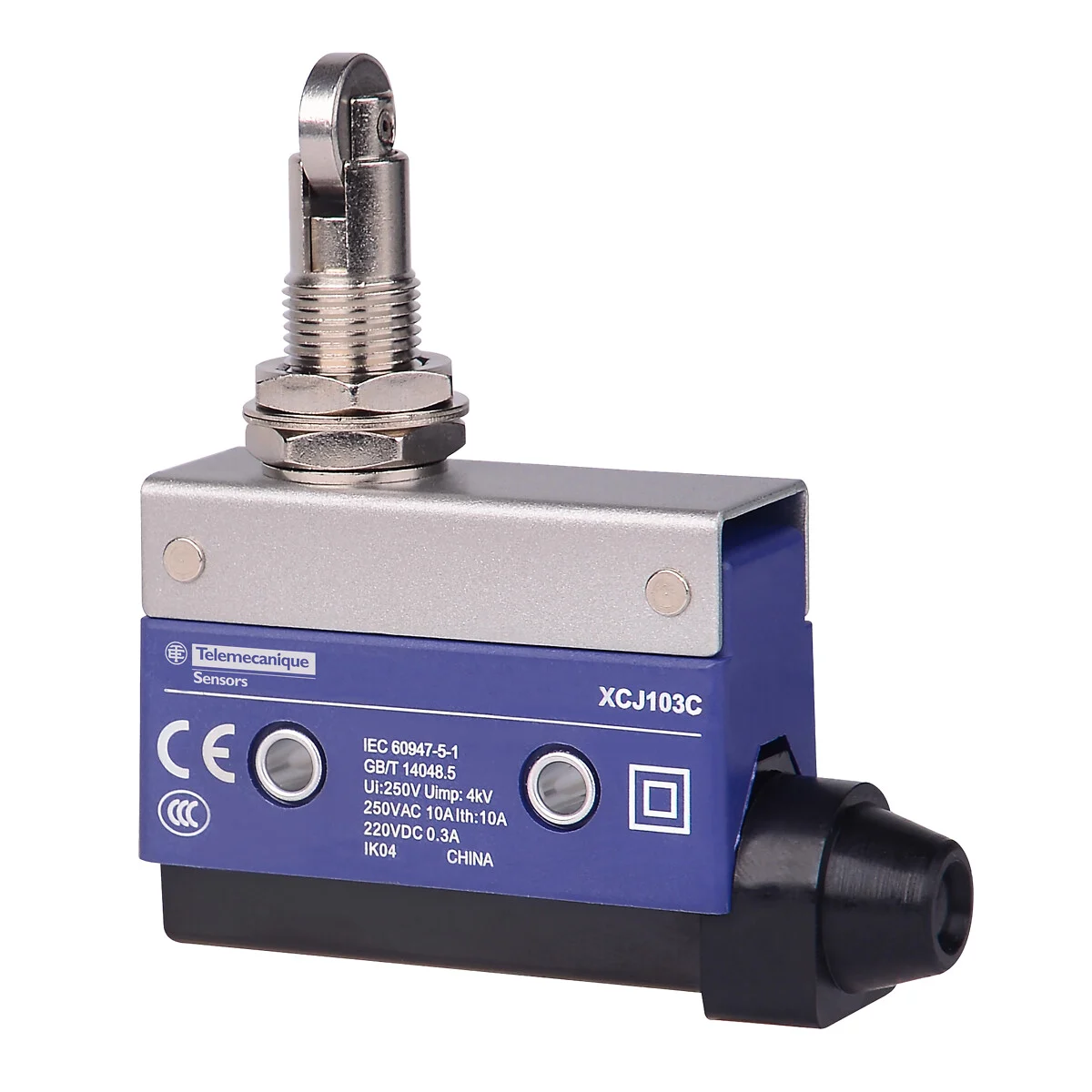
Telemecanique Sensors XCJ128C Limit Switch: Long Flat Roller Lever Plunger for Lateral Approach
The Telemecanique Sensors XCJ128C limit switch is a mechanical position switch designed for light to medium duty automation where a cam-driven, lateral approach is preferred. Its actuator is a roller lever plunger in thermoplastic that is long and flat, enabling a broader contact area between the moving cam surface and the actuator. This geometry can be particularly useful when designers want a more forgiving engagement zone while still maintaining a repeatable switching point.
With snap-action contact behavior and screw-clamp terminal wiring, the Telemecanique Sensors XCJ128C limit switch integrates neatly into conventional PLC input designs. In many machines, that combination keeps commissioning straightforward and simplifies field troubleshooting when mechanical alignment changes over time.
How Telemecanique Sensors XCJ128C Differs from Short-Lever Roller Variants
The long, flat roller lever increases the effective engagement length for a cam. If the cam path varies slightly due to tolerances, belt stretch, or bracket drift, a longer lever can help sustain reliable contact and reduce the risk of “near misses.” In practical machine design, this can improve operational resilience without adding complexity to the controls.
For system clarity, teams often standardize part naming as Telemecanique Sensors XCJ128C limit switch across drawings, maintenance instructions, and spare part catalogs.
Telemecanique Sensors XCJ128C Technical Characteristics
- Product type: Limit switch for light to medium duty applications
- Body type: Fixed
- Head type: Plunger head
- Movement: Linear operating head movement
- Actuator: Roller lever plunger thermoplastic, long and flat
- Switch actuation: By 30° cam
- Approach: Lateral approach, 1 direction
- Contact operation: Snap action
- Electrical connection: Screw-clamp terminals
- Cable entry: Flexible rubber cable gland (typical outer diameter 8.5–10.5 mm)
- Protection: IP40
- Selection context: A300 (AC) and R300 (DC) references are commonly used during evaluation
Telemecanique Sensors XCJ128C Common Use Cases
The Telemecanique Sensors XCJ128C limit switch is typically deployed in cam-driven or side-actuated mechanisms such as:
- Packaging machinery where a cam plate confirms station position
- Light conveyor automation where lateral engagement reduces structural complexity
- Indexing and transfer modules where a wider actuator surface improves tolerance to drift
- General automation assemblies that require repeatable end-position feedback signals
In these environments, the long lever can provide practical “mechanical tolerance buffering,” particularly when motion remains consistent but minor alignment shifts are expected over the lifecycle.
Cam and Mounting Design Guidance
To achieve stable switching points, apply disciplined mechanical design:
- Use a smooth cam profile: Abrupt edges can cause impacts that reduce repeatability and accelerate wear.
- Define engagement depth: Ensure the cam produces adequate travel to reach a stable switched state without excessive force.
- Keep the bracket stiff: Bracket flex can shift the trip point and create intermittent switching near the edge of actuation.
- Plan service access: Provide space for inspection and cable management around the switch body.
For broader consistency across equipment, many organizations review the family set available under Telemecanique sensor to align actuator styles and mounting practices across different machine generations.
Electrical Integration for Reliable Signals
The Telemecanique Sensors XCJ128C limit switch is typically wired into PLC digital inputs via screw-clamp terminals. For stable operation:
- Ensure strong terminations: Good conductor preparation and correct tightening reduce long-term intermittency.
- Protect the cable path: Route the cable to prevent strain at the gland during maintenance activity.
- Apply debounce where needed: If vibration exists at the dwell point, PLC filtering can reduce nuisance toggles.
Maintenance and Troubleshooting Routine
Routine inspection should focus on mechanical integrity: roller condition, lever movement smoothness, mounting tightness, and cam alignment. If the Telemecanique Sensors XCJ128C limit switch shows inconsistent behavior, begin by validating the cam engagement depth and the rigidity of the mounting structure. Mechanical drift is often the main cause in long-life equipment.
FAQ
1) What actuator does XCJ128C use?
XCJ128C uses a long, flat thermoplastic roller lever plunger intended for cam engagement.
2) What approach direction is supported?
It supports lateral approach in one direction and typically actuates by a 30° cam.
3) Why choose a long lever roller actuator?
A longer lever can improve engagement tolerance and reduce sensitivity to minor alignment shifts.
4) How is wiring typically handled?
Wiring is commonly terminated using screw-clamp terminals, with cable entry through a flexible gland.
5) What is a common first step if switching becomes intermittent?
Check cam alignment, actuator engagement depth, and mounting rigidity before replacing the switch.