
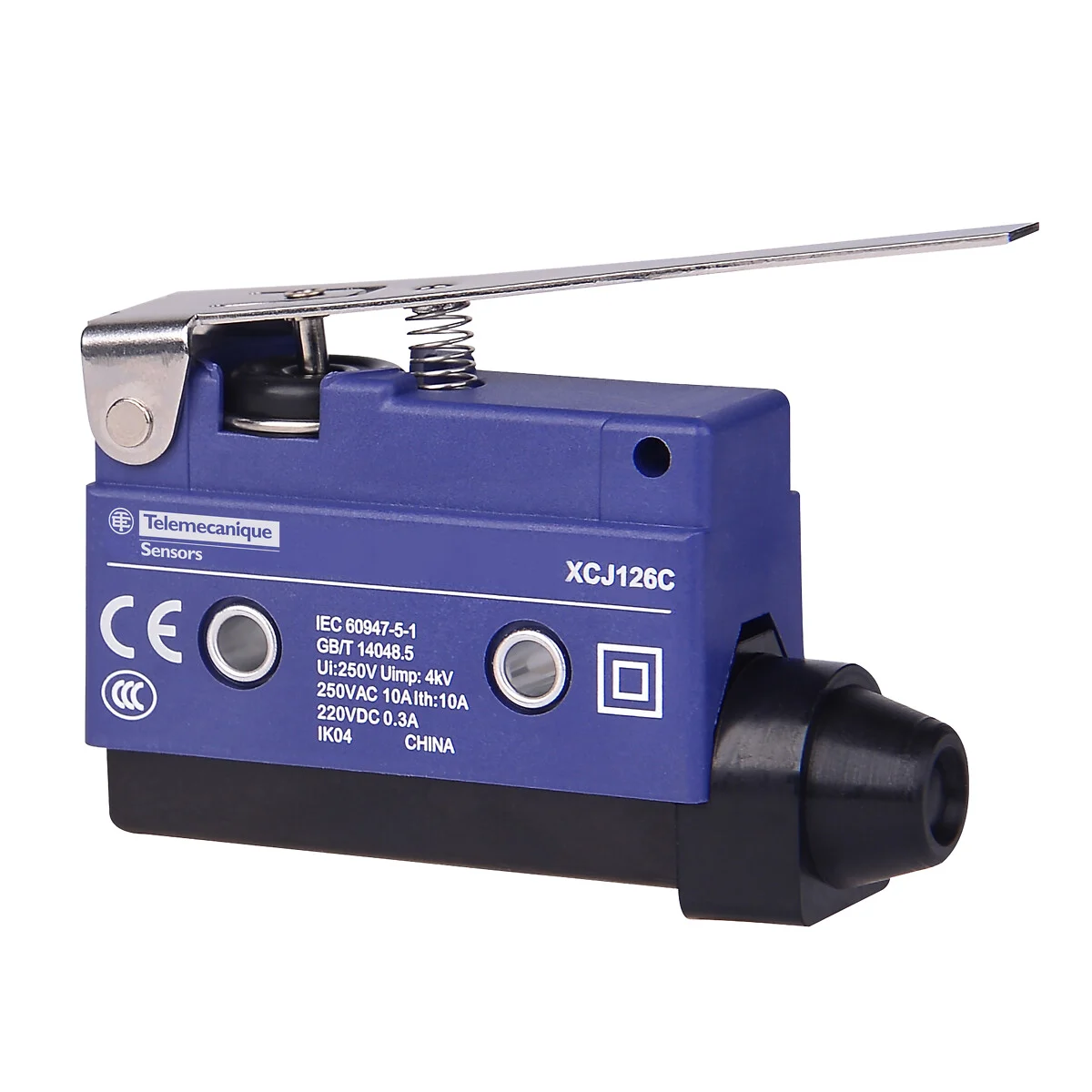
Telemecanique Sensors XCJ125C Limit Switch: Short Flat Lever Plunger for Vertical Approach
The Telemecanique Sensors XCJ125C limit switch is a practical choice for light to medium duty machinery where a compact actuator and predictable end contact are required. This model uses a plunger head with spring return lever plunger steel, short and flat, and it is intended for vertical approach in one direction. In many machines, that matches real-world mechanics: a moving component returns to a known stop and a short, flat lever provides stable engagement.
Because the switch uses a snap-action contact mechanism, the Telemecanique Sensors XCJ125C limit switch provides a crisp transition that helps PLC inputs interpret the event with clarity. When engineered with correct mounting, it supports repeatable trip points and straightforward maintenance procedures.
Telemecanique Sensors XCJ125C Position Sensing Concept
XCJ125C is best understood as a mechanical “truth source” for position. When the actuator is engaged, the internal contact state changes reliably. For maintenance teams, this transparency is valuable: diagnostics usually begin with a quick mechanical check of alignment, travel, and striker condition.
Technical Characteristics
- Product type: Limit switch (light to medium duty)
- Body: Fixed body format, typically installed by the body
- Head: Plunger head with linear operating head movement
- Actuator: Spring return lever plunger steel, short and flat
- Switch actuation: On end
- Approach: Vertical approach, 1 direction
- Contact operation: Snap action
- Electrical connection: Screw-clamp terminals
- Cable entry: Flexible rubber cable gland (typical outer diameter 8.5–10.5 mm)
- Protection: IP40
- Design context: Widely referenced rating families include A300 (AC) and R300 (DC)
Where a Short Flat Lever Plunger Helps
A short, flat lever can be beneficial in tight assemblies where a longer lever would interfere with nearby parts. For example, a short lever works well when:
- There is limited clearance around the actuation point
- The striker is already guided and will hit the switch consistently
- The machine designer wants a simple end contact rather than a cam sweep
In these scenarios, the Telemecanique Sensors XCJ125C limit switch can provide consistent end-position confirmation without forcing the design team to rework the kinematics.
Mechanical Installation Best Practices
To keep the actuation point stable over time, mount and align the XCJ125C with discipline:
- Rigid mounting surface: Minimize bracket deflection that could shift the trip point.
- Controlled striker contact: Ensure the striker meets the lever consistently and avoids harsh impacts.
- Travel margin: Provide adequate actuation travel so vibration does not create nuisance transitions.
- Avoid overtravel abuse: Repeated excessive force can reduce mechanical longevity and change behavior.
For standardization across machine platforms, many facilities also review the broader family portfolio through Telemecanique sensor so that actuator styles and mounting patterns remain consistent across lines.
Electrical Integration Notes
The Telemecanique Sensors XCJ125C limit switch typically connects to PLC digital inputs using screw-clamp terminals. To improve long-term stability:
- Secure wiring: Use proper conductor preparation and tightening torque suitable for terminals.
- Noise hygiene: Separate signal cabling from high-current power paths where feasible.
- Input filtering: If mechanical vibration is present at the trip point, PLC debounce can help.
Maintenance and Operational Reliability
In routine inspections, check mounting tightness, inspect the lever for mechanical wear, and validate the switching point using a controlled, slow actuation test. If the Telemecanique Sensors XCJ125C limit switch becomes intermittent, the most common causes are mechanical alignment drift or striker deformation. Address these first before replacing components, especially in high-cycle equipment.
FAQ
1) What actuator is used on XCJ125C?
XCJ125C uses a spring return steel lever plunger that is short and flat.
2) What approach direction does XCJ125C support?
It is intended for vertical approach in one direction, with on-end actuation.
3) Is XCJ125C intended for washdown environments?
It is typically used in controlled conditions due to IP40. Consider higher IP protection for harsh contamination.
4) What is the benefit of snap-action contacts?
Snap action provides a fast, crisp transition that reduces ambiguous intermediate states for PLC inputs.
5) What should be checked first if the signal flickers near the trip point?
Check alignment, travel margin, and bracket rigidity. Mechanical factors are the most common root causes.