
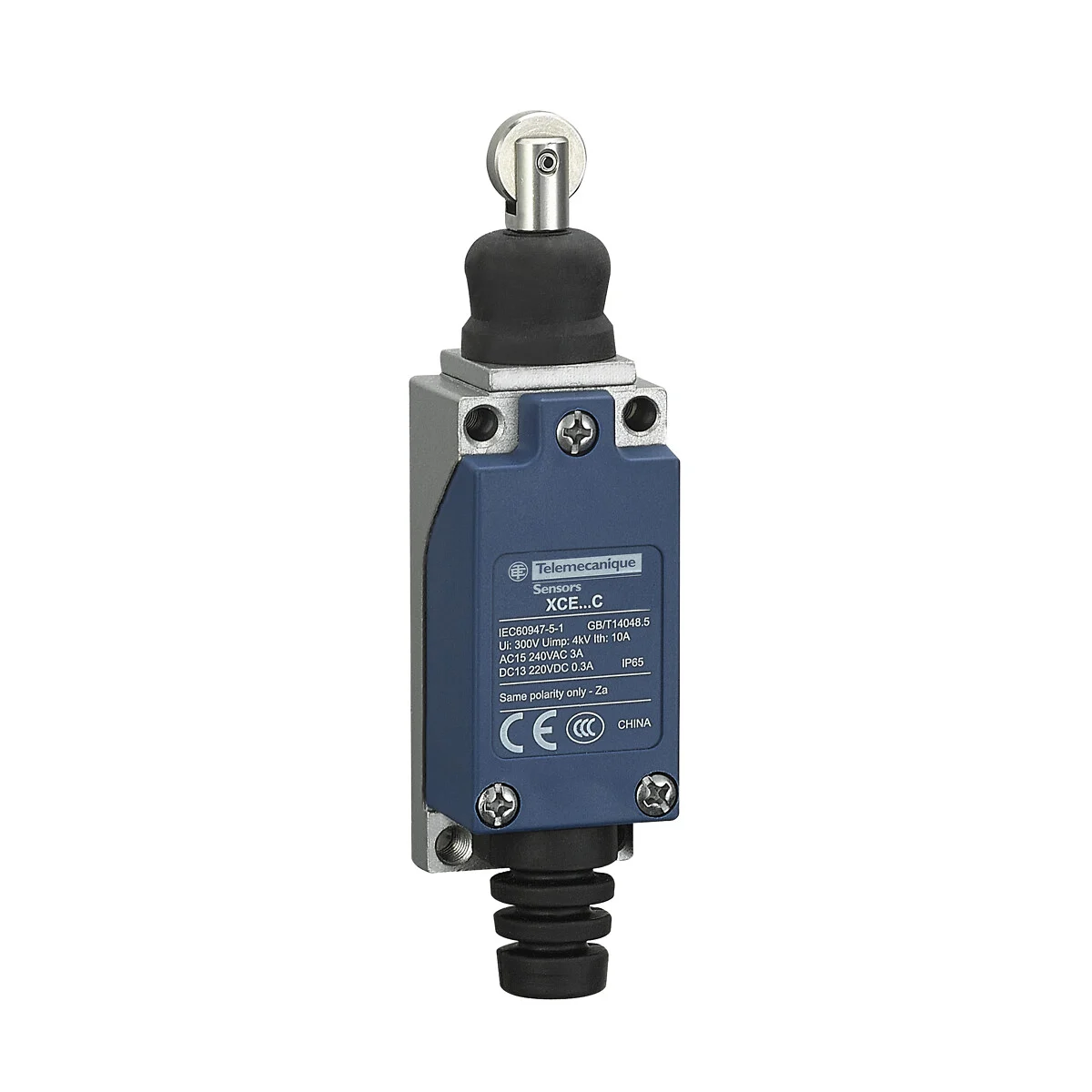
Telemecanique Sensors XCE154C Limit Switch: Round Rod Lever (Ø3 mm) for Robust Lateral Detection
The Telemecanique Sensors XCE154C limit switch is built for medium-duty industrial position feedback using a rotary head and a spring return round rod lever with a 3 mm steel rod. This actuator profile is often selected when the moving element is narrow, when the contact point is small, or when a rod-style lever better matches the kinematics of the mechanism. In many plants, Telemecanique XCE154C limit switch is considered a pragmatic standard for consistent lateral engagement without the additional rolling component used in roller levers.
Keyword Variations Engineers Actually Use
To support equipment catalogs and CMMS naming conventions, this product is commonly referenced as Telemecanique Sensors XCE154C limit switch, Telemecanique XCE154C limit switch, and Telemecanique Sensors XCE154C round rod lever limit switch. These “brand + product code + product type” combinations reduce ambiguity across the XCE family. Technical Characteristics (XCE154C)
- Range / Series: OsiSense XC, Basic
- Product type: Limit switch; Application: Medium duty
- Body / Head: Fixed body; rotary head
- Operator: Spring return round rod lever, steel round rod 3 mm
- Switch actuation: By any moving part
- Approach: Lateral approach, 2 directions
- Electrical connection: Screw-clamp terminals (1 x 1.5 mm²)
- Cable entry: Flexible rubber cable gland; 6–9 mm cable OD
- Contact operation: Snap action
- Operating rate: 120 cycles/min
- IP rating: IP65 (IEC 60529)
- Ratings: A300 (AC 240 V, Ie 3 A, Ithe 10 A) and R300 (DC 220 V, Ie 0.3 A) per IEC 60947-5-1
Telemecanique Sensors XCE154C Why Choose a Round Rod Lever Instead of a Roller Lever?
The engineering rationale typically comes down to contact mechanics. A roller lever is excellent for reducing friction when a cam slides along the actuator. A round rod lever can be advantageous when the contact is more of a tap, a push, or a brief engagement—especially if the moving part is a narrow striker or a simple bracket edge. The Telemecanique Sensors XCE154C limit switch is also specified for actuation “by any moving part,” reinforcing that it is not limited to a single cam style.
Telemecanique Sensors XCE154C Installation Considerations
Because lateral approach in two directions is specified, ensure your bracket geometry does not allow unintended reverse engagement that could trigger false signals. Maintain cable gland compression to preserve IP65 protection, and route the cable to minimize mechanical stress at entry. For high-cycle machines, periodic inspection of the lever for deformation or looseness supports reliability governance and reduces unplanned downtime.
Control System Integration
In typical PLC-driven automation, the switch is wired as a discrete input device. Mechanical contacts can bounce, so in higher-speed sequences, input filtering or software debouncing supports stable state recognition. The documented operating rate helps set expectations for cycle frequency within normal industrial use.
Selection Guidance
Select Telemecanique XCE154C limit switch when your mechanism benefits from a steel rod lever interface, when approach is lateral (often bidirectional), and when you need IP65 protection in a medium-duty category. For related Telemecanique references and product ecosystem guidance, see Telemecanique sensör.
FAQ (Telemecanique Sensors XCE154C )
- What actuator does XCE154C use?
A spring return round rod lever with a 3 mm steel rod on a rotary head. - Is it suitable for two-direction lateral approach?
Yes, lateral approach in two directions is specified. : - What is the ingress protection rating?
IP65 per IEC 60529 when installed correctly. - How is it actuated?
The datasheet indicates actuation can be by any moving part, supporting flexible mechanical interfaces. - What electrical designations are listed?
A300 and R300 are referenced in relation to IEC 60947-5-1 for AC/DC usage categories.