
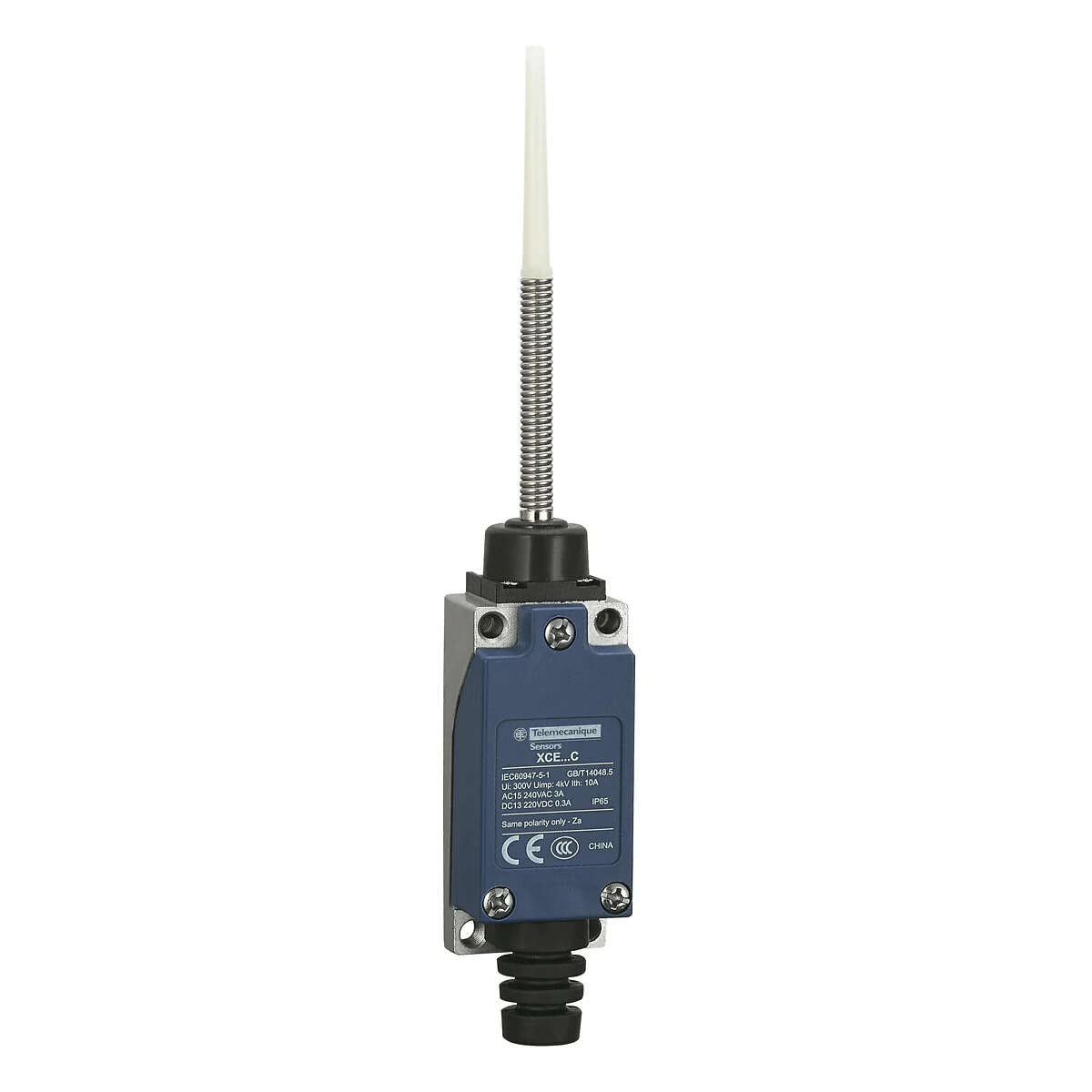
Telemecanique Sensors XCE145C Limit Switch: Variable-Length Roller Lever for Flexible Cam Geometry
The Telemecanique Sensors XCE145C limit switch is a medium-duty OsiSense XC Basic series device designed around a rotary head and a spring return thermoplastic roller lever with variable length. In machine design programs where the cam profile, clearance, or mounting position changes across variants, a variable-length lever can provide the extra mechanical adaptability needed to achieve consistent switching without redesigning the entire bracket set.
Brand + Code + Product Type Variations
To align with maintenance registers and search behavior, this unit is commonly referenced as Telemecanique Sensors XCE145C limit switch, Telemecanique XCE145C limit switch, and Telemecanique Sensors XCE145C roller lever limit switch. These “brand + product code + product type” combinations improve clarity when multiple actuator styles exist in the same family.
Primary Technical Characteristics (Telemecanique Sensors XCE145C)
- Range / Series: OsiSense XC, Basic
- Product type: Limit switch; Application: Medium duty
- Body / Head: Fixed body; rotary head
- Operator: Spring return roller lever (thermoplastic, variable length)
- Actuation: By 30° cam
- Approach: Lateral approach, 2 directions
- Material: Plastic and metal
Telemecanique Sensors XCE145C What “Variable Length” Changes in Practice
In governance terms, “variable length” is not a marketing detail—it affects switching repeatability and mechanical tolerance. A longer lever may allow actuation with lower cam force, while a shorter lever can reduce the risk of over-travel or unintended contact in compact assemblies. For engineering teams managing multiple machine sizes, the Telemecanique Sensors XCE145C limit switch supports a more standardized electrical design while allowing mechanical fine-tuning at the actuator interface.
Cam Design and Actuation Geometry
The stated actuation method “by 30° cam” provides a useful conceptual framework: a cam with a controlled angle engages the roller lever through a defined travel arc. This can improve consistency compared to unpredictable contact points. When drafting mechanical drawings, treat the cam-to-roller contact as a functional pair—surface finish, cam rigidity, and lever alignment all contribute to switching stability.
Integration into Control Systems
Like other electromechanical limit switches, the XCE145C is typically wired into PLC discrete inputs, relay logic, or interlock chains (non-safety). Good practice includes input filtering to address mechanical bounce and ensuring cable routing preserves enclosure integrity. For broader component standardization and related references, consult Telemecanique sensor.
Selection Guidance: When Telemecanique Sensors XCE145C Makes Sense
Select Telemecanique XCE145C limit switch when you need a roller lever style limit switch but the installation geometry is not fixed across all machines. If your approach is strictly end-on, a plunger model is often simpler. If the approach is multi-directional and contact may come from many angles, a whisker actuator may outperform a lever in tolerance. The key is to align actuator mechanics with the real kinematics of the moving part.
FAQ (Telemecanique Sensors XCE145C)
- What is the actuator type on XCE145C?
A spring return thermoplastic roller lever with variable length on a rotary head. - How is it actuated?
It is specified for actuation by a 30° cam. - Can it be used for lateral approach?
Yes—lateral approach in two directions is specified. - What duty category is it intended for?
It is positioned as an OsiSense XC Basic series medium-duty limit switch. - Why choose a variable-length lever?
It supports mechanical fine-tuning to match cam clearance, force, and travel across different machine layouts.