
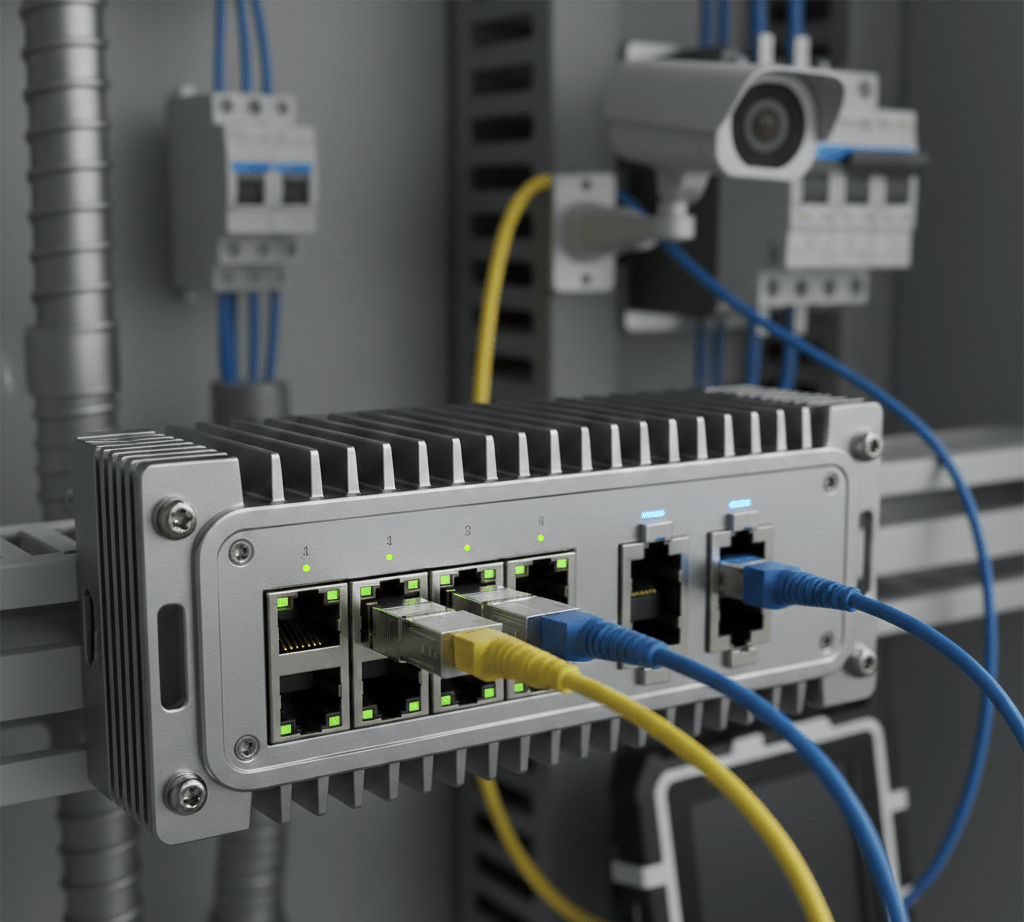
PoE+ IEEE 802.3at/af Industrial Ethernet Switch
Modern industrial networks increasingly deploy IP-based devices requiring both data connectivity and electrical power – IP cameras, wireless access points, VoIP phones, and industrial IoT sensors. Running separate power cables alongside network cables doubles installation costs and complexity. Advantech PoE+ (Power over Ethernet Plus) industrial Ethernet switches deliver data and power simultaneously over standard Ethernet cables, simplifying installations while maintaining the ruggedization and reliability essential for industrial environments.
IEEE 802.3af (PoE) standard ratified in 2003 provides up to 15.4W per port, adequate for basic IP cameras and access points. The IEEE 802.3at (PoE+) standard approved in 2009 doubles power delivery to 30W per port, supporting high-performance PTZ cameras, multi-radio access points, and industrial sensors with integrated heaters. Industrial PoE+ switches must deliver rated power across all ports simultaneously while operating in harsh conditions with extended temperature ranges, electrical noise immunity, and mechanical robustness exceeding commercial networking equipment.
Power Budget and Port Configuration
Total PoE power budget determines how many devices can receive maximum power simultaneously. An 8-port PoE+ switch might specify 120W total budget – adequate for eight 15W devices but only four 30W devices at maximum load. Understanding application power requirements prevents oversubscription where connected devices exceed available budget, causing the switch to deny power or reduce per-port allocation. Industrial deployments should maintain 20-30% power budget headroom accommodating device inrush currents during startup and future expansion.
Port-by-port power management provides flexibility prioritizing critical devices. Surveillance systems might allocate high priority to perimeter cameras ensuring continuous operation even if power budget exhausts, while interior cameras operate at lower priority. Time-based power scheduling reduces energy consumption by powering down non-essential devices during unoccupied periods – warehouse lighting and cameras might disable overnight, reducing both power costs and equipment wear.
PoE Device Detection and Classification
PoE switches employ sophisticated detection mechanisms preventing damage to non-PoE devices accidentally connected. The switch applies low voltage probe signals detecting the 25kΩ signature resistor identifying PoE-capable devices. Only after successful detection does the switch enable full 48V DC power. Classification protocols communicate power requirements – Class 0 devices draw 0.44-12.95W, Class 3 devices use 6.49-12.95W, while Class 4 (PoE+) devices require 12.95-25.5W at the powered device (30W at the switch accounting for cable losses).
Legacy passive PoE implementations from pre-standard deployments always deliver power without detection, risking damage to incompatible devices. Industrial switches supporting both standard PoE and legacy passive PoE modes accommodate mixed environments during migration from proprietary systems. Force mode options override detection for devices lacking proper signature resistors though requiring careful configuration preventing equipment damage.
Cable Distance Limitations and Extenders
IEEE 802.3 standards specify 100-meter maximum cable length for Ethernet and PoE, a limitation imposed by signal attenuation and voltage drop rather than PoE power delivery alone. Industrial facilities often require longer distances between wiring closets and remote equipment locations. PoE extenders deployed at 90-meter intervals regenerate both data signals and PoE power, enabling deployments exceeding 300 meters through daisy-chaining multiple extenders. Some industrial switches offer extended PoE modes increasing distance to 250 meters by reducing data rates from 1000 Mbps to 100 Mbps, trading speed for reach.
Cable quality significantly impacts PoE performance over distance. Cat5e cable suffices for basic PoE deployments, but PoE+ at maximum power benefits from Cat6 or Cat6a cables with lower DC resistance. Poorly terminated connectors or damaged cables create voltage drops reducing delivered power below device requirements. Cable testers measuring PoE voltage at far ends verify adequate power delivery before deploying powered devices.
Industrial Environment Considerations
Commercial PoE switches specify 0°C to 40°C operation with maximum 80% humidity, inadequate for industrial environments experiencing -40°C cold storage facilities, +70°C equipment enclosures, and 100% humidity in outdoor installations. Industrial PoE+ switches operate across -40°C to +75°C with conformal coating protecting circuit boards against humidity, salt spray, and chemical exposure. Fanless designs prevent dust accumulation while eliminating mechanical failures, crucial for deployments in contaminated environments.
Electrical noise from VFDs, welding equipment, and switching power supplies creates common-mode and differential-mode interference exceeding commercial equipment immunity. Industrial switches implement enhanced EMI filtering, isolated power supplies, and robust surge protection on all ports. Lightning protection modules on outdoor-rated models divert transients from nearby strikes, protecting both switch electronics and connected devices. DIN-rail mounting enables installation in control cabinets alongside automation equipment without requiring separate networking racks.
Network Redundancy and Reliability Features
Industrial processes cannot tolerate network downtime causing production stops, safety system failures, or loss of critical monitoring. PoE+ switches supporting rapid ring recovery protocols (RSTP, MSTP, or proprietary ring protocols) provide sub-second failover when network links break. Dual redundant power inputs with automatic failover ensure switch operation continues during power supply failures or maintenance. Port-based power redundancy delivers power to critical devices from multiple switch ports simultaneously, maintaining device operation even if one switch or port fails.
IGMP snooping prevents multicast traffic flooding, crucial for IP video surveillance systems where hundreds of cameras streaming simultaneously would overwhelm network bandwidth without proper multicast management. Quality of Service (QoS) prioritizes time-sensitive traffic like VoIP calls and alarm notifications over bulk data transfers ensuring consistent performance during high network utilization. Storm control limits broadcast, multicast, and unknown unicast traffic preventing network congestion from misconfigured devices or network attacks.
Remote Management and Monitoring
Industrial PoE switches deployed in distributed locations require remote management avoiding expensive site visits for configuration changes or troubleshooting. Web-based graphical interfaces enable configuration from office workstations without specialized software. SNMP (Simple Network Management Protocol) integration with network management systems provides centralized monitoring of all switches, tracking port status, PoE power consumption, temperature, and error counters.
Per-port PoE monitoring displays real-time power consumption identifying devices drawing excessive power potentially indicating failures. Automated alerts via email or SNMP traps notify administrators of critical events – port failures, power budget exhaustion, or temperature extremes. Remote port power cycling enables restarting hung IP cameras or access points without site visits. Configuration backup and restore functions protect against data loss and enable rapid switch replacement during failures.
Application Examples
Manufacturing facilities deploy PoE+ switches powering IP cameras monitoring production lines, wireless access points connecting mobile devices for inventory management, and VoIP phones at workstations. A single 24-port PoE+ switch can serve an entire production area, eliminating dozens of individual power adapters and receptacles. The centralized power delivery simplifies electrical inspections and maintains clean industrial aesthetics.
Outdoor surveillance systems use PoE+ switches rated for extended temperatures powering perimeter cameras and access control readers. Fiber uplinks connect outdoor switches to central network infrastructure, with PoE delivering power to cameras positioned along fences, parking lots, and loading docks. Built-in heaters in outdoor cameras draw significant power during winter months, requiring PoE+ capacity rather than basic PoE.
Building automation systems leverage PoE+ for HVAC controllers, lighting control panels, and environmental sensors. A single network infrastructure delivers both control communications and power, reducing installation costs 30-40% compared to separate data and power cabling. The switches enable flexible reconfiguration as building usage evolves without rewiring.
Frequently Asked Questions
What’s the difference between PoE and PoE+?
PoE (802.3af) delivers up to 15.4W per port, while PoE+ (802.3at) provides up to 30W per port. PoE+ supports high-power devices like PTZ cameras, multi-radio wireless access points, and industrial equipment with heaters or motors. Both standards coexist – PoE+ switches power both PoE and PoE+ devices automatically.
Can I use regular Ethernet cables for PoE?
Yes, PoE works over standard Cat5e, Cat6, or Cat6a cables. Cat6/Cat6a cables with lower resistance provide better power delivery efficiency, especially important for long cable runs or high-power PoE+ devices. Avoid CCA (Copper Clad Aluminum) cables as their higher resistance reduces PoE performance.
How many PoE+ devices can one switch power?
This depends on the switch’s total power budget and individual device requirements. A switch with 240W budget can power 8 devices at 30W each, or 16 devices at 15W each. Most deployments mix device types – some using full PoE+, others using less power.
What happens if total PoE demand exceeds switch capacity?
Switches implement power management policies. Priority-based allocation ensures critical devices receive power first. When budget exhausts, the switch denies power to lower-priority devices or reduces per-port allocation if power management allows. Proper planning maintains 20-30% headroom preventing issues.
Can PoE switches power non-PoE devices?
Standard PoE switches detect powered device signatures before enabling power, preventing damage to non-PoE devices. Passive PoE (non-standard) always delivers power and could damage incompatible equipment. Use only standard 802.3af/at PoE for safety.
How far can PoE reach?
Standard PoE operates up to 100 meters. Extended PoE modes on some industrial switches reach 250 meters by reducing speed to 100 Mbps. PoE extenders enable distances beyond 300 meters through daisy-chaining, regenerating both data and power.
Do PoE switches require special installation?
Installation resembles regular Ethernet switches – mount the switch, connect power, and attach Ethernet cables. Industrial models offer DIN-rail mounting for control cabinets. Ensure adequate ventilation for fanless models and verify power supply capacity for total PoE budget plus switch consumption.
Can PoE+ switches operate in extreme temperatures?
Industrial-grade PoE+ switches operate from -40°C to +75°C, suitable for outdoor installations, cold storage, and hot industrial environments. Commercial switches specify 0°C to 40°C operation, inadequate for industrial deployments. Verify temperature ratings match application requirements.