
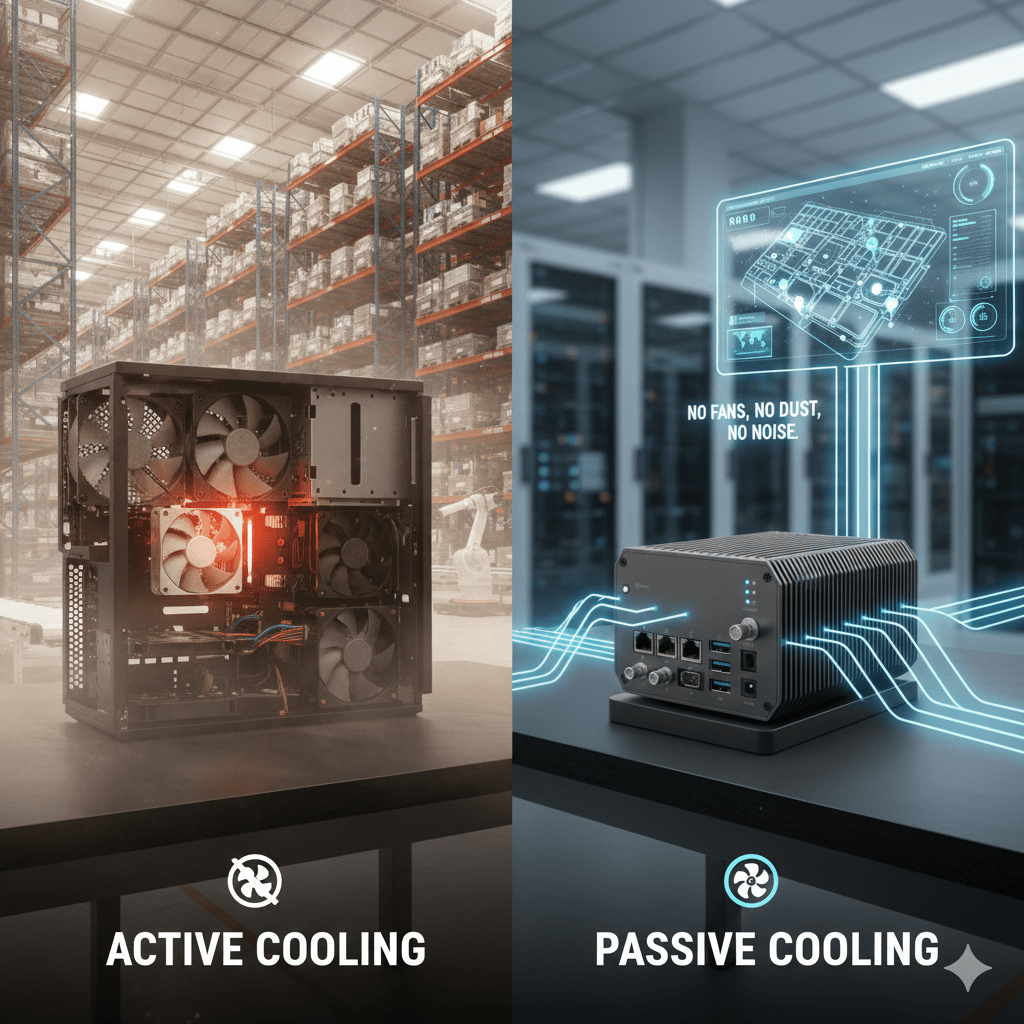
Passive Cooling Fanless Embedded Computer Systems
Thermal management fundamentally determines industrial computer reliability and operational lifespan. Active cooling using mechanical fans addresses thermal challenges through forced air circulation, but introduces failure-prone moving parts, noise pollution, and dust accumulation pathways. Advantech passive cooling fanless embedded computers eliminate these vulnerabilities through sophisticated thermal engineering that conducts, radiates, and convects heat without mechanical assistance, delivering silent, maintenance-free operation in demanding industrial environments.
Passive cooling represents a holistic thermal design philosophy rather than simply removing fans from conventional computer architectures. Every component placement, chassis contour, and material selection serves thermal management objectives. High-conductivity aluminum alloys form the foundation, with thermal conductivity exceeding 200 W/m·K efficiently spreading heat from concentrated sources. Ribbed external surfaces increase surface area by 300-400% compared to flat panels, maximizing natural convection heat transfer. Strategic internal heat pipe placement moves thermal energy from processors and power supplies to chassis zones with optimal cooling potential.
Thermal Design Power and Performance Scaling
Processor Thermal Design Power (TDP) ratings quantify maximum heat generation under sustained workloads. Intel Atom processors with 6-10W TDP represent the low end, suitable for basic data acquisition, protocol conversion, and simple HMI applications. Celeron processors at 15-25W TDP accommodate moderate multitasking and edge analytics. Core i3/i5/i7 processors ranging from 15W to 45W TDP deliver desktop-class performance for demanding applications including real-time video analytics, complex motion control, and virtual machine hosting.
Chassis thermal capacity must match or exceed processor TDP for sustained operation. Compact fanless systems measuring 170 x 105 x 45mm adequately dissipate 10-15W processors. Medium chassis at 210 x 140 x 60mm handle 25-35W TDP. Large fanless platforms reaching 260 x 210 x 75mm accommodate high-performance 45W processors through extensive ribbing and heat pipe networks. Selecting appropriately sized systems prevents thermal throttling where processors reduce clock speeds to avoid overheating, maintaining consistent performance throughout operational lifespans.
Heat Pipe Technology and Thermal Interfaces
Heat pipes represent remarkable passive thermal devices transferring heat through phase-change cycles. Internal wicking structures transport liquid from condensation zones to evaporation zones where processor heat vaporizes the working fluid. Vapor travels through the hollow core to cooler regions where it condenses, releasing latent heat to chassis surfaces. This cycle continues indefinitely, moving heat with thermal conductivity effectively 100x greater than solid copper rods of equivalent size.
Thermal interface materials (TIM) between processors and heat spreaders critically impact overall thermal performance. Air gaps create insulating barriers dramatically increasing thermal resistance. High-performance thermal pads conforming to surface imperfections, thermal paste filling microscopic voids, or phase-change materials flowing under heat and pressure ensure intimate contact. Premium systems employ liquid metal interfaces achieving thermal conductivity 10x better than conventional thermal pastes, though requiring careful application preventing electrical shorts.
Ambient Temperature Derating and Environmental Factors
Passive cooling efficiency depends on temperature differential between chassis surfaces and surrounding air. In 25°C ambient environments, chassis might stabilize at 65-70°C under maximum load, providing 40-45°C differential driving heat transfer. As ambient temperature increases to 50°C, that differential shrinks to 15-20°C, dramatically reducing cooling effectiveness. Manufacturers specify maximum ambient temperatures where systems maintain rated performance – typically 40-50°C for standard models, 60°C for industrial variants.
Altitude affects cooling through reduced air density decreasing convective heat transfer. Systems rated for sea-level operation may require derating 10-15% at 2000m elevation, 20-25% at 3000m. Enclosed installations within equipment cabinets require careful airflow consideration – while the computer itself needs no internal ventilation, chassis heat must dissipate to surrounding air. Cabinet fans circulating air around (not through) fanless computers significantly improve thermal performance in enclosed spaces.
Computational Fluid Dynamics Optimization
Modern fanless computer thermal designs leverage Computational Fluid Dynamics (CFD) simulation during development, modeling airflow patterns, temperature distributions, and hot spot identification before physical prototyping. Engineers virtually test chassis rib orientations, heat sink fin spacing, and component placement optimizing natural convection currents. Vertical installations benefit from chimney effects where heated air rises along chassis surfaces, drawing cooler air from below. Horizontal mounting requires careful rib orientation ensuring convection paths remain unobstructed.
CFD analysis reveals counterintuitive optimization opportunities. Larger rib spacing sometimes outperforms dense fins by reducing airflow restriction, increasing convective velocity. Strategic chassis ventilation holes allowing air circulation through internal cavities (without creating dust ingress paths) can improve cooling 15-20%. Component placement separating high-power devices prevents localized hot spots where multiple heat sources overwhelm nearby thermal dissipation capacity.
Material Science and Surface Treatments
Aluminum dominates fanless computer chassis construction through optimal balance of thermal conductivity (205 W/m·K for 6063 alloy), strength-to-weight ratio, corrosion resistance, and manufacturability. Die-cast aluminum enables complex geometries with integrated ribbing and mounting features impossible with machined or stamped construction. Extruded aluminum profiles create continuous heat sinks running full chassis length with excellent thermal uniformity. Precision CNC machining produces mounting surfaces with tight tolerances ensuring proper thermal interface contact.
Surface treatments influence radiative heat transfer and corrosion protection. Anodized finishes increase surface emissivity enhancing radiation while providing hard, corrosion-resistant coatings. Black anodizing maximizes radiation compared to natural aluminum though aesthetic considerations sometimes favor silver or custom colors. Powder coating provides durable protective finishes but typically reduces thermal performance slightly compared to anodizing. Industrial environments with corrosive atmospheres may specify additional protective treatments even at minor thermal performance costs.
Solid-State Storage and Component Selection
Achieving truly fanless operation requires addressing all moving parts, not just cooling fans. Mechanical hard disk drives with spinning platters and actuator arms represent failure vulnerabilities, generate heat, and consume power. Industrial-grade solid-state drives (SSDs) eliminate mechanical components while offering superior performance, shock resistance, and extended temperature operation. SLC (Single-Level Cell) and MLC (Multi-Level Cell) flash technologies balance endurance, performance, and cost for different application requirements.
Industrial SSDs incorporate power-loss protection preventing data corruption during unexpected shutdowns common in industrial environments. Capacitor banks provide sufficient energy completing in-flight write operations and flushing volatile buffers to non-volatile storage. Wear-leveling algorithms distribute write operations across all memory cells preventing premature failure of frequently accessed sectors. Some industrial SSDs specify endurance exceeding 3000 TBW (Terabytes Written), supporting continuous data logging applications for many years.
Vibration and Shock Resistance
Fanless computers naturally resist vibration better than fan-cooled equivalents through elimination of rotating components and reduced internal cable routing. PCB mounting uses locking screws with thread-locking compounds preventing loosening from continuous vibration. Connector strain relief prevents mechanical stress on solder joints. Some systems specify conformal coating protecting circuit boards against vibration-induced component contact and providing moisture resistance.
Shock resistance specifications verify survival of sudden impacts from drops, transportation, or machinery collisions. MIL-STD-810 shock testing drops computers from specified heights or subjects them to controlled impacts. Industrial systems typically withstand 50G shocks for 11ms half-sine pulses without damage. This robustness suits mobile applications, machinery-mounted installations, and transportation systems experiencing frequent mechanical stresses that would destroy conventional computers.
Real-World Deployment Examples
A pharmaceutical manufacturer deployed fanless embedded computers in cleanroom production equipment manufacturing injectable medications. Cleanroom classification requires minimizing particle generation – even fan-bearing wear creates submicron particles violating cleanliness standards. The fanless computers installed in tablet compression machines, filling lines, and inspection systems maintain Class 100,000 cleanroom compatibility while running recipe management, quality data collection, and equipment monitoring software. Five years of continuous operation achieved 99.8% uptime with zero maintenance interventions attributed to computer hardware.
An outdoor digital signage network across 500 locations in desert climates experiences summer temperatures exceeding 50°C inside weatherproof enclosures. Fanless computers running media player software proved reliable while fan-cooled alternatives failed regularly from dust accumulation and bearing failures in extreme heat. The fanless systems operate continuously without cleaning or maintenance, reducing service costs by 85% compared to earlier fan-cooled deployments. Battery backup maintains operation during brief power interruptions common in the remote locations.
Frequently Asked Questions
How hot do fanless computer chassis get during operation?
External chassis temperatures typically reach 60-75°C under maximum processor load in 25°C ambient conditions. This feels hot to touch but remains within design limits. Higher ambient temperatures or enclosed installations increase chassis temperatures proportionally. Proper ventilation around the chassis prevents excessive heat buildup.
Can fanless computers match fan-cooled performance?
Yes, when properly configured. Fanless systems use the same processors as fan-cooled computers, just lower TDP variants with appropriate chassis thermal capacity. A fanless system with Core i5-8265U (15W TDP) delivers comparable performance to fan-cooled systems with standard voltage Core i5 processors for most industrial workloads involving cyclical rather than sustained maximum loads.
What happens if fanless computers overheat?
Modern processors implement multiple thermal protection mechanisms. Initial warnings at 90-95°C trigger logging and notifications. At 95-100°C, clock speeds reduce (thermal throttling) decreasing heat generation while maintaining operation. Emergency shutdown at 100-105°C prevents permanent damage. Properly designed fanless systems rarely encounter these limits during normal operation.
Do fanless computers require special installation considerations?
Primary requirement involves adequate air circulation around the chassis for convective cooling. Avoid completely enclosed installations without ventilation. Mounting orientation affects cooling – vertical installation typically performs best, horizontal acceptable with proper rib orientation. Ensure chassis surfaces aren’t blocked or insulated preventing heat dissipation.
How long do fanless computers typically last?
Eliminating fans removes the primary mechanical failure point. With solid-state storage, fanless systems achieve MTBF exceeding 100,000 hours (11+ years). Industrial component selection and conservative thermal design extend operational lifespans to 10-15 years in many deployments. Capacitor aging represents the primary long-term degradation mechanism.
Are fanless computers suitable for outdoor installations?
Yes, with appropriate enclosures providing weather protection. Fanless designs prevent rain, snow, or dust ingress through ventilation openings since none exist. Operating temperature ranges must accommodate local climate extremes. Some fanless computers specify -40°C to +60°C operation suitable for outdoor deployments in most climates.
Can I upgrade processors in fanless computers?
Generally no – processors are soldered to motherboards rather than socketed, and thermal designs optimize for specific TDP ratings. Upgrading would require motherboard replacement. Some modular systems allow swapping CPU modules, but thermal capacity still limits maximum TDP. Select appropriate performance levels initially rather than planning processor upgrades.
What maintenance do fanless computers require?
Minimal to none for most applications. No fans to clean or replace, no filters requiring service. Occasional inspection of mounting hardware, cable connections, and chassis cleanliness suffices. Industrial environments with heavy contamination might benefit from periodic chassis cleaning to maintain optimal heat dissipation from external surfaces.