
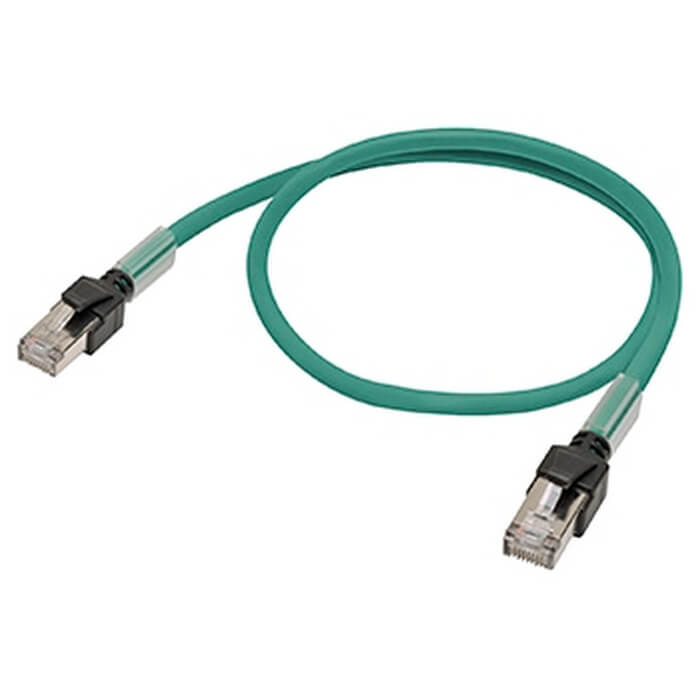
Omron XS6W-6LSZH8SS500CM-G Industrial Ethernet Patch Cable
| Feature | Value |
|---|---|
| Manufacturer | Omron |
| Model | XS6W-6LSZH8SS500CM-G |
| Product Type | Industrial Ethernet Patch Cable |
| Ethernet Category | Cat.6A (IEC) |
| Cable Type | F/UTP Shielded |
| Connector 1 | RJ45 Straight Plug |
| Connector 2 | RJ45 Straight Plug |
| Cable Length | 5 m |
| Outer Jacket | LSZH (Low Smoke Zero Halogen) |
| Outer Jacket Color | Green |
| Cable Diameter | 6.3 mm |
| Suitable for Robotics | No |
The Omron XS6W-6LSZH8SS500CM-G Industrial Ethernet Patch Cable is intended for industrial Ethernet communication where reliable signal transmission and mechanical durability are required. Designed with Cat.6A transmission performance, this cable supports high-speed network communication between industrial controllers, managed switches, HMIs, IPCs, and other Ethernet-enabled automation devices. Its LSZH jacket makes it suitable for installations where reduced smoke emission and halogen-free materials are preferred.
As an F/UTP shielded cable, the Omron XS6W-6LSZH8SS500CM-G Industrial Ethernet Patch Cable helps reduce electromagnetic interference commonly encountered in manufacturing environments containing motors, servo drives, inverters, and switching equipment. The factory-assembled RJ45 connectors simplify installation while maintaining consistent electrical performance.
Omron XS6W-6LSZH8SS500CM-G Technical Description
This industrial Ethernet cable is manufactured with two straight RJ45 connectors and complies with Cat.6A transmission requirements according to IEC specifications. The shielded F/UTP construction provides additional protection against external electrical noise while supporting stable communication over Gigabit Ethernet and higher bandwidth industrial networks.
The LSZH sheath contributes to safer cable installations by limiting smoke generation and avoiding halogen gas release during fire conditions. The green outer jacket also assists with cable identification inside industrial control cabinets and structured machine wiring.
Operating Principle
The cable establishes a physical Ethernet connection between two compatible network devices using twisted-pair copper conductors arranged to meet Cat.6A performance characteristics. Shielding minimizes external electromagnetic disturbances while maintaining signal integrity throughout the communication path.
Because both cable ends use straight RJ45 connectors, installation is straightforward in standard Ethernet ports without additional adapters or custom termination work.
Typical Applications
- Industrial Ethernet networks
- Machine automation systems
- Factory communication infrastructure
- PLC and HMI connectivity
- Industrial switches
- Control cabinet wiring
- EtherCAT compatible network installations
- Production monitoring systems
Industrial Use Cases
Manufacturing facilities frequently use this cable for communication between PLC controllers and distributed I/O stations where dependable data exchange is essential for synchronized machine operation.
Packaging equipment integrates industrial Ethernet networks to coordinate conveyors, vision systems, and operator interfaces. The Cat.6A transmission capability supports continuous communication throughout automated production sequences.
Process automation installations may employ shielded Ethernet infrastructure to connect industrial switches with SCADA equipment while reducing communication errors caused by electrical noise.
Assembly lines utilizing industrial robots often separate fixed cabinet wiring from moving robot cables. Although this model is not specified for robotic motion, it performs effectively within stationary cabinet and machine-frame installations.
Advantages
- Cat.6A industrial communication performance
- Factory-installed straight RJ45 connectors
- F/UTP shielding for improved EMC performance
- LSZH outer jacket
- 5-meter cable length for flexible cabinet routing
- Consistent industrial Ethernet connectivity
- Easy installation without field termination
Selecting the Appropriate Cable
When selecting an industrial Ethernet cable, engineers should verify cable category, shielding requirements, connector compatibility, installation environment, and cable length. Applications exposed to strong electromagnetic interference generally benefit from shielded cable constructions similar to the Omron XS6W-6LSZH8SS500CM-G Industrial Ethernet Patch Cable.
It is also important to evaluate installation conditions. Fixed machine wiring, control panels, and communication cabinets often require different cable characteristics than continuously moving cable carrier applications.
Additional information about Omron sensor products and industrial automation components can help when designing complete machine communication systems.
Integration with Automation Systems
The Omron XS6W-6LSZH8SS500CM-G Industrial Ethernet Patch Cable can be integrated with PLCs, industrial PCs, managed Ethernet switches, remote I/O modules, operator terminals, and network gateways supporting standard RJ45 Ethernet interfaces. Its Cat.6A specification makes it appropriate for modern industrial network architectures requiring stable, high-speed communication.
Frequently Asked Questions
Is this cable suitable for Gigabit Ethernet?
Yes. The Cat.6A specification supports high-speed industrial Ethernet communication.
Does the cable include shielding?
Yes. It uses an F/UTP shielded cable construction to reduce electromagnetic interference.
What connectors are installed?
Both ends are equipped with straight RJ45 plugs.
What is the cable length?
The overall cable length is 5 meters.
What does LSZH mean?
LSZH indicates a Low Smoke Zero Halogen jacket material designed for installations requiring reduced smoke and halogen emissions.
Can this cable be used for moving robotic applications?
No. The manufacturer specifies that this model is not intended for robotic applications involving continuous motion.
Which industrial devices can be connected?
Typical devices include PLCs, HMIs, industrial switches, IPCs, remote I/O stations, and Ethernet-enabled controllers.
Why is shielding important in industrial environments?
Shielding helps reduce electromagnetic interference generated by motors, drives, switching equipment, and other electrical devices, contributing to more stable network communication.