
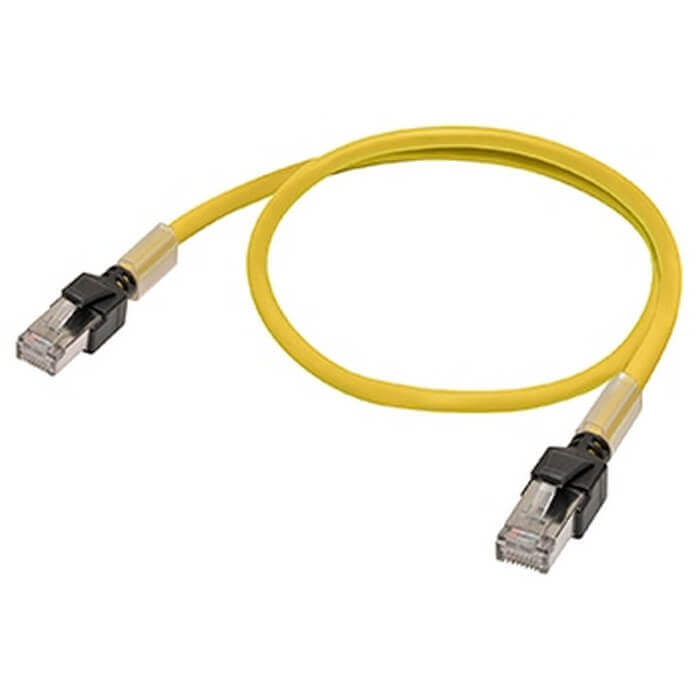
Omron XS6W-6LSZH8SS2000CM-Y Ethernet Patch Cable
| Specification | Value |
|---|---|
| Manufacturer | Omron |
| Product Type | Industrial Ethernet Patch Cable |
| Model | XS6W-6LSZH8SS2000CM-Y |
| Ethernet Category | Cat.6A |
| Cable Construction | F/UTP Shielded |
| Connector Type | RJ45 Straight Plug × RJ45 Straight Plug |
| Cable Length | 20 m |
| Outer Jacket Material | LSZH (Low Smoke Zero Halogen) |
| Jacket Color | Yellow |
| Recommended Installation | Stationary Industrial Ethernet Systems |
Reliable industrial communication depends on more than network hardware alone. The physical cabling infrastructure plays a significant role in maintaining consistent data exchange between controllers, industrial computers, operator terminals, and network switches. The Omron XS6W-6LSZH8SS2000CM-Y Ethernet Patch Cable is designed for fixed Ethernet installations where longer cable runs are required while maintaining Category 6A transmission performance.
With a factory-manufactured length of 20 meters, the Omron XS6W-6LSZH8SS2000CM-Y Ethernet Patch Cable provides flexibility when connecting automation equipment distributed across production lines, electrical rooms, or large machine assemblies. The yellow jacket further supports organized cable identification, particularly in installations where multiple communication networks coexist.
Technical Description
This industrial Ethernet cable is manufactured according to Category 6A requirements and incorporates an F/UTP cable structure. Four twisted conductor pairs are enclosed within an overall foil shield that helps reduce susceptibility to electromagnetic interference generated by industrial electrical equipment.
Both cable ends are factory terminated with straight RJ45 connectors, allowing direct installation into compatible Ethernet devices without additional field assembly. The outer jacket is manufactured from Low Smoke Zero Halogen material, making the cable suitable for installations where reduced smoke emission and halogen-free construction are specified.
Working Principle
The cable provides the physical transmission medium for Ethernet communication by carrying digital signals through balanced twisted-pair conductors. The twisting geometry minimizes internal crosstalk while maintaining stable electrical characteristics over the full cable length.
The surrounding foil shield improves resistance to electromagnetic interference generated by nearby motors, servo amplifiers, switching devices, transformers, and variable frequency drives. This construction contributes to reliable communication between industrial automation components operating in electrically demanding environments.
Typical Applications
- Industrial Ethernet backbone installations
- Distributed PLC communication
- Industrial switch connections
- Machine-to-machine Ethernet communication
- Remote HMI installations
- Industrial computer networking
- Control room communication systems
- Factory automation infrastructure
Industrial Application Examples
Paper Manufacturing
Large paper production machines often distribute control equipment across extensive machine sections. Longer Ethernet patch cables simplify communication between local control cabinets and central automation systems.
Mining Operations
Industrial Ethernet networks connect monitoring systems, programmable controllers, operator workstations, and communication gateways installed throughout processing facilities.
Data Acquisition Systems
Production facilities frequently collect operational data from multiple automation devices located throughout manufacturing lines. Structured Ethernet cabling supports stable communication between these distributed systems.
Water Distribution Infrastructure
Control panels installed at pumping stations and monitoring points rely on industrial Ethernet communication to exchange operational information with supervisory control equipment.
Advantages
- Category 6A transmission capability for industrial Ethernet
- 20-meter cable length supports larger equipment layouts
- F/UTP shielding improves protection against electromagnetic interference
- Factory-installed RJ45 connectors simplify installation
- Yellow jacket supports structured cable identification
- LSZH outer sheath suitable for specified industrial installations
- Supports organized communication infrastructure
- Designed for stationary industrial Ethernet applications
Factors to Consider Before Selection
When specifying an Ethernet patch cable, engineers should evaluate the required installation distance, network architecture, cable routing, and environmental conditions. A cable that closely matches the installation distance helps improve cable management and reduces unnecessary cable accumulation.
Shielding requirements, connector compatibility, and Ethernet category should also be verified before installation. Maintaining appropriate separation between communication cables and high-power electrical wiring further contributes to stable network performance.
Omron XS6W-6LSZH8SS2000CM-Y For additional industrial networking and automation components, explore Omron sensor products.
Omron XS6W-6LSZH8SS2000CM-Y Frequently Asked Questions
1. What is the Omron XS6W-6LSZH8SS2000CM-Y Ethernet Patch Cable designed for?
It is intended for industrial Ethernet communication between compatible automation devices using RJ45 interfaces.
2. What is the cable length?
The factory-manufactured cable length is 20 meters.
3. Which Ethernet category does it support?
The cable complies with Category 6A specifications.
4. Why is F/UTP shielding important?
The foil shield helps reduce the influence of electromagnetic interference commonly found in industrial environments.
5. What connector type is used?
The cable is equipped with straight RJ45 connectors at both ends.
6. What is the benefit of the LSZH jacket?
LSZH material is selected for installations where reduced smoke generation and halogen-free cable construction are required.
7. Is the yellow jacket related to electrical performance?
No. The jacket color is primarily intended to simplify cable identification and organized network management.
8. What should engineers verify before installing this cable?
They should confirm the required cable length, Ethernet category compatibility, routing conditions, connector configuration, and shielding requirements for the intended industrial network.