
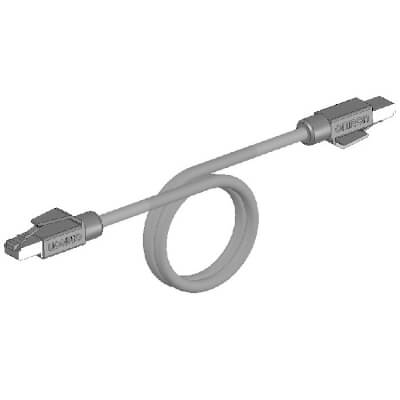
Omron XS5W-T421-DMD-KR Robotic Industrial Ethernet Cable
| Feature | Value |
|---|---|
| Manufacturer | Omron |
| Model | XS5W-T421-DMD-KR |
| Product Type | Industrial Ethernet Cable (Robotic) |
| Ethernet Category | Cat5e |
| Connector 1 | RJ45 Straight Plug |
| Connector 2 | RJ45 Straight Plug |
| Cable Type | SF/UTP |
| Cable Length | 2 m |
| Suitable for Robotics | Yes |
| Outer Jacket | PVC |
| Outer Jacket Color | Blue |
| Cable Diameter | 6.5 mm |
The Omron XS5W-T421-DMD-KR Robotic Industrial Ethernet Cable is developed for industrial Ethernet installations where continuous movement and repetitive mechanical stress are expected. Unlike standard Ethernet cables intended for static installations, this robotic version is designed for applications involving cable carriers, robotic arms, and moving automation equipment while maintaining stable Ethernet communication.
The Omron XS5W-T421-DMD-KR Robotic Industrial Ethernet Cable belongs to Omron’s XS5 Industrial Ethernet cable family and incorporates straight RJ45 connectors at both ends. The cable complies with Category 5e communication requirements and uses an SF/UTP shielded construction to improve communication stability in electrically noisy industrial environments. According to the manufacturer, this model is specifically identified as suitable for robotic applications while maintaining a 2-meter cable length and PVC outer sheath. :contentReference[oaicite:0]{index=0}
Technical Description
Industrial automation networks increasingly depend on reliable physical communication media to connect PLCs, industrial computers, machine controllers, managed switches, vision systems, and HMI terminals. The robotic version of the XS5W series addresses environments where cable flexibility and repeated motion are integral parts of machine operation.
The cable uses RJ45 straight connectors on both ends, allowing direct integration with Ethernet-enabled automation devices. The SF/UTP shield configuration combines foil shielding and braided protection to reduce electromagnetic interference generated by servo drives, variable frequency drives, motors, and switching equipment commonly found inside industrial machinery.
Omron XS5W-T421-DMD-KR Operating Principle
An Industrial Ethernet cable transfers digital communication packets between network nodes using four twisted-pair conductors. The physical design of the cable contributes to maintaining signal integrity by minimizing crosstalk and limiting the influence of external electromagnetic noise.
In robotic systems, cable movement introduces additional mechanical demands. Repeated bending, twisting, and continuous flexing can shorten the service life of conventional Ethernet cables. The Omron XS5W-T421-DMD-KR Robotic Industrial Ethernet Cable is intended for installations where moving equipment requires a communication cable designed for robotic operation.
Typical Applications
- Industrial robot cells
- Robot end-of-arm communication
- Automated assembly equipment
- Motion control systems
- Flexible manufacturing systems
- Industrial Ethernet communication networks
- Machine automation
- Industrial control cabinets
Industrial Applications
Manufacturing facilities increasingly combine robotics with Industrial Ethernet networks to synchronize production equipment. Communication cables installed on robotic equipment must withstand continuous movement without compromising network performance.
This cable is commonly used in:
- Automotive body assembly robots
- Robotic welding stations
- Material transfer robots
- Electronic assembly cells
- Pharmaceutical packaging systems
- Automated inspection equipment
- Flexible production lines
- Industrial palletizing systems
Advantages
- Designed for robotic applications
- Cat5e Industrial Ethernet communication
- RJ45 straight connectors on both cable ends
- SF/UTP shielded construction
- PVC jacket for industrial environments
- Supports dynamic cable routing
- Compatible with Industrial Ethernet architectures
- Standardized 2-meter cable length
Sector-Specific Examples
Robotic Welding Systems
Industrial robots exchange process information with PLCs and supervisory controllers throughout each production cycle. Flexible Ethernet cabling helps maintain communication while robotic joints perform repetitive movements.
Battery Manufacturing
Automated handling systems transfer battery modules between production stations. Communication cables installed inside cable carriers support continuous data exchange between controllers and motion equipment.
Electronics Production
Pick-and-place robots require dependable Ethernet communication for synchronization with inspection systems and manufacturing execution platforms.
Considerations Before Selecting the Cable
Engineers should evaluate whether the cable will operate in static or dynamic conditions. Applications involving robotic movement, drag chains, or repetitive flexing generally require cables specifically designed for continuous motion. Additional considerations include connector compatibility, required cable routing, shielding level, installation radius, and overall network architecture.
Additional information about Omron sensor series and industrial connectivity products can be useful when designing complete automation systems that integrate sensors, controllers, and Industrial Ethernet infrastructure.
Omron XS5W-T421-DMD-KR Frequently Asked Questions
1. What distinguishes this cable from the standard XS5W-T421-DMD-K?
This model is identified by the manufacturer as suitable for robotic applications where continuous movement is expected.
2. Which connector type is provided?
Both cable ends are equipped with straight RJ45 plugs.
3. Which Ethernet category does the cable support?
The cable is specified as Category 5e.
4. Is the cable shielded?
Yes. It uses an SF/UTP shield construction to improve resistance against industrial electromagnetic interference.
5. What is the cable length?
The standard cable length is 2 meters.
6. Which automation devices commonly use this cable?
Industrial robots, PLCs, industrial switches, HMIs, machine controllers, vision systems, and industrial PCs are typical examples.
7. Can the cable be installed inside robotic cable carriers?
It is designed for robotic applications where repeated cable movement is required, making it appropriate for many dynamic industrial installations within the manufacturer’s specifications.
8. Which Industrial Ethernet networks can use this cable?
It is intended for Industrial Ethernet applications including EtherCAT®, EtherNet/IP™, and other Ethernet-based automation networks compatible with Cat5e cabling.