
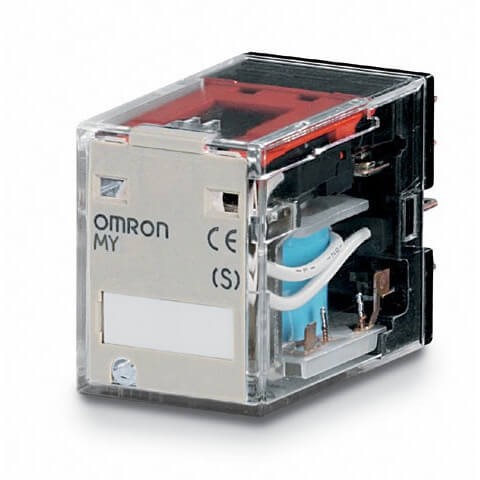
Omron MY4N1 24VDC (S) Miniature Power Relay Guide
The Omron MY4N1 24VDC (S) miniature power relay is a plug-in industrial relay designed for control panels, machine automation, sequence control, and general-purpose switching tasks. As part of Omron’s MY relay family, it is commonly selected when engineers need a compact relay with a 24 VDC coil, 4PDT contact configuration, visible operating status, and socket-based installation.
This model is often used in applications where multiple circuits must be switched at the same time from one control signal. Its 4PDT design provides four changeover contacts, making it suitable for interlocking, signal routing, auxiliary control, alarm circuits, motor control logic, and interface duties between PLC outputs and field devices.
Key Technical Characteristics
The Omron MY4N1 24VDC (S) is generally identified as a plug-in, 14-pin relay with a 24 VDC coil and 4PDT contact arrangement. Related Omron MY4N DC24 data lists a 24 VDC coil, LED operation indicator, plug-in terminal structure, 4PDT contact form, Au-clad silver alloy contact material, and socket mounting compatibility. The standard MY4N DC24 reference also shows rated loads of 220 VAC 3 A for resistive loads and 24 VDC 3 A for resistive loads, with lower ratings for inductive loads. :contentReference[oaicite:0]{index=0}
For the MY4N1 variant, distributor data describes the model as a plug-in 14-pin 4PDT relay with mechanical and LED indicators, reverse coil polarity design, label facility, 24 VDC coil voltage, and 5 A rated carry current. :contentReference[oaicite:1]{index=1} These details make the relay practical for maintenance teams because the contact state and coil energization can be checked visually without immediately reaching for test equipment.
Where This Relay Fits Best
The Omron MY4N1 24VDC (S) miniature power relay is well suited for industrial panels using 24 VDC control architecture. That voltage is widely used in PLC cabinets, safety-related auxiliary circuits, conveyor systems, packaging machines, HVAC control panels, and process automation equipment. The plug-in form factor also reduces downtime because the relay can be replaced from its socket without rewiring the entire control circuit.
Its multiple contacts are useful when a single coil signal must operate several independent circuits. For example, one contact may send feedback to a controller, another may switch a pilot lamp, another may energize an auxiliary contactor, and another may interrupt a permissive circuit. This makes the relay a practical interface component rather than only a simple on-off device.
Installation and Socket Considerations
Socket compatibility is one of the strengths of the MY series. Omron lists multiple applicable sockets for MY4N DC24 style relays, including PYF and PY14 socket families. :contentReference[oaicite:2]{index=2} In real panel design, socket choice should be based on mounting style, wiring method, available cabinet space, service access, and approval requirements.
Because this is a 24 VDC relay, polarity and coil wiring should be checked carefully during installation. The “N” style indicator helps confirm coil status, while the plug-in design supports fast diagnostics. For more Omron relay references, visit Omron industrial components.
FAQ
What is the Omron MY4N1 24VDC (S) used for?
It is used for industrial control, signal switching, relay logic, machine automation, PLC interface circuits, and control panel applications where one 24 VDC signal must switch several circuits through 4PDT contacts.
Is the Omron MY4N1 24VDC (S) a plug-in relay?
Yes. It is commonly described as a plug-in relay with a 14-pin format. This allows it to be mounted in a compatible socket, making replacement and maintenance easier in control panels.
What does 4PDT mean on this relay?
4PDT means four-pole double-throw. The relay has four changeover contact sets. Each set can switch between normally closed and normally open paths when the coil is energized.
Does the Omron MY4N1 24VDC (S) include an indicator?
Yes. The MY4N1 version is commonly supplied with LED and mechanical indication, allowing technicians to see whether the relay is energized and to inspect status during troubleshooting.
Can it be used with PLC outputs?
Yes, it is commonly used as an interface relay with PLC output modules, provided the PLC output voltage, current capability, wiring polarity, and load characteristics match the relay and application requirements.
What should be checked before replacing this relay?
Check the coil voltage, contact configuration, socket type, contact rating, load type, wiring polarity, approval requirements, and whether the original application needs indicator, test button, or suppression features.