
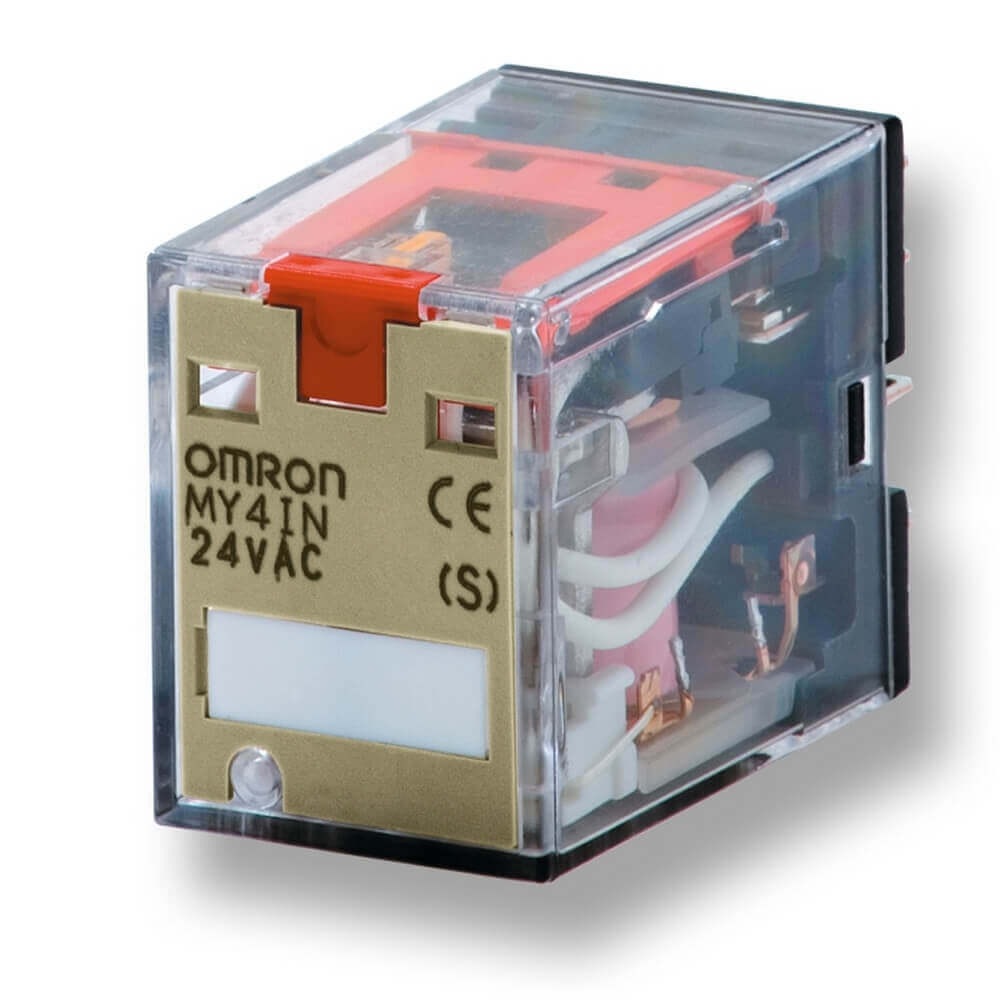
Omron MY4IN1-D2 220VDC (S) Miniature Power Relay Guide
The Omron MY4IN1-D2 220VDC (S) miniature power relay is a plug-in industrial relay designed for control panels, automation circuits, machine interfaces, and signal switching applications where a 220 VDC coil supply is required. This relay belongs to Omron’s MY series, a widely used family of compact electromechanical relays known for practical panel integration and reliable multi-contact switching.
This model is generally identified as a 4PDT relay, meaning it provides four changeover contact sets in one compact body. That structure allows a single coil command to switch multiple circuits at the same time. In control cabinet design, this can be useful for interlocking, alarm routing, auxiliary control, motor control logic, and PLC output expansion.
Technical Overview
The MY4IN1-D2 220VDC (S) version is built for DC coil operation and includes a diode for coil surge absorption. The diode helps suppress reverse voltage generated when the relay coil is de-energized. This is particularly important when the relay is driven by electronic control devices, transistor outputs, or PLC modules that may be sensitive to voltage spikes.
The relay also includes practical service features such as a mechanical indicator, LED indication, and a test button. The transparent case supports visual inspection, while the plug-in terminal structure simplifies replacement during maintenance. Instead of rewiring the complete circuit, technicians can remove the relay from its compatible socket and replace it quickly.
Where This Relay Is Commonly Used
The Omron MY4IN1-D2 220VDC (S) miniature power relay is suitable for industrial environments where DC control voltage is already available. It may be used in automation panels, process control systems, machine safety support circuits, conveyor systems, production equipment, and electrical distribution control panels.
Its 4PDT contact arrangement makes it useful when one control signal must operate several electrically isolated circuits. For example, one contact can drive an indicator, another can route a feedback signal, another can enable an auxiliary device, and another can control an interlock chain.
Design Advantages
A key advantage of this relay is its balance between compact size and multi-circuit capability. In crowded control panels, reducing component count is often valuable. A single 4PDT relay can sometimes replace several smaller relays, depending on circuit requirements.
The built-in diode is also important from an engineering perspective. DC relay coils can create inductive kickback, and the D2 configuration helps manage that effect internally. This contributes to cleaner switching behavior and helps protect upstream control electronics.
For more technical product browsing, visit Omron relay information.
Frequently Asked Questions
What is the Omron MY4IN1-D2 220VDC (S) miniature power relay used for?
It is used for switching multiple control circuits from one 220 VDC coil command. It is commonly applied in control panels, automation systems, machine interfaces, and industrial electrical logic circuits.
What does 4PDT mean?
4PDT means four pole double throw. The relay has four independent changeover contacts, allowing four separate circuits to be switched at the same time.
Why is the D2 feature important?
The D2 feature indicates a built-in diode for coil surge absorption. This helps reduce voltage spikes generated by the relay coil when power is removed.
Is this relay suitable for AC coil circuits?
No. This version is specified for 220 VDC coil operation. AC coil circuits require an AC-rated relay model with the correct coil voltage.
Omron MY4IN1-D2 220VDC (S) Why does the relay have an LED indicator?
The LED indicator helps technicians confirm whether the coil is energized. This is useful during commissioning, troubleshooting, and routine maintenance.
Can it be replaced without rewiring?
When used with a compatible plug-in socket, the relay can usually be removed and replaced without rewiring the entire circuit, reducing downtime.