
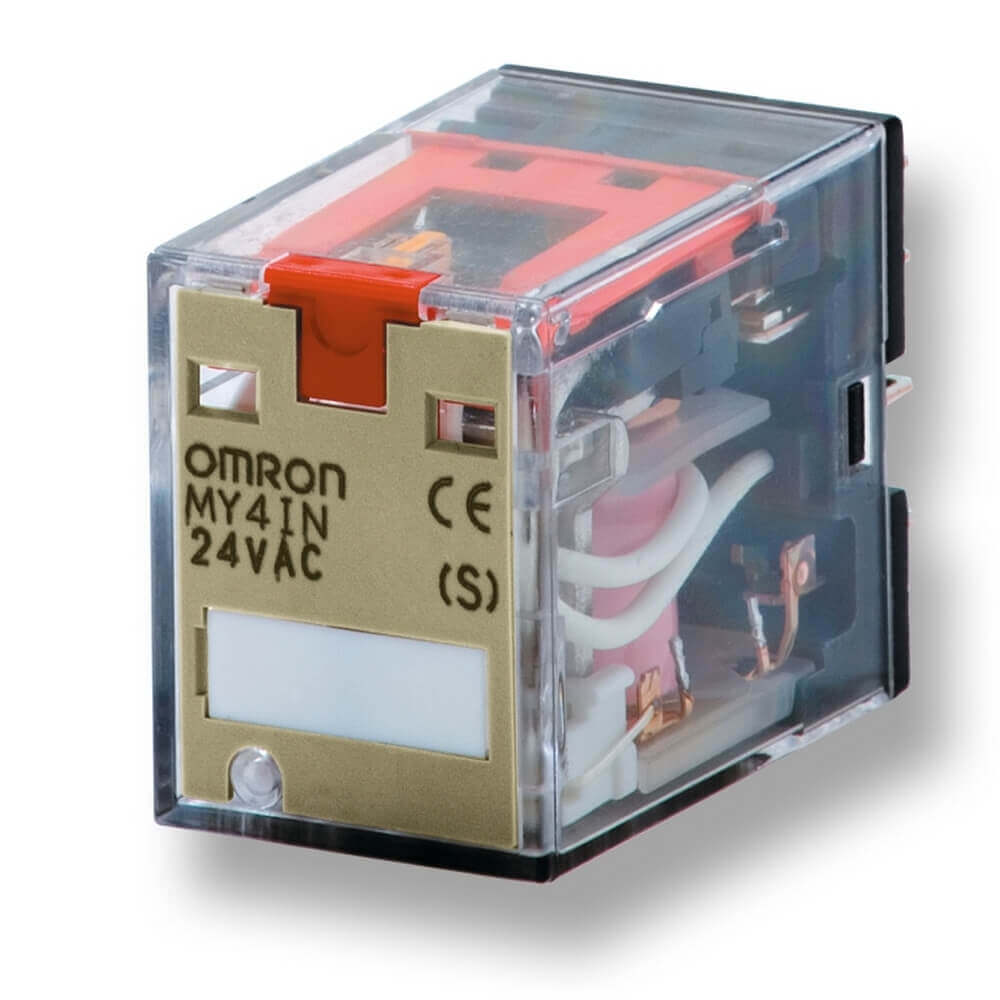
Omron MY4IN-CR 220/240VAC (S) Miniature Power Relay Guide
The Omron MY4IN-CR 220/240VAC (S) miniature power relay is a plug-in electromechanical relay designed for industrial control circuits using 220/240 VAC coil voltage. It is part of Omron’s MY series, a relay family commonly used in control cabinets, machine automation, signal switching, and general-purpose industrial panels.
This relay is built with a 4PDT contact arrangement. In practical terms, one coil operation can switch four independent changeover contacts at the same time. This is valuable when a single control signal must manage several isolated circuits, such as alarm outputs, status signals, auxiliary commands, and interlock paths.
Technical Characteristics
The MY4IN-CR 220/240VAC (S) model is an AC coil relay with built-in CR circuit surge absorption. The CR circuit helps control electrical transients that may occur when the coil is switched. This makes the relay suitable for control panels where electrical noise management and reliable operation are important.
The relay also includes LED indication, a mechanical indicator, transparent case, plug-in terminals, and a lockable test button. These features make the component easier to inspect, test, and replace during maintenance. The LED indicator confirms coil energization, while the mechanical indicator shows the relay’s operating condition.
Why 220/240 VAC Coil Voltage Is Important
Many industrial and commercial control systems use 220/240 VAC as a control voltage. The Omron MY4IN-CR 220/240VAC (S) miniature power relay fits these systems without requiring a separate lower-voltage DC control supply. This can simplify panel design where AC control voltage is already present.
The relay is especially useful in machine panels, process equipment, building service control systems, pump control circuits, HVAC panels, packaging machines, and industrial auxiliary control applications.
Role of CR Surge Suppression
When an AC relay coil is de-energized, transient voltage and electrical noise may occur. The built-in CR suppression circuit helps reduce these effects. This is useful in panels containing sensitive control equipment, timers, counters, controllers, or other devices that may be affected by noise.
By including suppression inside the relay, the design can reduce the need for separate external components in many installations. This supports cleaner wiring and a more compact cabinet layout.
Practical Use in Control Panels
A 4PDT relay can help engineers simplify circuit logic. One contact may switch a control signal, another may provide feedback to a controller, another may operate a lamp, and another may activate an auxiliary circuit. Because the contacts are independent, different circuit paths can be managed from one relay action.
The plug-in construction is also important for service teams. When installed with the correct socket, the relay can be removed and replaced without rewiring. This supports faster maintenance and helps reduce downtime in operating equipment.
For more technical product browsing, visit Omron relay information.
Omron MY4IN-CR 220/240VAC (S) Frequently Asked Questions
What is the Omron MY4IN-CR 220/240VAC (S) miniature power relay?
It is a plug-in industrial relay with a 220/240 VAC coil, 4PDT contact form, LED indicator, mechanical indicator, test button, and built-in CR surge absorption.
What does the CR circuit do?
The CR circuit helps suppress transient voltage and electrical noise generated during AC coil switching.
What does 4PDT mean?
4PDT means four pole double throw. The relay includes four independent changeover contacts operated by one coil.
Can this relay replace a 24 VDC relay?
No. This model is designed for 220/240 VAC coil operation. A 24 VDC circuit requires a relay with a 24 VDC coil.
Omron MY4IN-CR 220/240VAC (S) Why is the LED indicator important?
The LED indicator allows technicians to confirm coil energization quickly, which helps during installation, testing, and troubleshooting.
Is this relay easy to maintain?
Yes. Its plug-in design allows replacement through a compatible socket, reducing the need to disturb existing wiring.
Where is this relay typically used?
It is typically used in industrial control panels, machine automation systems, pump control circuits, HVAC panels, and auxiliary switching circuits.