
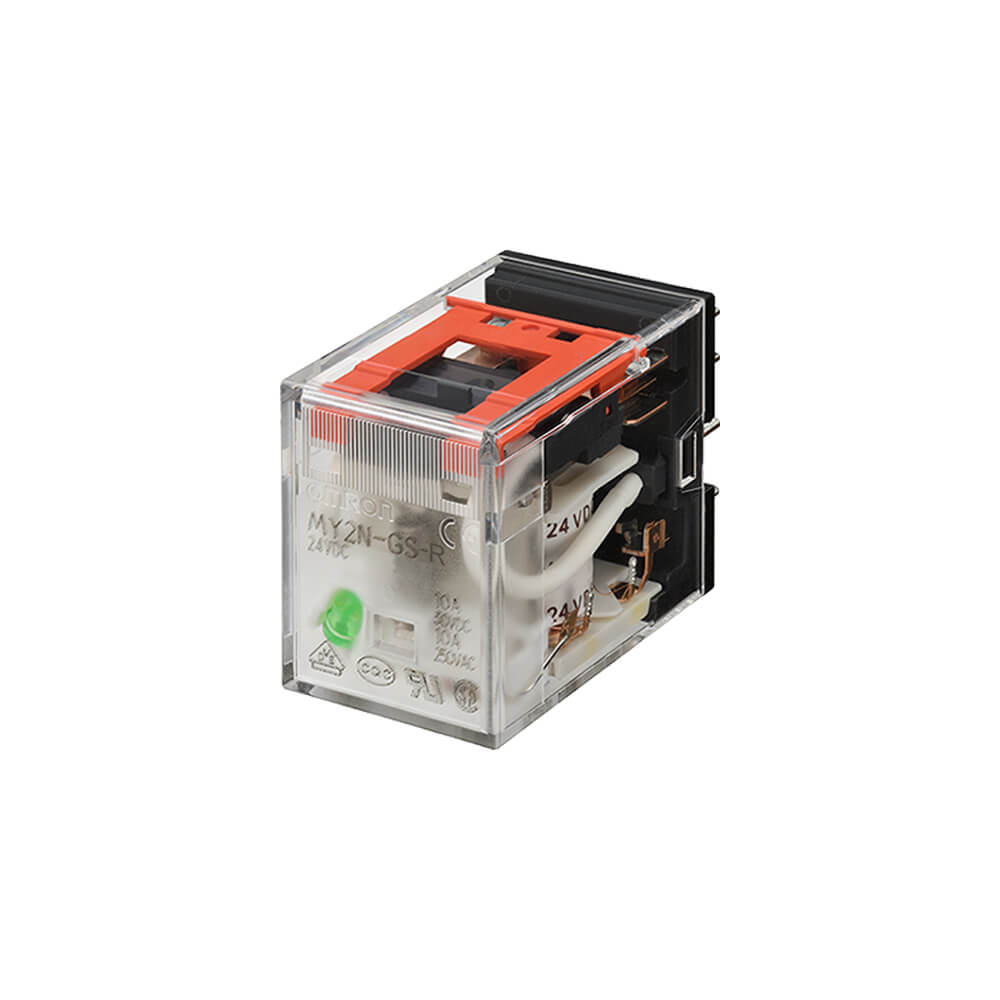
Omron MY4-GS-R AC110/120 Relay: Technical Guide for Industrial Control Panels
The Omron MY4-GS-R AC110/120 relay is a general purpose plug-in electromechanical relay designed for control panels, automation circuits, machine interfaces, and signal switching applications where a 110/120 VAC coil is required. It belongs to Omron’s MY-GS relay family and combines a compact body, 4PDT contact structure, mechanical indication, and socket-based installation for practical field maintenance.
This model is commonly selected when engineers need a multi-pole relay that can switch several isolated circuits from one coil command. According to Omron product data, the MY4-GS-R AC110/120 is a plug-in, 14-pin relay with 4 poles, 4PDT contact description, 6 A rated carry current, AC operation, silver contact material, transparent case, and mechanical indicator. :contentReference[oaicite:0]{index=0} DigiKey also lists this relay as a socketable 4PDT general purpose relay with 120 VAC coil, 6 A contact rating, 250 VAC and 220 VDC maximum switching voltage, 20 ms operate time, 20 ms release time, and an operating temperature range of -55°C to 70°C. :contentReference[oaicite:1]{index=1}
Key Technical Characteristics
The main technical value of the Omron MY4-GS-R AC110/120 relay is its balance between compact installation and multi-contact switching. Its 4PDT configuration provides four changeover contacts, allowing one coil input to manage multiple control paths at the same time. This makes it useful in interlock circuits, status feedback systems, motor control auxiliaries, alarm panels, and relay logic assemblies.
The 110/120 VAC coil makes this version suitable for control systems where the relay drive voltage is aligned with common AC panel voltages. DigiKey lists a coil resistance of 4.43 kΩ, coil current of 27.1 mA, must operate voltage of 96 VAC, and must release voltage of 36 VAC for the AC110/120 version. :contentReference[oaicite:2]{index=2} These values help panel designers confirm whether the control source can energize the relay reliably under expected operating conditions.
Mechanical Indicator and Transparent Case
A useful feature of this relay is its mechanical indicator. In practical troubleshooting, visual feedback can reduce diagnostic time because technicians can see whether the relay has changed state without relying only on measurement tools. Omron’s MY-GS documentation describes mechanical indicators as a standard feature and explains that they help identify contact operation when the coil is energized. :contentReference[oaicite:3]{index=3}
The transparent case also supports visual inspection. In environments where preventive maintenance is part of regular panel review, this makes the relay easier to assess. While a visual check does not replace electrical testing, it can provide a quick first-level confirmation during commissioning or fault analysis.
Installation and Socket Compatibility
The Omron MY4-GS-R AC110/120 relay uses a plug-in terminal structure. This format is preferred in many industrial panels because it allows the relay to be replaced without disturbing fixed wiring on the socket. Omron lists compatible socket families for MY4-GS-R models, including PY14-02, PYF-14-PU, PYF-14-PU-L, PYF14A-N, PYF14S, and PYFZ-14-E on related MY4-GS-R pages. :contentReference[oaicite:4]{index=4}
For panel builders, socket compatibility is important because it affects DIN rail layout, wiring method, serviceability, and spare part planning. A relay that can be removed from its base helps reduce downtime in repetitive control systems, especially where multiple identical relays are installed in one cabinet.
Typical Applications
The Omron MY4-GS-R AC110/120 relay is suitable for general purpose switching in industrial automation. It can be used for signal multiplication, control circuit isolation, auxiliary switching, alarm output control, status indication, sequence control, and interface circuits between controllers and field devices. Its 4PDT layout is especially useful when several independent contacts must operate from the same coil command.
Because it is an electromechanical relay, designers should always evaluate load type, switching frequency, inrush current, contact life, ambient temperature, and applicable safety requirements. A relay used for resistive loads may behave differently from one used with inductive loads, so the final selection should be matched to the real circuit rather than the coil voltage alone.
Why This Relay Matters in Control Design
The Omron MY4-GS-R AC110/120 relay offers a practical combination of 14-pin plug-in mounting, 4PDT switching, 6 A rated carry current, AC coil operation, and visible mechanical status. For maintenance teams, this supports faster replacement and easier troubleshooting. For designers, it provides a standardized relay platform for panel layouts that require repeatable switching behavior.
For more Omron-related information, visit Omron components.
Frequently Asked Questions
What type of relay is the Omron MY4-GS-R AC110/120?
It is a plug-in general purpose electromechanical relay with a 14-pin structure, 4PDT contact arrangement, 6 A rated carry current, and 110/120 VAC coil operation.
Omron MY4-GS-R AC110/120 What does 4PDT mean on this relay?
4PDT means four pole double throw. In practical terms, the relay has four changeover contact sets. Each set can switch between normally closed and normally open paths when the coil is energized.
Is the Omron MY4-GS-R AC110/120 relay suitable for socket mounting?
Yes. It is designed as a plug-in relay and is used with compatible 14-pin relay sockets. This supports easier installation, replacement, and maintenance inside control panels.
What is the coil voltage of the Omron MY4-GS-R AC110/120 relay?
The coil is designed for AC operation at 110/120 VAC. This makes it suitable for control circuits using this voltage range.
What is the contact rating of this relay?
Omron lists the MY4-GS-R AC110/120 with a 6 A rated carry current. Actual switching suitability depends on load type, voltage, switching frequency, and environmental conditions.
Does this relay include a mechanical indicator?
Yes. The mechanical indicator provides a visible indication of relay operation, helping technicians confirm relay state during inspection or troubleshooting.
Where is this relay commonly used?
It is commonly used in control panels, relay logic circuits, automation systems, machine control interfaces, alarm circuits, and applications requiring multiple contacts controlled by one AC coil.
What should be checked before selecting this relay?
Engineers should verify coil voltage, load current, switching voltage, contact type, socket compatibility, ambient temperature, expected switching frequency, and whether the load is resistive or inductive.