
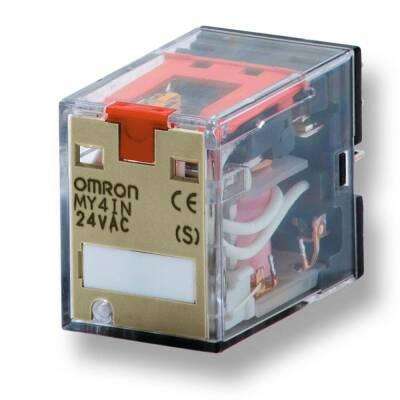
Omron MY2N1 100/110VDC (S) Miniature Power Relay
The Omron MY2N1 100/110VDC (S) miniature power relay is a plug-in DPDT relay designed for higher-voltage DC control circuits. It is commonly described as a relay with mechanical and LED indication, a 100/110 VDC coil, and plug-in mounting for socket-based control panels.
This type of relay is especially useful where operators and maintenance teams need both electrical switching and visible status feedback. The mechanical indicator helps show contact operation, while the LED indicator helps confirm coil energization. Together, these features make the relay easier to inspect during troubleshooting.
Technical Profile
The Omron MY2N1 100/110VDC (S) miniature power relay is built around a DPDT contact structure, allowing two changeover contacts to operate from one coil. It is suitable for systems using 100 VDC or 110 VDC control voltage. Related MY series 100/110 VDC coil data lists coil current values around 8.7 mA at 100 VDC and 9.6 mA at 110 VDC, with high coil resistance suitable for this voltage class.
The relay is typically used with plug-in sockets, which simplifies panel assembly and future replacement. DPDT contacts make the unit flexible enough for control duplication, signal routing, interlock logic, and auxiliary circuit switching.
Contact Capability
The MY2N family is designed for control and power switching applications within defined limits. Typical contact ratings include AC and DC resistive and inductive load ratings. In practical use, the relay may control pilot lights, interposing circuits, auxiliary contactor coils, monitoring inputs, alarm circuits, and other moderate loads.
For higher-voltage DC circuits, contact protection deserves careful attention. DC arcs are generally more difficult to extinguish than AC arcs because there is no natural zero-crossing point. Engineers should confirm that the selected load, voltage, current, and suppression method are appropriate for the relay’s rated performance.
Typical Applications
The MY2N1 100/110VDC (S) is well suited for industrial control cabinets, energy equipment, older automation systems, and panels where 110 VDC auxiliary power is standard. It may be found in protection circuits, command circuits, process control panels, and equipment that requires dependable relay logic.
Its mechanical and LED indication is valuable in dense panels. Instead of relying only on meter testing, a technician can visually compare relay states and quickly identify whether a coil has received a command. This does not replace proper electrical testing, but it improves diagnostic speed.
Selection and Maintenance Notes
Before selecting this relay, confirm the exact coil voltage, contact load, socket family, and polarity requirements. Some MY2N1 versions specify A1 positive orientation, so wiring should follow the product marking and circuit documentation. Incorrect polarity may prevent proper operation or damage indicator components.
Maintenance teams should periodically inspect socket tightness, terminal condition, relay seating, and signs of overheating or contact wear. In critical systems, replacement intervals should be based on switching frequency, load severity, and operating environment.
For more information, visit Omron components.
Omron MY2N1 100/110VDC (S) FAQ
What is the Omron MY2N1 100/110VDC (S) used for?
It is used for switching and control in panels that use 100 VDC or 110 VDC auxiliary power.
What is the difference between MY2N and MY2N1?
The MY2N1 version is commonly associated with mechanical and LED indication, while MY2N versions are often identified by LED operation indication. Exact features should always be confirmed from the part marking.
Does polarity matter?
For this type of DC relay, polarity may matter depending on the indicator and internal circuit design. Always follow the terminal marking, especially where A1 positive is specified.
Can it be used in 24 VDC systems?
No. This model is designed for 100/110 VDC coil operation. A 24 VDC system requires a matching 24 VDC relay coil.
Why is DPDT useful?
DPDT allows two separate circuits to be switched from one coil, which is useful for control duplication, status feedback, and interlocking.