
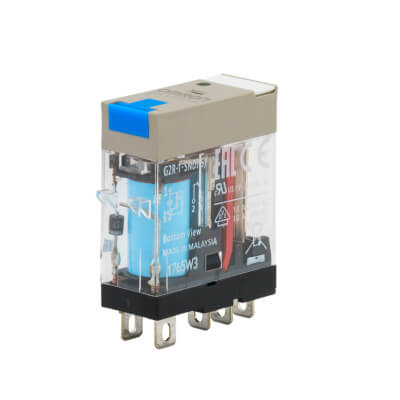
Omron G2R-1-SNI 12VDC (S) Relay Socket Explained
The Omron G2R-1-SNI 12VDC (S) relay socket is a compact plug-in general-purpose relay developed for low-voltage DC control circuits. It is particularly useful in automation panels, control modules, battery-backed systems and machine interfaces where a 12 VDC coil is required.
Technical Specification Overview
Omron lists the G2R-1-SNI DC12 (S) as a 1-pole plug-in relay with LED indicator, latching lever and mechanical operation indicator. The coil rating is 12 VDC with 47.2 mA coil current, while the coil resistance is listed at 278 ohms. The operate voltage is 70 percent maximum, which helps define the voltage level required for reliable activation.
The relay uses an SPDT contact structure and Ag alloy contacts. Its rated contact load includes 250 VAC 10 A for resistive loads and 30 VDC 10 A for resistive DC loads. For inductive loads, the usable current is lower, so the application should always be checked against the actual load type.
Best-Fit Applications
This 12 VDC version is suitable for small automation systems, control boards, signal switching, relay interface modules, low-voltage machine circuits and DC-powered control panels. The plug-in format makes servicing more efficient because the relay can be removed from its socket without changing the entire wiring structure.
Operational Benefits
The LED indicator helps identify coil energization instantly. The mechanical indicator provides a visible confirmation of relay operation, while the lockable test button supports commissioning and troubleshooting. These practical features reduce diagnostic time in busy industrial environments.
For wider Omron relay category information, visit Omron technical resources.
FAQ
What is Omron G2R-1-SNI 12VDC (S)?
It is a 12 VDC plug-in general-purpose relay with SPDT contacts, LED indication, mechanical operation indicator and a test button.
What is the coil current?
The Omron G2R-1-SNI DC12 (S) coil rating is listed as 12 VDC 47.2 mA.
Can it switch AC and DC loads?
Yes, within its rated limits. It can switch AC and DC loads, but resistive and inductive ratings are different and should be reviewed before use.
Why choose a 12VDC relay instead of an AC model?
A 12VDC relay is preferred when the control circuit is powered by a DC supply, battery system, electronic controller or low-voltage automation module.