
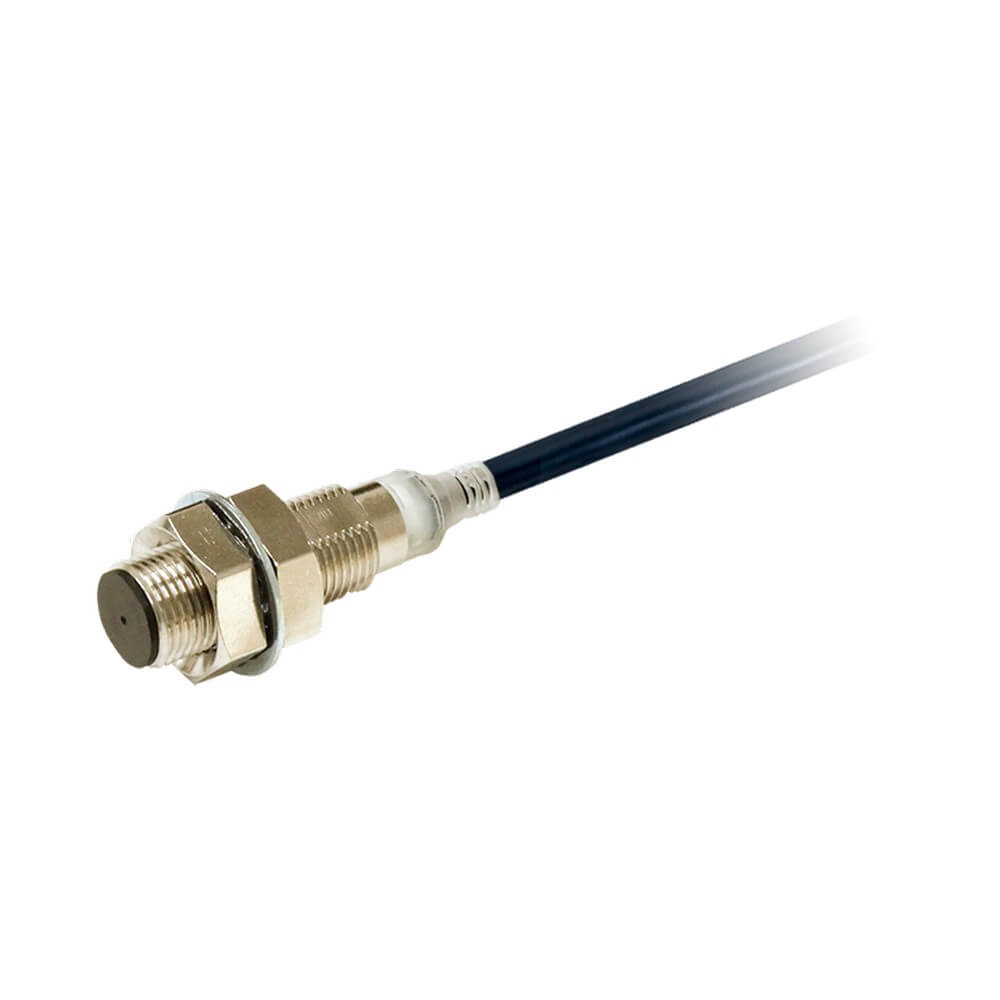
Omron E2E-X9C112 Inductive Proximity Sensor
| Feature | Value |
|---|---|
| Sensor Type | Inductive Proximity Sensor |
| Series | E2E NEXT |
| Housing Size | M12 |
| Mounting Type | Quasi-Flush |
| Sensing Distance | 9 mm |
| Output Type | NPN |
| Operation Mode | Normally Open (NO) |
| Supply Voltage | 10 to 30 VDC |
| Connection Type | 2 m Cable |
| Housing Material | Nickel-Plated Brass |
| Response Frequency | 700 Hz |
| Protection Rating | IP67 / IP67G / IP69K |
| Operating Temperature | -25°C to +70°C |
The Omron E2E-X9C112 Inductive Proximity Sensor is engineered for reliable metal detection in industrial automation environments where durability, sensing stability, and environmental resistance are critical. As part of the E2E NEXT family, this sensor combines an extended sensing distance with a compact M12 threaded housing, making it suitable for machinery that requires dependable object detection without increasing installation complexity.
Technical Description
The Omron E2E-X9C112 Inductive Proximity Sensor operates using electromagnetic induction to detect metallic objects without physical contact. This sensing method eliminates mechanical wear and provides consistent detection performance throughout long operating cycles.
The sensor features an NPN normally open output and operates from a 10 to 30 VDC power supply. The integrated 2-meter cable enables straightforward installation in industrial equipment, while the nickel-plated brass housing provides mechanical protection against demanding environmental conditions.
The Omron E2E-X9C112 Inductive Proximity Sensor is commonly installed in automated production lines, conveyor systems, robotic workstations, and material handling equipment where accurate metal target detection is essential.
Working Principle
The sensing face generates a high-frequency electromagnetic field. When a metallic object enters the sensing range, eddy currents are induced within the target material. These currents alter the characteristics of the sensor’s oscillator circuit.
The internal electronics detect these changes and activate the output signal once the target reaches the specified sensing distance. Since detection occurs without physical contact, the sensor experiences minimal wear and maintains stable performance over extended periods.
Application Areas
Automated Production Equipment
The sensor can verify the presence of metal parts, monitor transfer operations, and confirm machine positioning sequences during manufacturing processes.
Material Handling Systems
Conveyors, transfer units, and automated transport systems can utilize the sensor for metal carrier detection and movement monitoring.
Robotic Assembly Stations
Robotic systems frequently require reliable position feedback for fixtures, grippers, and mechanical components.
Machine Tool Applications
CNC equipment and industrial machinery can use the sensor for position monitoring, limit detection, and process verification.
Industrial Applications
- Automotive manufacturing
- Metal processing facilities
- Packaging machinery
- Warehouse automation systems
- Industrial robotics
- Machine building projects
- Material transport systems
- Production automation equipment
Advantages
- Extended 9 mm sensing distance.
- Reliable NPN normally open output.
- Compact M12 threaded housing.
- High environmental resistance.
- Non-contact metal detection.
- 700 Hz response frequency.
- IP67, IP67G, and IP69K protection ratings.
- Durable nickel-plated brass construction.
Industry-Specific Examples
In automotive plants, the sensor can confirm the presence of stamped metal parts before automated assembly operations.
Packaging facilities may use the sensor to monitor mechanical positions and machine sequence transitions.
Logistics centers can integrate the device into conveyor systems to identify metallic carriers moving between transfer points.
Machine builders often use the sensor to verify slide positions and moving assemblies within custom automation equipment.
Factors to Consider When Selecting This Sensor
- Verify compatibility with metallic target materials.
- Confirm that the 9 mm sensing range meets application requirements.
- Ensure controller compatibility with NPN inputs.
- Evaluate cable routing requirements.
- Review environmental conditions including washdown exposure.
- Consider installation clearances near surrounding metal structures.
Additional Omron Sensor Solutions
Engineers seeking related sensing technologies can review Omron sensor products for additional industrial automation applications.
Frequently Asked Questions
1. What type of objects can the Omron E2E-X9C112 Inductive Proximity Sensor detect?
The sensor is designed to detect metallic objects using inductive sensing technology.
2. What is the rated sensing distance?
The rated sensing distance is 9 mm.
3. What output configuration is available?
The sensor uses an NPN normally open output.
4. What operating voltage is required?
The sensor operates from a 10 to 30 VDC power supply.
5. What cable length is provided?
The device is supplied with a 2-meter integrated cable.
6. Is the sensor suitable for harsh industrial environments?
Yes. The sensor features IP67, IP67G, and IP69K protection ratings.
7. Does the sensor require contact with the detected object?
No. Detection occurs through an electromagnetic field without physical contact.
8. What industries commonly use this sensor?
Automotive, packaging, logistics, robotics, machine building, and metalworking industries frequently use inductive proximity sensors.
9. What housing material is used?
The sensor utilizes a nickel-plated brass housing.
10. Why is the Omron E2E-X9C112 Inductive Proximity Sensor suitable for automation systems?
It combines stable metal detection, high environmental resistance, compact dimensions, and reliable industrial performance.