
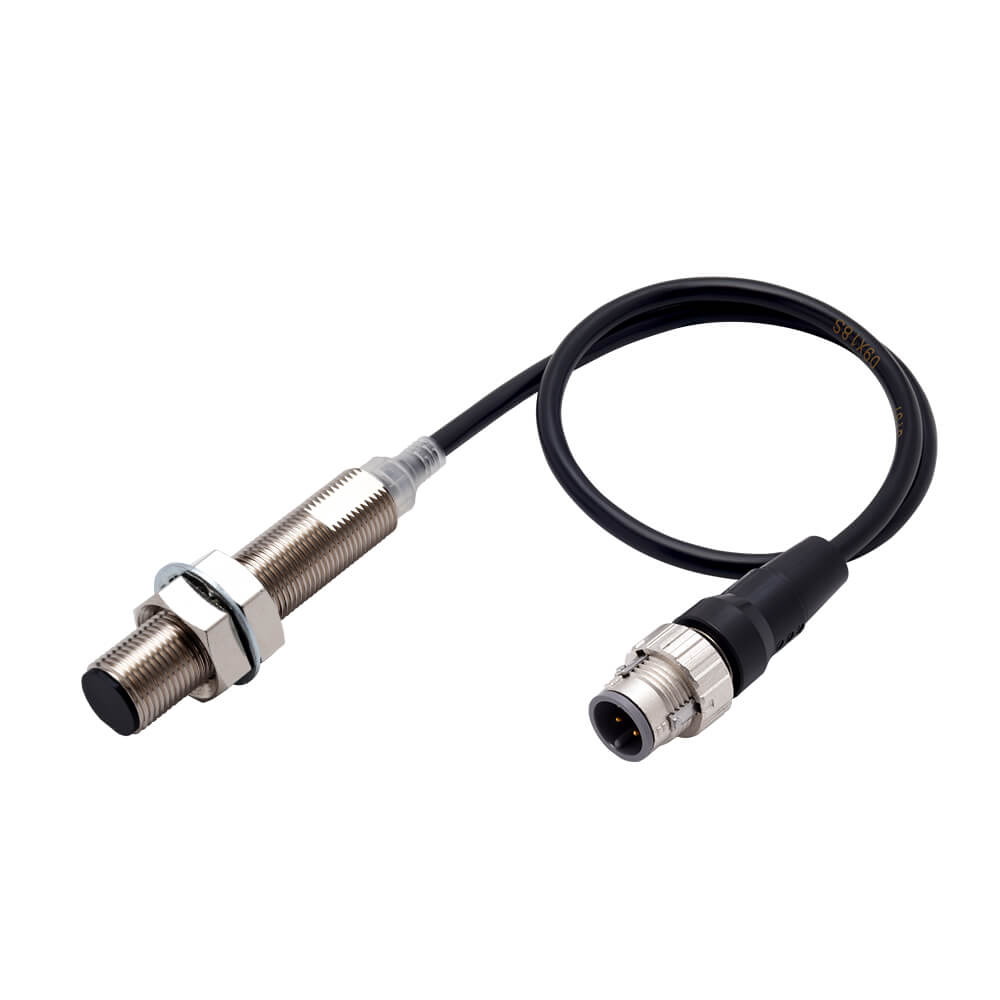
Omron E2E-X9B1TL12-M1TJ 0.3M Inductive Proximity Sensor
| Feature | Value |
|---|---|
| Sensor Type | Inductive Proximity Sensor |
| Series | E2E NEXT |
| Housing Diameter | M12 |
| Housing Type | Long Body Cylindrical |
| Sensing Distance | 9 mm |
| Mounting Style | Quasi-Flush |
| Output Type | PNP Normally Open |
| Communication | IO-Link COM3 |
| Connection Type | M12 SmartClick Connector with 0.3 m Cable |
| Housing Material | Nickel-Plated Brass |
| Protection Rating | IP67 / IP67G / IP69K |
| Thread Size | M12 |
The Omron E2E-X9B1TL12-M1TJ 0.3M Inductive Proximity Sensor is designed for industrial automation systems that require dependable metallic object detection together with advanced communication capabilities. As part of the E2E NEXT product family, this model combines a long-body M12 housing with IO-Link connectivity, making it suitable for machine builders and plant engineers implementing modern diagnostic and monitoring strategies.
Its elongated cylindrical construction can provide additional installation flexibility in equipment where mounting depth, bracket design, or mechanical accessibility influence sensor selection. The sensor supports non-contact detection of metallic targets while offering access to operational information through IO-Link communication.
The Omron E2E-X9B1TL12-M1TJ 0.3M Inductive Proximity Sensor is commonly integrated into machinery where reliable sensing performance, simplified maintenance, and compact connector-based installation are important design considerations.
Technical Description
This inductive proximity sensor utilizes electromagnetic field technology to detect conductive metallic objects without requiring physical contact. The sensor is housed in a nickel-plated brass M12 cylindrical body designed for industrial environments where vibration, contamination, and mechanical stress may be present.
The long-body design differentiates this model from standard housing variants within the same family. This configuration may simplify installation in machinery where additional threaded engagement or mounting flexibility is preferred.
The Omron E2E-X9B1TL12-M1TJ 0.3M Inductive Proximity Sensor incorporates IO-Link COM3 communication, allowing process data, identification information, and diagnostic details to be exchanged with compatible control systems.
Working Principle
The sensing element continuously generates an electromagnetic field in front of the sensing face. When a metallic object enters this field, eddy currents are induced within the target material.
The induced currents reduce the oscillator energy inside the sensor. Internal electronics monitor these changes and activate the output signal when the detection threshold is reached.
Beyond switching functionality, the Omron E2E-X9B1TL12-M1TJ 0.3M Inductive Proximity Sensor can communicate operational parameters and status information through IO-Link. This enables more detailed visibility into device performance compared to conventional discrete sensors.
Applications in Industrial Equipment
- Automated assembly stations
- Conveyor positioning systems
- Transfer mechanisms
- Machine tool automation
- Robotic production cells
- Packaging equipment
- Metal processing machinery
- Factory automation systems
The sensor’s combination of compact diameter, long housing construction, and digital communication capability makes it suitable for a broad range of industrial applications.
Industrial Application Examples
Production Line Automation
Manufacturing lines frequently require verification of metal carriers, fixtures, and moving components. Reliable object detection supports accurate process sequencing and machine coordination.
Robotic Handling Systems
Robotic cells can utilize proximity sensors to verify fixture engagement and monitor the position of metallic tooling components during automated operations.
Metal Fabrication Equipment
In machining and fabrication facilities, proximity sensors assist with workpiece positioning, machine status monitoring, and automated movement control.
Packaging and Material Flow Systems
Transfer mechanisms and indexing devices often depend on non-contact sensing technology to maintain repeatable product movement and machine timing.
Advantages
- Extended 9 mm sensing distance
- Long-body housing design for installation flexibility
- Integrated IO-Link communication
- M12 SmartClick connector system
- Compact cylindrical form factor
- High environmental protection ratings
- Nickel-plated brass housing construction
- Support for digital maintenance strategies
Engineers seeking additional Omron sensor solutions can evaluate various E2E NEXT models according to installation requirements, communication preferences, and sensing distance needs.
Sector-Based Usage Scenarios
Automotive Manufacturing
The sensor can verify the presence and position of metal components before robotic assembly operations proceed.
Warehouse Automation
Automated transport systems may use inductive sensing technology to monitor carrier locations and transfer mechanisms.
Industrial Machinery
Machine builders can integrate proximity sensors for limit detection, positioning feedback, and operational monitoring.
Packaging Production
Packaging equipment often employs metallic component detection to synchronize machine sequences and maintain production flow.
Factors to Consider During Sensor Selection
Engineers should evaluate mounting space, sensing distance requirements, environmental exposure, communication architecture, and maintenance strategies when selecting a proximity sensor.
The Omron E2E-X9B1TL12-M1TJ 0.3M Inductive Proximity Sensor may be particularly suitable where a longer housing structure provides mechanical installation benefits while maintaining the performance characteristics of the E2E NEXT family.
Compatibility with existing IO-Link infrastructure should also be verified during system design and commissioning.
Frequently Asked Questions
1. What type of sensing technology does this sensor use?
The sensor uses inductive sensing technology to detect metallic objects without physical contact.
2. What is the rated sensing distance?
The rated sensing distance is 9 mm.
3. Does the sensor support IO-Link communication?
Yes. It supports IO-Link COM3 communication.
4. What output configuration is available?
The sensor provides a PNP normally open output.
5. What is the purpose of the long-body housing?
The extended housing may provide additional mounting flexibility in certain machine designs.
6. Which industries commonly use this sensor?
Automotive, packaging, robotics, machine building, logistics, and metalworking industries frequently use this type of sensor.
7. What protection ratings does the sensor provide?
The sensor is rated IP67, IP67G, and IP69K.
8. What material is used for the housing?
The housing is manufactured from nickel-plated brass.
9. How does IO-Link improve system visibility?
IO-Link provides access to diagnostic information, parameter settings, identification data, and operational status information.
10. Why is the Omron E2E-X9B1TL12-M1TJ 0.3M Inductive Proximity Sensor suitable for industrial automation?
Its combination of durable construction, non-contact sensing technology, IO-Link communication, and compact installation format supports a wide range of automation applications.