
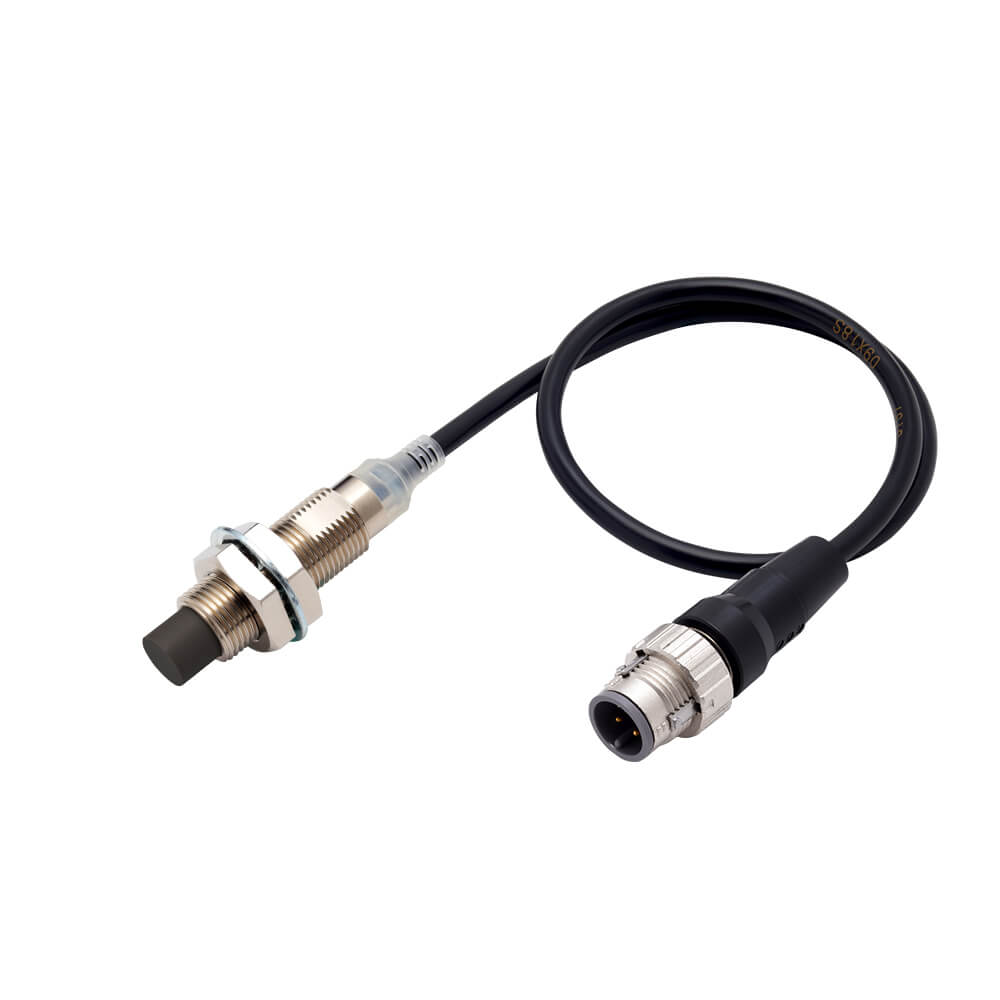
Omron E2E-X8MB1T12-M1TJ 0.3M Inductive Proximity Sensor
| Feature | Value |
|---|---|
| Product Type | Inductive Proximity Sensor |
| Series | E2E NEXT |
| Sensing Distance | 8 mm |
| Housing Diameter | M12 |
| Mounting Type | Shielded |
| Output Type | NPN Normally Open |
| Supply Voltage | 10 to 30 VDC |
| Connection Method | M12 SmartClick Connector with 0.3 m Cable |
| Cable Length | 0.3 m |
| Housing Material | Nickel-Plated Brass |
| Protection Rating | IP67 / IP69K |
| Operating Temperature | -25°C to +70°C |
Compact automation systems often require sensing devices that combine reliable detection performance with flexible wiring options. The Omron E2E-X8MB1T12-M1TJ 0.3M Inductive Proximity Sensor is designed for these applications, offering non-contact metallic object detection together with a short pigtail cable and M12 connector interface.
As a member of the E2E NEXT sensor family, this model supports machine builders and system integrators seeking a durable proximity sensor suitable for industrial environments where modular cabling and simplified maintenance are important considerations.
Technical Description
The Omron E2E-X8MB1T12-M1TJ 0.3M Inductive Proximity Sensor provides an 8 mm sensing distance and utilizes inductive detection technology to identify metallic objects. The sensor incorporates an NPN normally open output that can be integrated into PLC systems, industrial controllers, and distributed automation architectures.
The M12 threaded housing allows installation in compact machine assemblies while maintaining mechanical stability. A short 0.3-meter pigtail cable combined with an M12 connector supports flexible wiring arrangements and simplifies sensor replacement during maintenance activities.
The nickel-plated brass housing contributes to mechanical durability and resistance to common industrial contaminants such as dust, oil mist, and moisture.
Operating Principle
The Omron E2E-X8MB1T12-M1TJ 0.3M Inductive Proximity Sensor operates by generating a high-frequency electromagnetic field at the sensing surface. When a conductive metallic target enters the sensing zone, eddy currents are induced within the material.
These currents influence the oscillation characteristics of the sensor circuit. Internal electronics continuously evaluate the resulting changes and activate the output when the configured sensing threshold is reached.
This non-contact detection method minimizes mechanical wear while supporting reliable operation in applications involving frequent detection cycles.
Usage Areas
- Industrial automation equipment
- Robotic manufacturing cells
- Packaging machinery
- Assembly systems
- Machine tool automation
- Material handling equipment
- Automated inspection stations
- Conveyor systems
The Omron E2E-X8MB1T12-M1TJ 0.3M Inductive Proximity Sensor is particularly suitable for installations where standardized M12 cabling is preferred and quick replacement procedures are required.
Industrial Applications
Machine Building
Equipment manufacturers frequently use proximity sensors to monitor machine positions, moving components, and mechanical status conditions throughout automated processes.
Robotics and Automation
Robotic systems often require reliable confirmation of fixture positions, tooling locations, and metallic component movement to support coordinated operations.
Packaging Production Lines
Packaging machinery utilizes inductive sensors for position monitoring, indexing verification, and synchronization of moving mechanical assemblies.
Material Transfer Systems
Automated transport equipment relies on proximity sensors to verify pallet locations, actuator positions, and transfer mechanism status.
Advantages
- 8 mm sensing distance
- Compact M12 threaded housing
- NPN normally open output
- M12 connector compatibility
- 0.3-meter pigtail cable design
- IP67 and IP69K protection ratings
- Nickel-plated brass construction
- Non-contact metallic object detection
The Omron E2E-X8MB1T12-M1TJ 0.3M Inductive Proximity Sensor offers installation flexibility for industrial systems that utilize connector-based wiring architectures and modular maintenance practices.
Engineers seeking additional sensing technologies may review Omron sensor products and related automation solutions.
Sector-Specific Use Cases
- Detection of tooling positions in assembly equipment
- Monitoring actuator movement in robotic cells
- Verification of metallic carrier locations on conveyors
- Position feedback for automated handling devices
- Monitoring fixture presence in manufacturing stations
- Detection of machine component travel limits
Important Considerations When Selecting the Sensor
When evaluating the Omron E2E-X8MB1T12-M1TJ 0.3M Inductive Proximity Sensor, engineers should consider the available installation space, target dimensions, required sensing range, and controller input compatibility.
The connector-based design is especially beneficial in machinery that follows standardized cabling practices. It can simplify installation, troubleshooting, and sensor replacement while reducing downtime during maintenance activities.
Environmental requirements, including exposure to moisture, vibration, dust, and cleaning procedures, should also be reviewed during system design and implementation.
Frequently Asked Questions
What type of sensor is this?
It is an inductive proximity sensor designed for non-contact detection of metallic targets.
What is the sensing distance?
The rated sensing distance is 8 mm.
Which output configuration does it use?
The sensor provides an NPN normally open output.
What supply voltage is required?
The operating voltage range is 10 to 30 VDC.
What is the cable length?
The sensor includes a 0.3-meter pigtail cable with an M12 connector interface.
Can it be used in washdown environments?
Yes. The IP67 and IP69K protection ratings support operation in demanding industrial environments.
What materials can be detected?
The sensor is intended for metallic object detection.
Why use a connector version instead of a long cable version?
Connector-based designs simplify replacement, maintenance, and standardized wiring practices.
Where is this sensor commonly used?
It is commonly installed in packaging machinery, robotic systems, conveyors, machine tools, and automated manufacturing equipment.
Does the sensor require contact with the target?
No. Detection is performed through an electromagnetic sensing field without physical contact.