
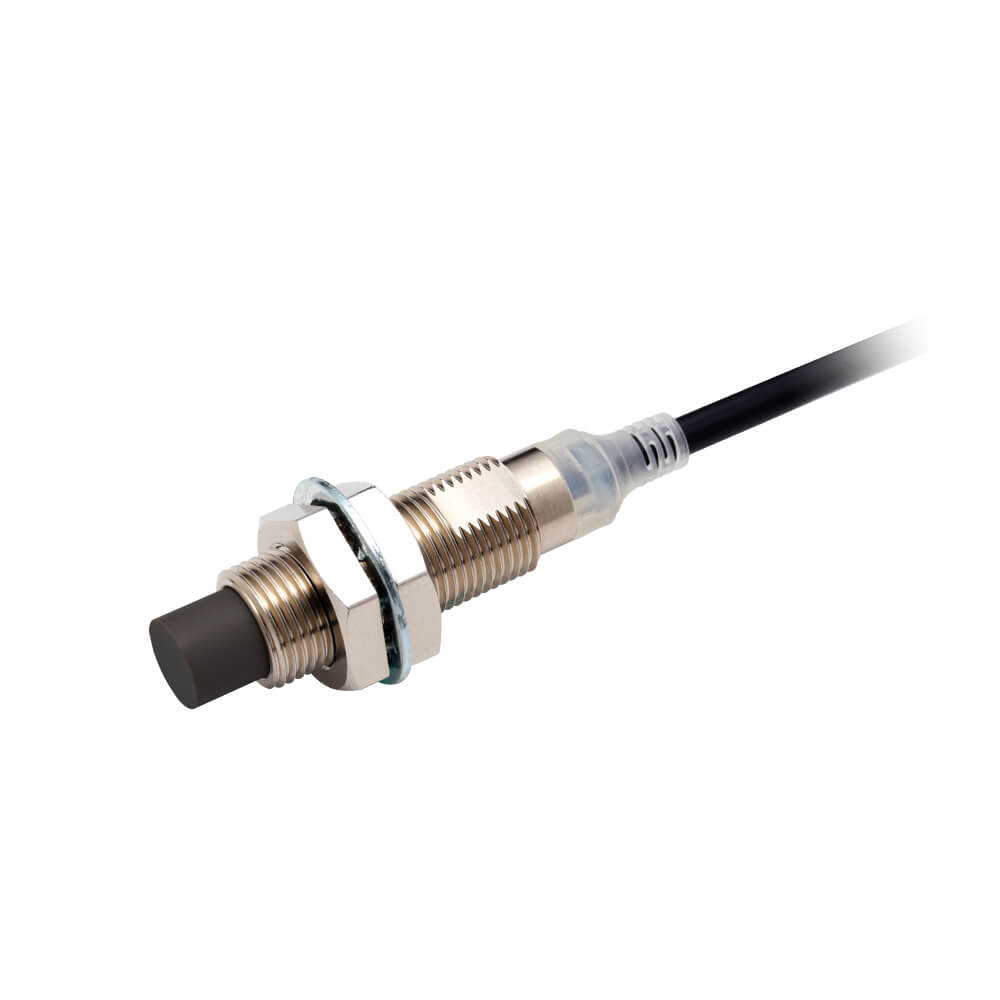
Omron E2E-X8MB1T12 2M Inductive Proximity Sensor
| Feature | Value |
|---|---|
| Product Type | Inductive Proximity Sensor |
| Series | E2E NEXT |
| Sensing Distance | 8 mm |
| Housing Diameter | M12 |
| Mounting Style | Shielded |
| Output Type | NPN Normally Open |
| Supply Voltage | 10 to 30 VDC |
| Cable Length | 2 m |
| Housing Material | Nickel-Plated Brass |
| Protection Rating | IP67 / IP69K |
| Connection Method | Pre-wired Cable |
| Operating Temperature | -25°C to +70°C |
Modern industrial equipment depends on accurate and repeatable sensing technologies to maintain process consistency. The Omron E2E-X8MB1T12 2M Inductive Proximity Sensor is engineered to detect metallic targets without physical contact, helping automation systems monitor movement, positioning, and machine status with minimal maintenance requirements.
As part of the E2E NEXT sensor family, this model combines a compact M12 housing with a shielded sensing structure and a factory-installed 2-meter cable. Its design supports integration into machinery where installation space is limited and reliable object detection is required.
Technical Description
The Omron E2E-X8MB1T12 2M Inductive Proximity Sensor utilizes inductive sensing technology to identify metallic objects within an 8 mm sensing range. The sensor incorporates an NPN normally open output suitable for connection to PLCs, machine controllers, and industrial automation devices.
The threaded M12 body enables secure installation in production equipment, conveyors, and automation systems. Its nickel-plated brass construction enhances durability while providing resistance to mechanical stress and industrial contaminants.
With IP67 and IP69K protection ratings, the sensor is suitable for environments where exposure to moisture, dust, and cleaning processes may occur.
Operating Principle
The sensor generates a high-frequency electromagnetic field at the sensing surface. When a conductive metallic object enters this field, eddy currents are created within the target.
The resulting change in the oscillation characteristics is monitored by the internal electronic circuitry. Once the predefined threshold is reached, the output state changes and communicates the detection event to the control system.
This non-contact operating method reduces mechanical wear and contributes to long service life in high-cycle industrial applications.
Usage Areas
- Automated assembly equipment
- Material transfer systems
- Packaging machinery
- Industrial conveyors
- Machine tool automation
- Automated inspection stations
- Robotic handling systems
- Metal fabrication equipment
The Omron E2E-X8MB1T12 2M Inductive Proximity Sensor is particularly useful in installations where compact dimensions and straightforward wiring are required.
Industrial Applications
Assembly Automation
The sensor can verify the presence and position of metallic fixtures, tooling components, and production carriers during assembly processes.
Packaging Equipment
Packaging systems often require reliable position detection for actuators, machine components, and indexing mechanisms. Inductive sensors provide repeatable operation under continuous production conditions.
Metal Processing Operations
Fabrication equipment uses proximity sensors for position feedback, machine sequencing, and movement verification of metallic workpieces.
Material Handling Systems
Transfer units and automated conveyors utilize inductive sensors to detect carriers, stops, and moving machine elements.
Advantages
- Reliable metallic object detection
- 8 mm sensing distance
- Compact M12 housing design
- NPN normally open output
- 2-meter integrated cable
- IP67 and IP69K environmental protection
- Durable nickel-plated brass construction
- Non-contact sensing operation
The Omron E2E-X8MB1T12 2M Inductive Proximity Sensor provides dependable performance in applications requiring accurate detection and compact installation dimensions.
Engineers evaluating additional sensing options can review Omron sensor products for related technologies and product families.
Sector-Specific Examples
- Detecting metal carriers in production cells
- Monitoring pneumatic actuator positions
- Verifying machine slide locations
- Detecting tooling components in machining centers
- Tracking metal pallets in conveyor systems
- Position monitoring within robotic automation stations
Important Selection Considerations
Before implementing the Omron E2E-X8MB1T12 2M Inductive Proximity Sensor, system designers should evaluate the required sensing distance, target dimensions, mounting constraints, and controller compatibility.
The shielded construction supports installation near surrounding metal surfaces, while the 2-meter cable length is suitable for machinery with relatively short wiring distances between the sensor and control cabinet.
Environmental conditions including temperature variation, vibration levels, and cleaning requirements should also be reviewed during project planning.
Frequently Asked Questions
What type of objects can this sensor detect?
The sensor is designed to detect metallic targets using inductive sensing technology.
What is the rated sensing distance?
The nominal sensing distance is 8 mm.
Which output configuration is available?
The sensor provides an NPN normally open output.
What supply voltage is required?
The operating voltage range is 10 to 30 VDC.
How long is the cable?
The sensor is supplied with a factory-installed 2-meter cable.
Can it operate in dusty environments?
Yes. Its IP67 and IP69K protection ratings support use in demanding industrial environments.
Does the sensor require physical contact with the target?
No. Detection is performed through an electromagnetic field without physical contact.
What industries commonly use this sensor?
Manufacturing, packaging, material handling, robotics, and machine building industries commonly use inductive proximity sensors.
Is the housing resistant to industrial conditions?
Yes. The nickel-plated brass housing is designed for industrial applications.
Why would a shielded sensor be selected?
Shielded sensors allow installation closer to surrounding metal structures while maintaining stable detection performance.