
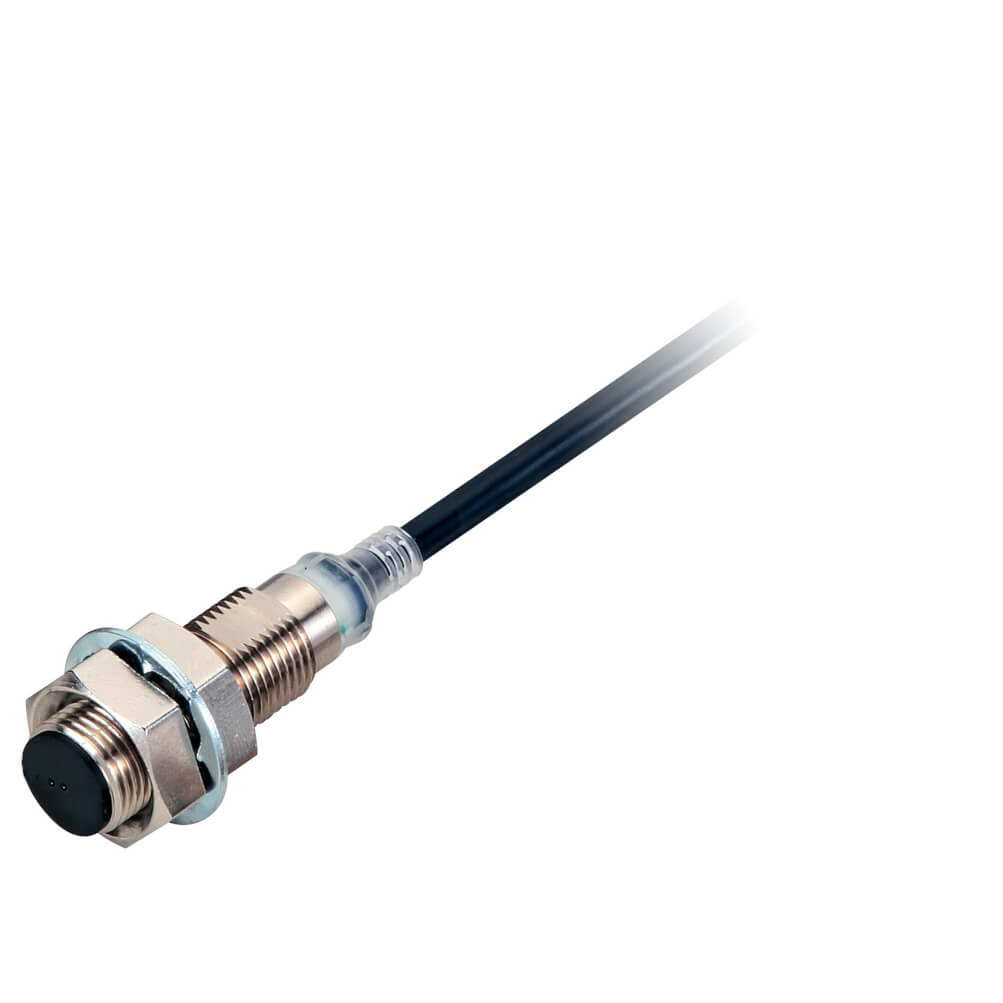
Omron E2E-X7D212-T 5M Inductive Proximity Sensor
| Feature | Value |
|---|---|
| Manufacturer | Omron |
| Model | E2E-X7D212-T 5M |
| Sensor Type | Inductive Proximity Sensor |
| Series | E2E NEXT |
| Housing Size | M12 Cylindrical |
| Sensing Distance | 7 mm |
| Mounting Type | Shielded (Quasi-flush) |
| Output Configuration | 2-wire |
| Output Logic | Normally Closed (NC) |
| Cable Length | 5 m |
| Housing Material | Nickel-Plated Brass |
| Protection Rating | IP67 / IP67G / IP69K |
| Overall Length | 47.1 mm |
| Thread Diameter | M12 |
Technical Description
The Omron E2E-X7D212-T Inductive Proximity Sensor is engineered for non-contact detection of metallic objects in industrial automation systems. As a member of the E2E NEXT series, this sensor combines a compact M12 threaded housing with advanced environmental protection characteristics and stable detection performance. The integrated 5-meter cable provides additional installation flexibility for machinery layouts where sensors are positioned away from control cabinets or field junction points.
The sensor offers a rated sensing distance of 7 mm and utilizes a normally closed two-wire output configuration. This output arrangement is frequently selected in monitoring circuits where continuous signal verification is important for machine operation and fault indication strategies.
The Omron E2E-X7D212-T Inductive Proximity Sensor is commonly installed in automated production environments that require dependable metallic object detection under challenging operating conditions.
Working Principle
The sensing mechanism is based on electromagnetic induction. An oscillator inside the sensor generates a high-frequency electromagnetic field at the sensing face. When a metallic object enters this field, eddy currents are generated within the target material.
These eddy currents absorb energy from the oscillating field, causing measurable changes within the sensor electronics. Once the target reaches the specified sensing range, the output state changes and provides a signal to connected control devices such as PLCs, industrial controllers, or machine monitoring systems.
Because no physical contact occurs between the sensor and the target, mechanical wear is minimized, contributing to consistent operation over long service intervals.
Application Areas
The Omron E2E-X7D212-T Inductive Proximity Sensor can be used across numerous industrial sectors where metallic objects must be detected reliably and repeatedly.
- Automated assembly equipment
- Industrial conveyor systems
- Machine tool installations
- Packaging machinery
- Material transfer systems
- Warehouse automation equipment
- Robotic manufacturing cells
- Metal processing machinery
Industrial Applications
Production Line Monitoring
Manufacturing systems often require verification of metal component presence before automated operations begin. The sensor provides reliable detection for these process control functions.
Automated Material Transport
Conveyor and transfer systems can use the sensor to monitor the movement of metallic carriers, pallets, and transport fixtures between production stations.
Machine Tool Equipment
Machining centers and automated tooling systems frequently employ inductive sensors for fixture verification, position confirmation, and mechanical sequence monitoring.
Robotics and Flexible Manufacturing
Industrial robots rely on accurate position information from sensors to verify tooling status, fixture engagement, and workpiece positioning before executing programmed movements.
Advantages of the Omron E2E-X7D212-T Inductive Proximity Sensor
- Reliable detection of metallic targets
- Non-contact sensing operation
- Compact M12 housing dimensions
- Extended 5-meter cable for flexible installation
- Normally closed output configuration
- Durable nickel-plated brass construction
- High resistance to moisture and contamination
- IP67, IP67G, and IP69K environmental protection
These characteristics support reliable operation in industrial facilities where sensors are exposed to vibration, washdown procedures, and demanding production conditions.
Sector-Specific Use Cases
- Detecting steel carriers in automotive assembly lines
- Monitoring fixture positions in welding equipment
- Verifying pallet movement in logistics systems
- Position detection in packaging machinery
- Monitoring tooling status in CNC machining centers
- Detecting metallic transport mechanisms in warehouse automation
Engineers seeking additional sensing technologies can review Omron sensor products when designing integrated automation systems and machine control architectures.
Factors to Consider When Selecting This Sensor
Several technical considerations should be evaluated before integrating a proximity sensor into an industrial automation project.
- Required sensing range
- Target material composition
- Installation space limitations
- Output logic requirements
- Cable routing distance
- Environmental protection needs
- Control system compatibility
- Maintenance accessibility requirements
The Omron E2E-X7D212-T Inductive Proximity Sensor is particularly suitable for installations requiring extended cable lengths combined with normally closed detection logic.
Frequently Asked Questions
1. What type of objects can this sensor detect?
The sensor is designed to detect metallic objects using inductive sensing technology.
2. What is the rated sensing distance?
The rated sensing distance is 7 mm.
3. What output configuration does this model use?
It utilizes a two-wire normally closed (NC) output configuration.
4. How long is the cable?
This version is equipped with a 5-meter integrated cable.
5. What is the housing size?
The sensor uses a compact M12 threaded cylindrical housing.
6. What environmental protection ratings are provided?
The sensor is rated IP67, IP67G, and IP69K.
7. Is the sensor suitable for harsh industrial environments?
Yes. The housing design and protection ratings support operation in demanding industrial conditions.
8. Why is non-contact sensing beneficial?
Non-contact operation minimizes mechanical wear and reduces maintenance requirements compared with contact-based sensing methods.
9. Where is the Omron E2E-X7D212-T Inductive Proximity Sensor commonly used?
Typical applications include assembly automation, machine tools, logistics systems, packaging equipment, and robotic manufacturing cells.
10. Why would an engineer choose the 5-meter cable version?
The extended cable length simplifies installation in large machines and distributed automation systems where sensors are positioned far from control panels.