
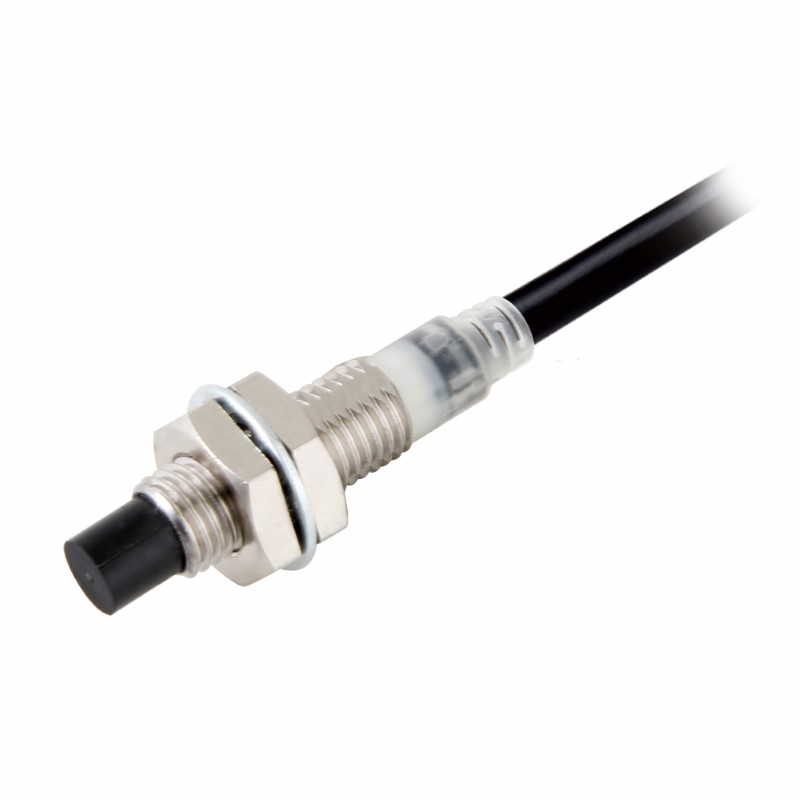
Omron E2E-X6MD28-T 5M Inductive Proximity Sensor
| Feature | Value |
|---|---|
| Sensor Type | Inductive Proximity Sensor |
| Series | E2E NEXT |
| Size | M8 |
| Mounting Type | Non-flush |
| Sensing Distance | 6 mm |
| Output Type | DC 2-wire |
| Operation Mode | NC |
| Connection Method | Cable |
| Cable Length | 5 m |
| Cable Specification | PVC, oil-resistant |
| Housing Material | Stainless steel |
| Overall Sensor Length | 37.8 mm |
| Thread Length | 20 mm |
| Protection Rating | IP67 / IP67G / IP69K |
Technical Description
The Omron E2E-X6MD28-T 5M Inductive Proximity Sensor is an M8 cylindrical inductive sensor developed for non-contact detection of metallic targets in automation systems. It uses a stainless-steel housing, a 5 m oil-resistant PVC cable, and a DC 2-wire output structure. The sensor has a 6 mm sensing distance and is designed for non-flush mounting.
This model is suitable for machine layouts where compact installation space, cable routing distance, and resistance to industrial contamination are important engineering factors. The Omron E2E-X6MD28-T 5M Inductive Proximity Sensor is especially relevant in equipment where metallic parts, machine slides, actuator positions, or mechanical stops must be monitored without physical contact.
Operating Principle
Inductive proximity sensors operate by generating a high-frequency electromagnetic field from the sensing face. When a metallic object enters this field, eddy currents are produced in the target material. These eddy currents change the energy condition of the oscillator circuit inside the sensor. The internal electronics evaluate this change and switch the output state.
Because detection occurs without mechanical contact, the sensor is not affected by contact wear in the same way as limit switches. This makes it useful for repetitive motion monitoring, indexing control, and machine feedback tasks where high cycle rates are common.
Application Areas
The 6 mm sensing distance and M8 housing format make this sensor appropriate for installations where space is limited but a longer detection distance than standard compact M8 sensors may be required. Typical use cases include metallic part presence detection, cylinder end-position confirmation, fixture status monitoring, and conveyor mechanism feedback.
- Metal part detection in automated assembly cells
- Position confirmation on pneumatic and mechanical actuators
- Detection of machine stops, cams, and brackets
- Conveyor indexing and pallet positioning
- Tool presence verification in compact machinery
- Machine guarding support signals in control systems
For broader product planning, related Omron sensor products can be reviewed when comparing different sensing distances, housing sizes, and connection types.
Industrial Applications
In automotive component assembly, the sensor can be used to confirm whether a metallic fixture has reached its intended position before a fastening, pressing, or transfer step begins. In packaging machinery, it may monitor mechanical levers, indexing plates, or metal actuator components that control product movement.
In metalworking equipment, the stainless-steel body and oil-resistant cable support use near lubricated mechanical sections, cutting fluid exposure, and repetitive machine motion. In logistics automation, the sensor may provide feedback from metal stops or transfer mechanisms used in pallet handling systems.
Advantages
- Non-contact metal detection reduces mechanical wear.
- M8 cylindrical housing supports integration into compact machine assemblies.
- 6 mm sensing distance provides useful detection range for small installations.
- Stainless-steel housing improves mechanical durability.
- Oil-resistant PVC cable supports use near lubricants and industrial fluids.
- IP67, IP67G, and IP69K ratings support use in demanding environments.
- DC 2-wire design simplifies integration in many industrial control circuits.
Sector-Based Usage Examples
Automotive Manufacturing
The sensor can detect fixture movement, metal nests, or clamp positions in automated assembly equipment.
Machine Tool Systems
It can monitor sliding metal parts, tool changer positions, or actuator travel limits in equipment exposed to coolant and oil mist.
Packaging Automation
The sensor can verify the position of metal guide mechanisms, indexing parts, or reject station components.
Material Handling
It may be used to detect metallic stops, transfer arms, and pallet-positioning hardware in conveyor-based systems.
Selection Considerations
When selecting this sensor, the mounting type must be reviewed carefully. Since the device is non-flush, adequate clearance around the sensing face is necessary to avoid unwanted influence from nearby metal. The target material, target size, installation distance, cable length, and environmental exposure should also be considered during system design.
The NC output state should be checked against the input logic of the PLC, relay module, or distributed I/O device. Engineers should also verify whether a 5 m cable is suitable for the panel location and cable routing path. The Omron E2E-X6MD28-T 5M Inductive Proximity Sensor should be installed with proper mechanical protection where cable movement, abrasion, or sharp edges may be present.
Frequently Asked Questions
What type of sensor is the Omron E2E-X6MD28-T 5M?
It is an inductive proximity sensor designed for non-contact detection of metallic objects.
What is the sensing distance?
The rated sensing distance is 6 mm.
What housing size does it use?
It uses an M8 cylindrical threaded housing.
Is this sensor flush mountable?
No. It is specified as a non-flush mounting sensor.
What is the output configuration?
The sensor uses a DC 2-wire output configuration.
What is the operation mode?
The operation mode is NC, meaning normally closed.
Can it be used near oil or coolant?
Yes. The cable is specified as oil-resistant PVC, and the sensor has IP67G protection.
What environments are suitable for this sensor?
It is suitable for industrial environments requiring dust, water, oil, and washdown resistance within its specified protection ratings.
What should be checked before installation?
Engineers should check target material, sensing distance, non-flush mounting clearance, cable routing, and compatibility with the control input.