
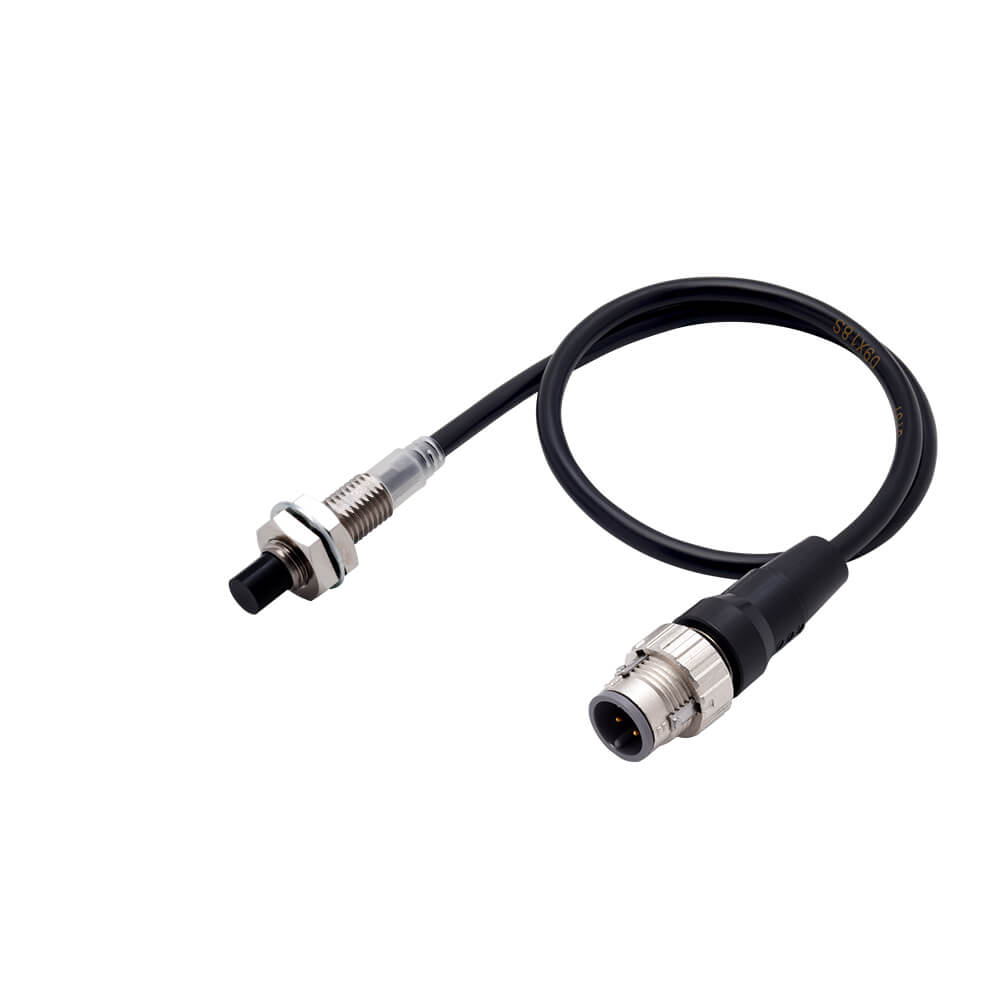
Omron E2E-X6MD28-M1TGJ 0.3M Inductive Proximity Sensor
| Feature | Value |
|---|---|
| Sensor Type | Inductive Proximity Sensor |
| Series | E2E NEXT |
| Housing Size | M8 |
| Mounting Type | Non-flush |
| Sensing Distance | 6 mm |
| Output Type | DC 2-wire |
| Operation Mode | NO |
| Housing Material | Stainless Steel |
| Thread Length | 20 mm |
| Overall Length | 37.8 mm |
| Connection Method | M12 Pigtail Smartclick Connector |
| Cable Length | 0.3 m |
| Cable Material | Oil-resistant PVC |
| Protection Rating | IP67 / IP67G / IP69K |
Technical Overview
The Omron E2E-X6MD28-M1TGJ Inductive Proximity Sensor is part of the E2E NEXT series designed for non-contact detection of metallic targets in industrial automation systems. The sensor features an M8 stainless-steel housing and a non-flush sensing structure that provides a nominal sensing distance of 6 mm. Its compact dimensions allow installation in confined mechanical assemblies while maintaining reliable metal detection performance.
The Omron E2E-X6MD28-M1TGJ Inductive Proximity Sensor incorporates a DC 2-wire configuration and a Smartclick M12 pigtail connector, enabling efficient integration into modern control architectures. The sensor is designed for environments where resistance to moisture, oil contamination, and washdown procedures is required.
Working Principle
Inductive proximity sensors operate by generating a high-frequency electromagnetic field at the sensing face. When a conductive metal object enters this field, eddy currents are induced in the target material. These currents alter the oscillator characteristics inside the sensor, allowing the internal electronics to detect the presence of the target.
The sensing process occurs without physical contact, eliminating mechanical wear and reducing maintenance requirements. This detection method is particularly suitable for repetitive motion systems and high-cycle industrial applications.
Key Design Characteristics
Compact M8 Construction
The sensor utilizes an M8 cylindrical body with a total length of 37.8 mm, making it suitable for equipment where mounting space is limited.
Stainless Steel Housing
The housing material provides mechanical durability and resistance to industrial contaminants commonly encountered in manufacturing facilities.
Environmental Protection
Protection ratings of IP67, IP67G, and IP69K support operation in environments exposed to dust, coolant splashes, cleaning agents, and high-pressure washdown procedures.
Applications
- Automated assembly stations
- Material handling equipment
- Packaging machinery
- Transfer systems
- Conveyor position monitoring
- Metal component verification
- Machine tool automation
- Robotic end-of-arm tooling systems
Industrial Applications
In automotive manufacturing facilities, the sensor can verify the presence of metallic brackets before welding or assembly operations begin. In packaging systems, it can detect metal carriers moving through indexing mechanisms. Within machine tools, it is often used for position confirmation of slides, fixtures, and clamping elements.
Food and beverage processing equipment may also utilize this sensor due to its high ingress protection ratings and durable housing construction. Logistics systems employ inductive sensors for monitoring metal pallets, carrier positions, and actuator status feedback.
Omron E2E-X6MD28-M1TGJ Advantages
- Non-contact metal detection
- Reduced mechanical wear
- Compact installation footprint
- High environmental protection ratings
- Oil-resistant cable construction
- Durable stainless-steel housing
- Simplified installation with Smartclick connector
- Stable detection performance for metallic targets
Sector-Specific Examples
Automotive Production
The sensor can confirm metal component positioning before robotic fastening processes.
Packaging Industry
It may monitor the movement of metallic machine elements and transport carriers.
Machine Building
Equipment manufacturers frequently integrate inductive sensors for end-position feedback and process monitoring functions.
Material Handling
Conveyor systems utilize proximity sensors to verify pallet movement and indexing accuracy.
Considerations When Selecting a Sensor
- Verify that the target material is metallic.
- Confirm the required sensing distance.
- Evaluate available installation space.
- Consider environmental exposure to moisture, oil, or cleaning processes.
- Match the output configuration with the control system requirements.
- Review connector compatibility and cable routing requirements.
Related Omron Sensor Solutions
Engineers evaluating alternative sensing technologies and configurations can explore additional Omron sensor products for machine automation and industrial detection applications.
Frequently Asked Questions
What type of objects can this sensor detect?
The sensor is designed to detect metallic objects using inductive sensing technology.
What is the nominal sensing distance?
The nominal sensing distance is 6 mm.
Is physical contact required for detection?
No. Detection occurs through an electromagnetic field without contact between the sensor and the target.
What housing material is used?
The sensor features a stainless-steel housing designed for industrial environments.
What protection ratings are supported?
The sensor is rated IP67, IP67G, and IP69K.
Can it be used in washdown environments?
The protection ratings make it suitable for applications involving frequent cleaning procedures.
What connection method does the sensor use?
It uses an M12 pigtail Smartclick connector with a 0.3-meter cable.
Which industries commonly use this sensor?
Automotive manufacturing, packaging, machine building, material handling, and general factory automation are common application areas.