
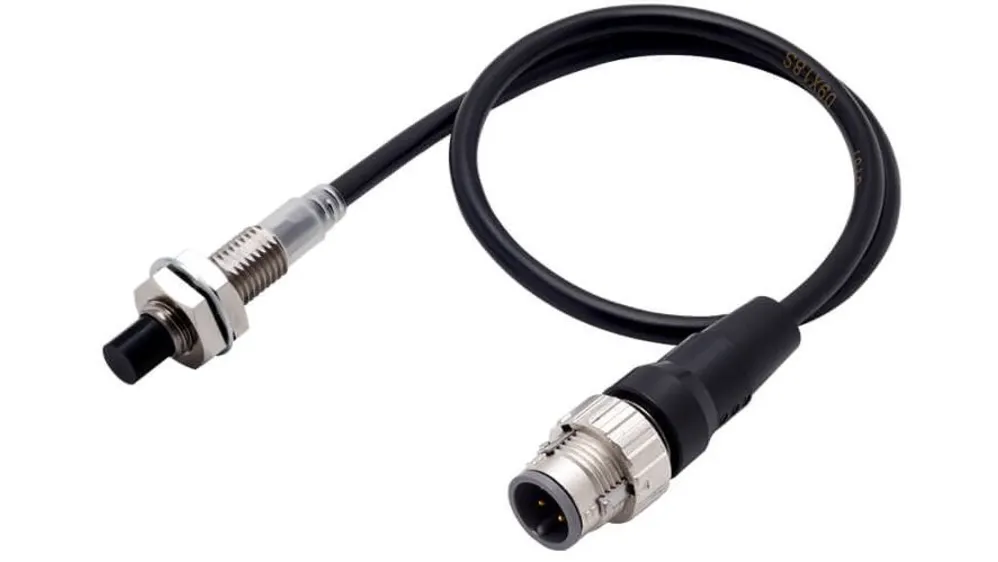
Omron E2E-X6MD18-M1TGJ-T 0.3M Inductive Proximity Sensor
| Feature | Value |
|---|---|
| Sensor Type | Inductive Proximity Sensor |
| Series | E2E NEXT |
| Housing Diameter | M18 |
| Mounting Style | Non-Flush |
| Sensing Distance | 6 mm |
| Output Configuration | DC 2-Wire Normally Open |
| Connection Type | M12 Pigtail Smartclick Connector |
| Cable Length | 0.3 m |
| Housing Material | Stainless Steel |
| Cable Material | Oil-Resistant PVC |
| Protection Rating | IP67 / IP67G / IP69K |
| Thread Length | 35 mm |
| Operating Principle | Electromagnetic Induction |
Reliable object detection is a fundamental requirement in automated production systems. The Omron E2E-X6MD18-M1TGJ-T 0.3M inductive proximity sensor is engineered to detect metallic targets without physical contact, helping automation systems maintain consistent monitoring and positioning functions. Designed as part of the E2E NEXT family, this sensor combines mechanical durability, stable sensing performance, and environmental resistance in a compact cylindrical package.
The Omron E2E-X6MD18-M1TGJ-T Inductive Proximity Sensor is intended for applications where accurate metal detection is required under demanding operating conditions. Its stainless-steel construction and high protection ratings support use in industrial facilities exposed to dust, moisture, vibration, and cleaning procedures.
Technical Description
The sensor features a threaded M18 cylindrical housing and a 6 mm sensing range. It utilizes a DC 2-wire normally open output design, making integration straightforward in many industrial control systems. The non-flush mounting configuration enables installation flexibility while maintaining reliable detection performance.
The integrated M12 pigtail Smartclick connector with a 0.3-meter cable simplifies installation and replacement activities. The oil-resistant PVC cable provides additional protection in manufacturing environments where lubricants and process fluids are present.
The Omron E2E-X6MD18-M1TGJ-T Inductive Proximity Sensor is developed for long operational life in automation equipment where continuous monitoring of metallic machine components is required.
How the Sensor Works
Inductive sensing technology is based on electromagnetic field generation. The sensor continuously creates a high-frequency oscillating magnetic field at its sensing face. When a conductive metallic object enters the sensing zone, eddy currents are generated inside the target material.
These induced currents affect the oscillation amplitude within the sensor circuit. Once the change exceeds a predefined threshold, the output switches state and sends a detection signal to the connected control system.
Because detection is achieved without physical contact, the sensing process eliminates mechanical wear and reduces maintenance requirements associated with traditional contact-based switches.
Primary Areas of Use
- Automated assembly lines
- Industrial conveyor systems
- Material transport equipment
- Machine tool automation
- Robotic positioning systems
- Packaging machinery
- Metal fabrication equipment
- Production monitoring systems
In automated manufacturing facilities, the sensor can verify the presence of metallic parts before processing stages begin. In machine automation systems, it may be used to confirm actuator positions and monitor moving machine elements.
Industrial Application Examples
Robotics and Automated Handling
Industrial robots frequently require accurate feedback regarding gripper position and component presence. The sensor can support robotic handling processes by detecting metal fixtures, pallets, and mechanical positioning elements.
Packaging Equipment
Packaging machines often depend on precise synchronization between mechanical assemblies. The sensor can monitor metallic components involved in indexing, transport, and machine sequencing operations.
Metal Processing Facilities
Manufacturing environments that process sheet metal, fabricated assemblies, or machined parts can use the sensor for workpiece detection and positioning verification before automated operations begin.
Automotive Production Systems
Vehicle manufacturing lines utilize inductive sensing technologies for fixture detection, tooling verification, and metal component monitoring throughout assembly and inspection processes.
Advantages
- Non-contact operation minimizes wear.
- Stable metal detection performance.
- Compact threaded housing simplifies installation.
- High resistance to industrial contaminants.
- Suitable for washdown environments.
- Durable stainless-steel construction.
- Simple integration with industrial control systems.
- Reliable operation in automated production facilities.
Sector-Specific Use Cases
In logistics centers, the sensor can monitor metallic carriers moving through automated transportation systems. In machinery manufacturing, it may be integrated into equipment used for actuator position verification and safety monitoring.
Food processing equipment manufacturers often require sensors capable of tolerating frequent cleaning procedures. The IP69K-rated design supports installation in areas exposed to high-pressure washdown processes.
For engineers seeking additional detection technologies, various Omron sensor series are available for industrial automation and machine-building projects.
Factors to Consider During Selection
- Confirm compatibility with metallic target materials.
- Verify that a 6 mm sensing range is suitable.
- Evaluate available installation space.
- Ensure sufficient clearance for non-flush mounting.
- Review cable routing requirements.
- Confirm environmental protection requirements.
- Check controller compatibility with DC 2-wire outputs.
Frequently Asked Questions
What type of objects can this sensor detect?
The sensor is designed for detecting metallic objects using inductive sensing technology.
What is the rated sensing distance?
The rated sensing distance is 6 mm.
Is physical contact required for detection?
No. Detection occurs through an electromagnetic field without contact with the target.
What output type is provided?
The sensor uses a DC 2-wire normally open output configuration.
Can the sensor operate in wet environments?
Yes. Its IP67, IP67G, and IP69K ratings support operation in demanding industrial environments.
What material is used for the housing?
The housing is constructed from stainless steel.
Where is the Omron E2E-X6MD18-M1TGJ-T Inductive Proximity Sensor commonly installed?
It is frequently installed in automation systems, conveyors, robotic cells, machine tools, and packaging equipment.
What connector type is used?
The sensor includes an M12 pigtail Smartclick connector with a 0.3-meter cable.
Why is non-contact sensing important?
Non-contact detection reduces mechanical wear, improves reliability, and minimizes maintenance requirements.
Can the sensor be used in automotive manufacturing?
Yes. It is suitable for detecting metallic components, fixtures, and tooling within automotive production environments.