
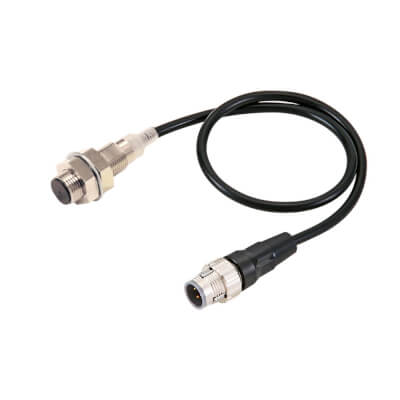
Omron E2E-X6B1T12-M1TJR 0.3M Inductive Proximity Sensor
| Feature | Value |
|---|---|
| Sensor Type | Inductive Proximity Sensor |
| Series | E2E NEXT |
| Housing Size | M12 Cylindrical Threaded |
| Sensing Distance | 6 mm |
| Output Type | PNP NO, 3-Wire |
| Supply Voltage | 10 to 30 VDC |
| Response Frequency | 800 Hz |
| Connection Type | M12 Connector with 0.3 m Robot Cable |
| Housing Material | Nickel-Plated Brass |
| Protection Rating | IP67, IP69K |
| Operating Temperature | -25°C to +70°C |
Industrial automation environments often expose sensors to repetitive motion, vibration, cable flexing, and continuous machine operation. The Omron E2E-X6B1T12-M1TJR 0.3M inductive proximity sensor is designed to provide stable metallic object detection while supporting installations where cable movement and mechanical stress are common. As a member of the E2E NEXT family, this model combines reliable sensing performance with a compact and durable mechanical structure.
The Omron E2E-X6B1T12-M1TJR Inductive Proximity Sensor is frequently integrated into robotic systems, automated handling equipment, transfer units, and manufacturing machinery. Its connectorized design with a robot cable configuration supports applications requiring improved cable durability in dynamic environments.
Technical Description
This sensor utilizes electromagnetic induction to detect metallic objects without direct physical contact. The shielded M12 cylindrical housing allows installation in confined industrial spaces while maintaining controlled sensing characteristics.
The Omron E2E-X6B1T12-M1TJR Inductive Proximity Sensor provides a PNP normally open output and operates from a 10 to 30 VDC supply. The model incorporates a 0.3-meter robot cable and M12 connector arrangement, making it suitable for machinery where repetitive movement may place additional stress on standard cabling.
Working Principle
An inductive proximity sensor generates a high-frequency electromagnetic field from its sensing face. When a conductive metal target enters this field, eddy currents are induced within the object. These currents affect the oscillator circuit inside the sensor.
The sensor electronics monitor these changes continuously. Once the predefined switching threshold is reached, the output changes state and sends a signal to a PLC, controller, industrial PC, or automation network interface.
Because there are no moving mechanical parts involved in the detection process, the sensing method supports long-term operational stability and reduced maintenance requirements.
Key Characteristics
- 6 mm sensing distance
- M12 threaded cylindrical housing
- Shielded sensing structure
- PNP normally open output
- 10–30 VDC operating voltage
- 800 Hz response frequency
- Robot cable design with M12 connector interface
- IP67 and IP69K environmental protection
- Nickel-plated brass housing construction
- Designed for demanding industrial automation environments
Areas of Application
The Omron E2E-X6B1T12-M1TJR Inductive Proximity Sensor can be used in a variety of automation systems where reliable metallic object detection is required.
Robotic Equipment
Industrial robots often require position feedback from grippers, fixtures, tool changers, and moving mechanical assemblies.
Automated Transfer Units
Transfer systems use proximity sensors to verify carrier positions, actuator status, and mechanical alignment during operation.
Assembly Machinery
Production equipment can utilize the sensor for part presence detection and sequence verification.
Motion Control Systems
Position monitoring of metallic machine components can support precise movement control and machine coordination.
Industrial Applications
The Omron E2E-X6B1T12-M1TJR 0.3M Inductive Proximity Sensor is commonly found in:
- Robotic welding cells
- Automotive manufacturing systems
- Automated assembly lines
- Packaging machinery
- Material handling equipment
- Automated warehouse systems
- Machine tool installations
- Electronics production facilities
Engineers interested in additional sensing technologies can explore Omron sensor solutions for related automation applications.
Advantages for Dynamic Installations
- Non-contact metal detection
- Reduced mechanical wear compared to physical switches
- Connectorized installation for easier replacement
- Robot cable design for moving applications
- High environmental protection ratings
- Suitable for continuous industrial operation
- Compact installation footprint
Sector-Specific Examples
Automotive Production Facilities
Robotic assembly stations can use the sensor to monitor fixture positions and metal component presence during production cycles.
Logistics Automation
Automated conveyors and transfer vehicles may rely on proximity sensing to confirm movement positions and equipment status.
Packaging Systems
Packaging equipment can use inductive sensors to monitor metallic actuators and indexing mechanisms during operation.
Selection Considerations
Several technical factors should be evaluated before implementing an inductive proximity sensor in an automation project.
- Required sensing distance
- Output type compatibility
- Target material properties
- Mechanical installation requirements
- Environmental exposure conditions
- Cable movement requirements
- Response speed requirements
- Control system integration needs
The Omron E2E-X6B1T12-M1TJR Inductive Proximity Sensor is especially suitable for applications where repetitive cable movement may occur and where a connectorized installation architecture is preferred.
Frequently Asked Questions
What is the sensing distance of the sensor?
The rated sensing distance is 6 mm.
Omron E2E-X6B1T12-M1TJR What output type does this model use?
It features a PNP normally open output configuration.
What is the operating voltage range?
The sensor operates from 10 to 30 VDC.
Omron E2E-X6B1T12-M1TJR What makes the M1TJR version different?
This version incorporates a robot cable configuration intended for installations involving cable movement and repetitive motion.
Can it be used in harsh industrial environments?
Yes. The sensor is rated IP67 and IP69K for protection against challenging environmental conditions.
Which materials can be detected?
The sensor is designed to detect conductive metallic targets.
What connection method is provided?
The model includes a 0.3-meter robot cable with an M12 connector interface.
Where is this sensor commonly applied?
Typical applications include robotic systems, assembly equipment, transfer machinery, conveyors, and automated manufacturing processes.