
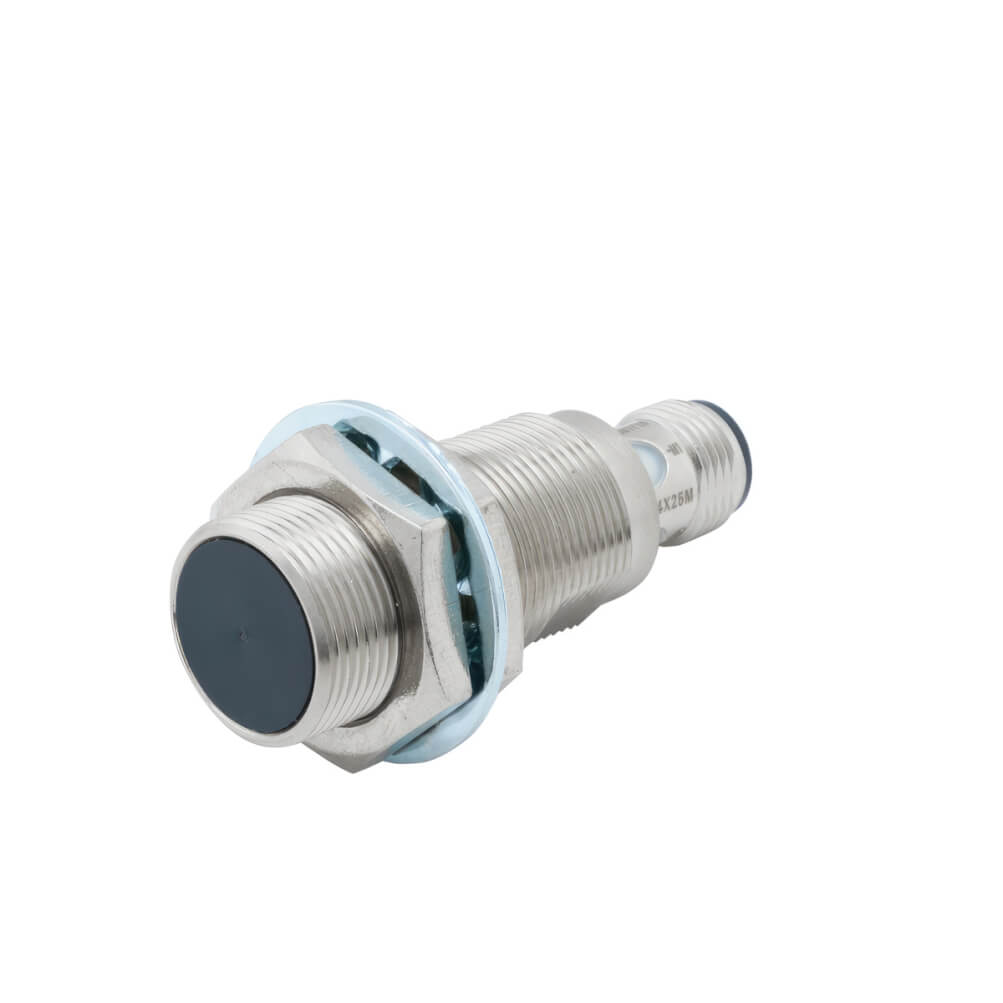
Omron E2E-X5B3D18-M1 Inductive Proximity Sensor
| Feature | Value |
|---|---|
| Product Type | Inductive Proximity Sensor |
| Series | Omron E2E NEXT |
| Sensing Distance | 5 mm |
| Housing Diameter | M18 |
| Mounting Type | Flush Shielded |
| Output Configuration | NPN Normally Open (NO) |
| Wiring Method | 3-Wire DC |
| Supply Voltage | 10 to 30 VDC |
| Response Frequency | 600 Hz |
| Connection Type | M12 Connector |
| Housing Material | Nickel-Plated Brass |
| Protection Rating | IP67 / IP67G / IP69K |
| Operating Temperature | -25°C to +70°C |
| Overall Length | Approx. 55 mm |
Technical Description
In automated production environments, accurate position monitoring and metallic object detection are essential for maintaining process consistency. The Omron E2E-X5B3D18-M1 Inductive Proximity Sensor is designed to provide dependable non-contact detection of metal targets while supporting modern industrial control architectures.
As part of the Omron E2E NEXT product family, this sensor combines a compact M18 threaded housing with advanced sensing electronics and enhanced environmental protection. The device features a 5 mm sensing range and an NPN normally open output, making it suitable for machinery that utilizes sinking input configurations.
The Omron E2E-X5B3D18-M1 Inductive Proximity Sensor is equipped with an M12 connector, enabling efficient installation, simplified maintenance procedures, and quick replacement during equipment servicing.
Working Principle
The sensor operates using electromagnetic induction. An internal oscillator continuously generates a high-frequency electromagnetic field at the sensing surface.
When a metallic object enters the sensing area, eddy currents are induced within the target material. These currents absorb energy from the oscillator and alter the characteristics of the generated field.
The sensor electronics detect these variations and switch the output state once the target reaches the predefined sensing threshold. Since no mechanical contact occurs during detection, the sensing process remains highly reliable over extended operational periods.
This non-contact operating principle makes inductive sensors particularly suitable for applications involving high cycle rates, vibration, and exposure to industrial contaminants.
Omron E2E-X5B3D18-M1 Product Features
- 5 mm sensing distance
- NPN normally open output
- M18 threaded cylindrical housing
- Flush-mounted shielded design
- M12 connector connection
- 3-wire DC operation
- 600 Hz switching frequency
- Nickel-plated brass housing construction
- IP67, IP67G, and IP69K environmental protection
- Designed for industrial automation systems
Typical Usage Areas
The Omron E2E-X5B3D18-M1 Inductive Proximity Sensor is widely used wherever reliable metallic object detection is required to support machine control and automation functions.
- Assembly automation equipment
- Machine tool systems
- Industrial robotics
- Automated transfer lines
- Packaging machinery
- Conveyor systems
- Metal fabrication equipment
- Warehouse automation systems
Its NPN output configuration allows integration into control systems commonly used in various industrial regions and legacy automation platforms.
Industrial Application Examples
Production Line Automation
Manufacturing systems often use proximity sensors to verify component positions before machining, assembly, or inspection operations begin.
Automated Material Transfer
Conveyor and transfer systems rely on inductive sensors to detect metallic carriers, positioning elements, and moving mechanical assemblies.
Robotic Fixture Verification
Robotic workstations frequently require confirmation of fixture positions before automated handling operations can proceed.
Packaging Equipment Monitoring
Packaging machines use sensors to monitor indexing mechanisms, actuator positions, and moving metal components throughout the production cycle.
Advantages in Automation Projects
The Omron E2E-X5B3D18-M1 Inductive Proximity Sensor provides several operational advantages for industrial engineers and machine builders.
- Non-contact sensing reduces mechanical wear
- Stable operation in demanding industrial environments
- Connectorized design simplifies replacement procedures
- Reliable detection of metallic objects
- Resistance to moisture, oils, and cleaning processes
- Suitable for continuous-duty automation applications
Its combination of environmental protection and stable sensing performance makes the sensor appropriate for installations where reliability and uptime are important operational objectives.
Omron E2E-X5B3D18-M1 Factors to Evaluate During Sensor Selection
Proper sensor selection should be based on application-specific technical requirements and installation conditions.
- Required sensing distance
- NPN input compatibility
- Available mounting space
- Target material characteristics
- Environmental exposure levels
- Connector and cable requirements
- Required switching frequency
Careful evaluation of these factors helps ensure consistent sensing performance throughout the operational lifecycle of the equipment.
Additional Omron Sensing Technologies
Engineers developing advanced automation systems can explore Omron sensör serileri that include photoelectric sensors, fiber optic systems, displacement sensors, vision solutions, and industrial measurement technologies.
Frequently Asked Questions
1. What type of objects can the sensor detect?
The sensor is designed to detect metallic targets through inductive sensing technology.
2. What is the sensing distance of this model?
The rated sensing distance is 5 mm.
3. What output configuration does the sensor provide?
The device features an NPN normally open output.
4. What electrical supply is required?
The sensor operates from a 10 to 30 VDC power source.
5. Does the sensor support flush mounting?
Yes. The shielded design allows flush installation in metallic mounting structures.
6. Which connection type is used?
The sensor uses an M12 connector interface.
7. Is it suitable for harsh industrial environments?
Yes. IP67, IP67G, and IP69K ratings support operation in environments exposed to water, oil, and cleaning procedures.
8. Which industries commonly use this sensor?
The sensor is commonly used in manufacturing, robotics, packaging, logistics automation, machine building, and metal processing industries.