
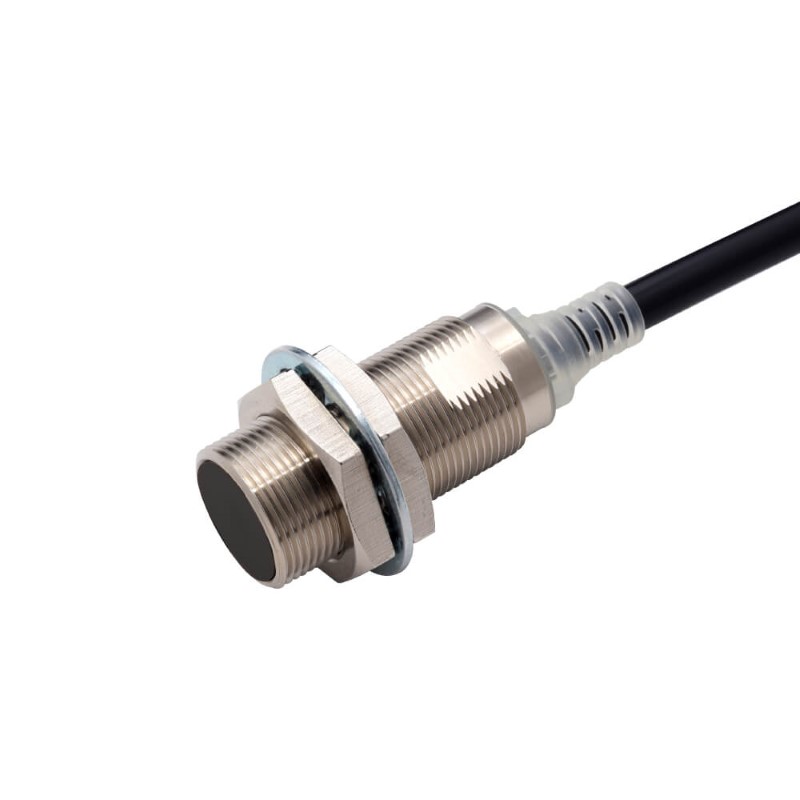
Omron E2E-X5B2L18 5M Inductive Proximity Sensor
| Feature | Value |
|---|---|
| Product Type | Inductive Proximity Sensor |
| Series | Omron E2E NEXT |
| Sensing Distance | 5 mm |
| Housing Size | M18 Cylindrical Threaded |
| Mounting Style | Flush Mount |
| Output Configuration | PNP Normally Open (NO) |
| Wiring Type | 3-Wire DC |
| Supply Voltage | 10 to 30 VDC |
| Response Frequency | 600 Hz |
| Cable Length | 5 m |
| Housing Material | Nickel-Plated Brass |
| Protection Degree | IP67 / IP67G / IP69K |
| Operating Temperature | -25°C to +70°C |
| Connection Method | Pre-wired Cable |
Technical Description
Industrial automation systems often require reliable position feedback and object detection over extended installation distances. The Omron E2E-X5B2L18 Inductive Proximity Sensor addresses these requirements through a non-contact sensing design combined with a factory-installed 5-meter cable, making it suitable for machines where control cabinets or I/O modules are positioned away from the sensing location.
The sensor belongs to the Omron E2E NEXT family, a series developed to provide stable sensing performance in demanding industrial environments. Featuring a 5 mm sensing range, shielded construction, and PNP normally open output, the sensor can be integrated into various automation architectures including PLC-controlled machinery, conveyor systems, and manufacturing equipment.
The Omron E2E-X5B2L18 Inductive Proximity Sensor is specifically designed for detecting metallic objects without physical contact, reducing wear and minimizing maintenance requirements compared with mechanical switches.
Working Principle
Inductive proximity sensors operate using an electromagnetic field generated at the sensing face. During operation, an internal oscillator creates a high-frequency magnetic field extending from the front surface of the sensor.
When a metallic object enters this field, electrical eddy currents are induced in the target material. These currents absorb energy from the oscillator and alter the amplitude of the electromagnetic field.
The sensor continuously monitors these changes. Once the target reaches the switching threshold, the output changes state and provides a signal to the connected control system.
Because the detection process does not require direct physical contact, sensing performance remains consistent even during high-cycle industrial operation.
Key Features
- 5 mm rated sensing distance
- PNP normally open switching output
- Flush-mounted shielded construction
- M18 threaded cylindrical housing
- Integrated 5-meter cable connection
- 600 Hz switching frequency
- 10 to 30 VDC operating voltage
- Nickel-plated brass housing
- IP67, IP67G, and IP69K protection ratings
- Suitable for harsh industrial environments
Omron E2E-X5B2L18 5M Usage Areas
The Omron E2E-X5B2L18 Inductive Proximity Sensor is commonly used in industrial processes where metallic targets must be monitored accurately and repeatedly.
- Production automation systems
- Conveyor transportation equipment
- Packaging machinery
- Industrial robotic cells
- Automated warehouse systems
- Assembly line equipment
- Metalworking machines
- Material handling installations
Its extended cable length can simplify installation in large equipment layouts where sensors are located far from control enclosures.
Industrial Applications
Automated Packaging Lines
Packaging systems frequently require monitoring of moving metal components, guide mechanisms, and machine positions. Inductive sensors provide switching signals that help coordinate machine functions.
Factory Conveyors
Metal pallets, carriers, and transfer devices can be detected to support material flow control and product tracking across production lines.
Robotic Workstations
Sensors can verify fixture positions and mechanical stop locations before robotic operations are executed.
Omron E2E-X5B2L18 5M Manufacturing Equipment
Machine builders often integrate proximity sensors into equipment for position feedback, cycle monitoring, and actuator confirmation.
Advantages in Engineering Applications
Several design characteristics make this sensor suitable for demanding industrial environments.
- Non-contact sensing reduces mechanical wear
- Stable detection performance in metal installations
- Long cable length supports flexible machine layouts
- Protection against water, oil, and industrial contaminants
- High durability under vibration and repetitive operation
- Suitable for continuous automation processes
The Omron E2E-X5B2L18 Inductive Proximity Sensor is often selected when engineers require reliable metallic target detection while minimizing maintenance-related downtime.
Factors to Consider During Product Selection
Proper sensor selection requires evaluation of both electrical and mechanical installation requirements.
- Verify the required sensing distance
- Confirm compatibility with PNP control inputs
- Ensure sufficient installation space for M18 mounting
- Evaluate environmental exposure conditions
- Consider required cable routing distances
- Review switching frequency requirements
- Assess target size and material composition
Environmental ratings should also be considered when sensors are exposed to washdown procedures, coolant systems, or outdoor conditions.
Additional Omron Sensor Options
Engineers seeking alternative sensing technologies can explore Omron sensör ürünleri covering inductive, photoelectric, fiber optic, laser, and displacement measurement applications.
Frequently Asked Questions
1. What type of object can this sensor detect?
The sensor is designed to detect metallic objects using inductive sensing technology.
2. What is the rated sensing distance?
The sensing distance is 5 mm under standard conditions.
3. What output configuration is provided?
The sensor features a PNP normally open output.
4. How long is the cable?
This version includes a factory-installed 5-meter cable.
5. Can it be mounted flush with metal surfaces?
Yes. The sensor is a shielded flush-mount model.
6. Is the sensor suitable for washdown environments?
Yes. It provides IP67, IP67G, and IP69K environmental protection.
7. What voltage range does it support?
The sensor operates from 10 to 30 VDC.
8. Which industries commonly use this product?
It is widely used in manufacturing, logistics, packaging, machine building, robotics, and material handling applications.