
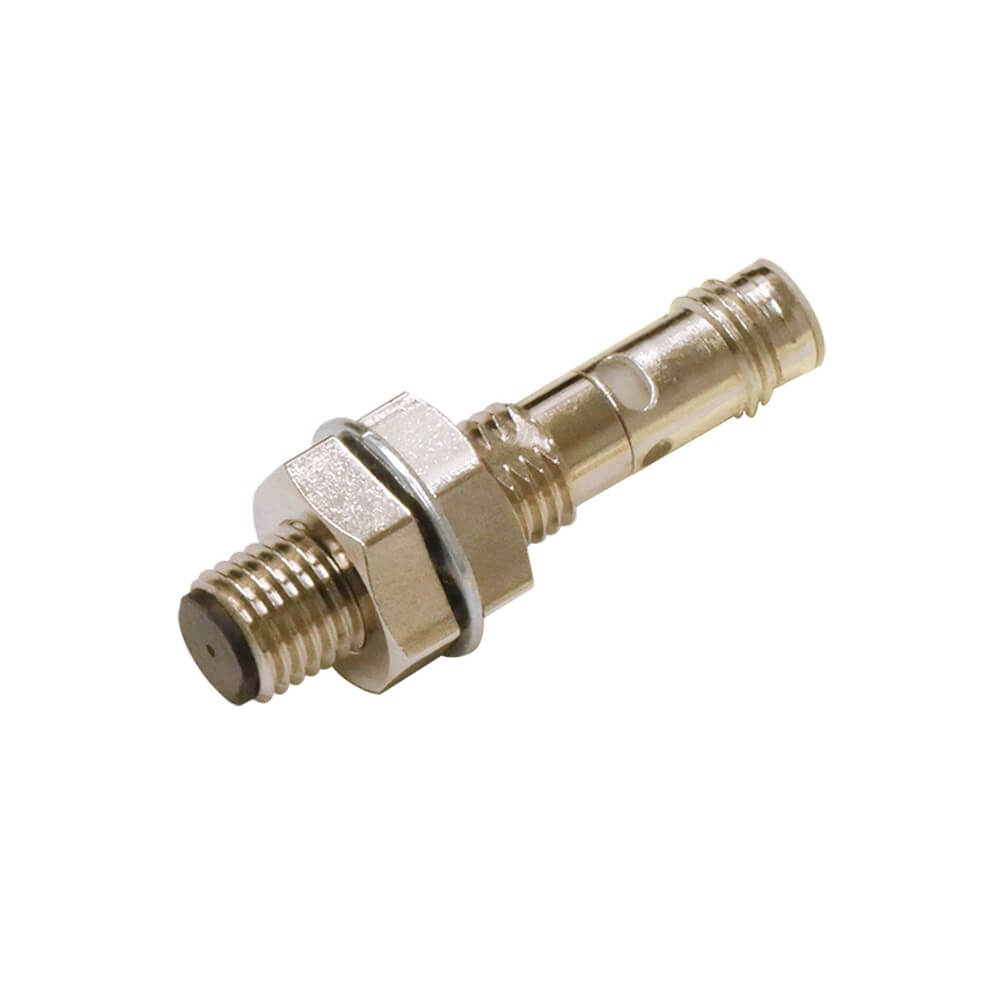
Omron E2E-X4MC18-M5 Inductive Proximity Sensor
| Feature | Value |
|---|---|
| Sensor Type | Inductive Proximity Sensor |
| Series | E2E NEXT |
| Housing Diameter | M8 |
| Mounting Method | Non-flush (Unshielded) |
| Sensing Distance | 4 mm |
| Output Configuration | NPN Normally Open |
| Connection Type | M12 Connector with 5 m Cable |
| Supply Voltage | 10 to 30 VDC |
| Response Frequency | 1 kHz |
| Housing Material | Stainless Steel |
| Protection Rating | IP67 / IP67G / IP69K |
| Operating Temperature | -40°C to +85°C |
| Short-Circuit Protection | Yes |
| Reverse Polarity Protection | Yes |
| Compliance | CE, UKCA |
Technical Description
Reliable metal object detection is a fundamental requirement in many automated production environments. The Omron E2E-X4MC18-M5 Inductive Proximity Sensor is engineered to provide non-contact sensing of metallic targets while maintaining consistent performance across a broad range of industrial applications.
This model is part of Omron’s E2E NEXT product family and incorporates a compact M8 cylindrical housing with a nominal sensing distance of 4 mm. The sensor combines a connector-based design with a 5-meter cable assembly, making it suitable for installations where additional wiring reach is necessary between field devices and control equipment.
The Omron E2E-X4MC18-M5 Inductive Proximity Sensor is designed for machine builders, system integrators, and maintenance engineers seeking dependable metal detection in industrial automation systems.
Working Principle
The sensor operates using electromagnetic induction. An internal oscillator generates a high-frequency magnetic field at the sensing surface. When a metallic object enters this field, induced eddy currents are generated within the target.
These eddy currents absorb energy from the oscillator circuit. The sensor electronics continuously monitor these changes and switch the output once a predefined threshold is reached.
Because there is no mechanical contact between the sensor and the target, the sensing process minimizes wear and allows continuous operation in repetitive industrial processes. The Omron E2E-X4MC18-M5 Inductive Proximity Sensor can therefore be integrated into applications requiring high cycle counts and reliable switching behavior.
Design Characteristics
The sensor utilizes a stainless-steel housing that supports operation in environments exposed to dust, moisture, oil, and vibration. Its non-flush construction allows a greater sensing range compared to many shielded sensors of equivalent size.
- Compact M8 threaded housing
- 4 mm sensing capability
- NPN normally open output
- Extended 5-meter connection cable
- M12 connector interface
- Industrial-grade environmental protection
- Integrated protection circuits
- Wide operating temperature range
Application Areas
The sensor can be used in various automation environments where metallic targets need to be detected accurately and repeatedly.
- Automated assembly systems
- Industrial conveyors
- Machine tool equipment
- Packaging machinery
- Robotic handling systems
- Transfer mechanisms
- Material processing equipment
- Production line monitoring
The Omron E2E-X4MC18-M5 Inductive Proximity Sensor is often selected when cable routing distances exceed those supported by shorter connector configurations.
Industrial Applications
In automated assembly environments, the sensor can verify component presence before the next manufacturing stage begins. Packaging equipment may use the sensor to monitor moving machine elements and indexing systems.
Robotic workstations can integrate the sensor to verify fixture positions and detect metallic tooling components. In machine tool applications, the sensor may be used for position monitoring of slides, actuators, and safety-related machine elements.
Warehouse automation systems can utilize inductive sensing technology to identify transport carriers, metallic positioning elements, and automated transfer devices.
Engineers interested in related industrial sensing technologies can review Omron sensor products for additional automation solutions.
Advantages
- Reliable detection of metallic objects
- Non-contact operating method
- Long cable length for flexible installation
- Resistance to industrial contaminants
- Compact housing dimensions
- Reduced maintenance requirements
- High environmental protection ratings
- Suitable for demanding production environments
Sector-Based Usage Examples
Automotive Production
The sensor can monitor the position of assembly fixtures and transfer systems used in manufacturing operations.
Food Processing Equipment
Its environmental protection ratings support installation on machinery exposed to washdown procedures and moisture.
Machine Manufacturing
Equipment builders frequently use inductive sensors to monitor moving machine components and actuator positions.
Distribution Centers
Automated transport systems can use the sensor for carrier positioning and process verification.
Omron E2E-X4MC18-M5 Important Selection Considerations
Before selecting an inductive proximity sensor, engineers should evaluate the requirements of the intended application.
- Target material characteristics
- Required sensing distance
- Environmental conditions
- Installation space limitations
- Electrical interface requirements
- Cable length requirements
- Protection rating expectations
- Maintenance accessibility
The Omron E2E-X4MC18-M5 Inductive Proximity Sensor may be particularly suitable where extended cable reach and compact installation dimensions are required simultaneously.
Frequently Asked Questions
What type of objects can this sensor detect?
The sensor is designed to detect metallic objects using inductive sensing technology.
What is the rated sensing distance?
The nominal sensing distance is 4 mm.
What output configuration does the sensor use?
It provides an NPN normally open output.
How long is the connection cable?
This version includes a 5-meter cable assembly.
Can the sensor be used in washdown environments?
Yes. The sensor supports IP67, IP67G, and IP69K protection ratings.
What voltage range is supported?
The operating voltage range is 10 to 30 VDC.
Does the sensor require physical contact with the target?
No. Detection occurs through an electromagnetic field.
What industries commonly use this sensor?
Automation, packaging, logistics, machinery manufacturing, and metal processing industries commonly use inductive sensors.
What housing material is used?
The housing is manufactured from stainless steel.
Can the sensor be connected to PLC systems?
Yes. It is designed for integration with industrial control systems and PLC inputs.