
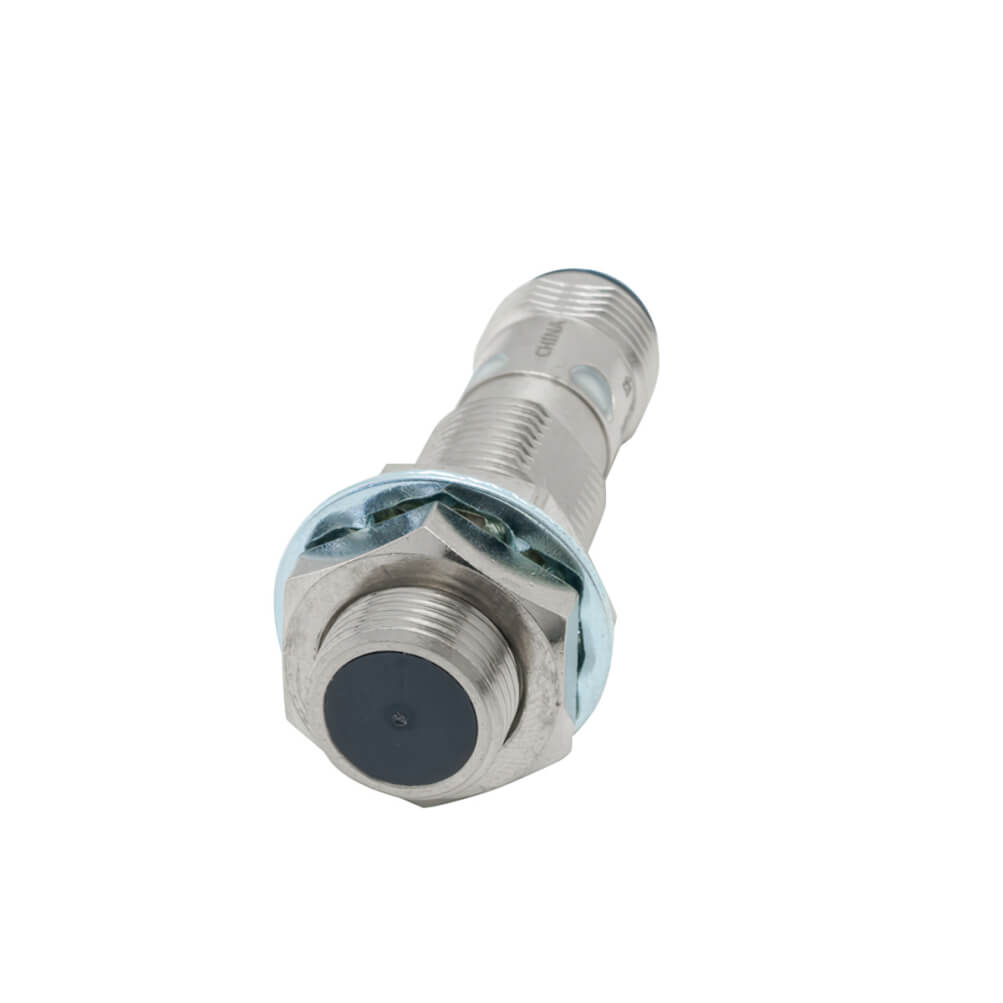
Omron E2E-X4B212 5M Inductive Proximity Sensor
| Feature | Value |
|---|---|
| Manufacturer | Omron |
| Series | E2E NEXT |
| Sensor Type | Inductive Proximity Sensor |
| Sensing Distance | 4 mm |
| Housing Diameter | M12 |
| Output Type | PNP Normally Closed (NC) |
| Supply Voltage | 10 to 30 VDC |
| Cable Length | 5 m |
| Response Frequency | 1 kHz |
| Housing Material | Nickel-Plated Brass |
| Protection Rating | IP67 / IP69K |
| Operating Temperature | -25°C to +70°C |
The Omron E2E-X4B212 5M Inductive Proximity Sensor is designed for dependable detection of metallic objects in automated industrial environments. Featuring a 5-meter integrated cable, this model supports installations where the sensor must be mounted at a greater distance from the control cabinet or I/O interface. The sensor combines a compact threaded housing with stable sensing characteristics and high environmental protection ratings.
Technical Description
The Omron E2E-X4B212 5M Inductive Proximity Sensor belongs to the E2E NEXT series of inductive sensors. It uses electromagnetic induction technology to detect metallic targets without direct physical contact. This detection method eliminates wear associated with mechanical switches and supports long-term operation in automated systems.
The sensor incorporates a shielded sensing structure that provides a rated sensing distance of 4 mm. Its PNP normally closed output configuration makes it suitable for applications where continuous signal monitoring is required.
Operating Principle
The sensor generates a high-frequency electromagnetic field through its internal coil. When a conductive metallic object enters this field, eddy currents are generated within the target. These currents alter the oscillation characteristics of the sensor circuit. The internal electronics recognize this change and switch the output state accordingly.
The Omron E2E-X4B212 5M Inductive Proximity Sensor provides repeatable detection performance even in applications involving frequent machine cycles and continuous operation.
Applications in Automation Systems
Inductive proximity sensors are widely used throughout industrial automation because of their reliability and resistance to environmental influences. The Omron E2E-X4B212 5M Inductive Proximity Sensor is commonly installed in machinery where metallic component detection is required.
- Automated conveyor monitoring
- Position verification systems
- Machine tool equipment
- Packaging machinery
- Automated assembly stations
- Transfer and indexing mechanisms
- Material handling equipment
- Industrial robotics
Industrial Applications
Logistics and Distribution Systems
Conveyor-based logistics systems use inductive sensors to verify pallet stops, guide positions, and transfer mechanisms. Reliable object detection contributes to synchronized material movement throughout the facility.
Packaging Lines
Packaging equipment often relies on proximity sensors to monitor machine positions, detect rotating components, and confirm mechanical movements during filling and sealing processes.
Metal Processing Equipment
Metal fabrication systems require accurate position feedback for clamps, fixtures, and moving machine elements. The sensor provides stable detection under repetitive operating conditions.
Automated Warehouses
Storage and retrieval systems frequently use inductive sensors to detect carriers, positioning stops, and shuttle mechanisms within automated storage environments.
Omron E2E-X4B212 5M Advantages
- Non-contact sensing technology
- Reduced maintenance requirements
- Resistance to vibration and mechanical wear
- Extended cable length for flexible installation
- Suitable for demanding industrial environments
- Reliable switching performance
- High environmental protection rating
- Compatible with modern PLC systems
The Omron E2E-X4B212 5M Inductive Proximity Sensor is particularly useful in installations where longer cable routing is required between field devices and control panels.
Omron E2E-X4B212 5M Engineers seeking additional sensing technologies can review Omron sensor series for related automation applications.
Sector-Specific Use Cases
- Monitoring carrier positions in automated warehouses
- Detecting metal fixtures on production lines
- Verifying actuator travel in packaging equipment
- Position sensing in pallet transfer systems
- Monitoring indexing tables in assembly machinery
- Detecting machine component movement in manufacturing cells
Important Selection Considerations
Before selecting an inductive proximity sensor, system designers should evaluate the operating environment and technical requirements.
- Required sensing distance
- Available mounting space
- Output configuration requirements
- Cable routing distance
- Environmental protection needs
- Target material characteristics
- Machine cycle frequency
- Control system compatibility
Proper installation and alignment contribute significantly to reliable sensing performance and long operational life.
Omron E2E-X4B212 5M Frequently Asked Questions
What is the sensing distance of this sensor?
The rated sensing distance is 4 mm.
What output configuration does it provide?
The sensor features a PNP normally closed output.
What voltage range is supported?
It operates from 10 to 30 VDC.
Why does this model have a 5-meter cable?
The extended cable allows installation farther from control cabinets or PLC input modules.
Can it detect non-metallic materials?
No. Inductive sensors are intended for metallic target detection.
What environmental protection ratings are available?
The sensor is rated IP67 and IP69K.
Where is the Omron E2E-X4B212 5M Inductive Proximity Sensor typically used?
It is commonly used in logistics systems, packaging equipment, assembly machinery, and industrial automation applications.
What maintenance is required?
Routine inspection of mounting integrity, cable condition, and sensing face cleanliness is generally sufficient.
Can the sensor be used in washdown environments?
Yes. Its IP69K rating supports operation in demanding cleaning environments.
What housing material is used?
The sensor uses a nickel-plated brass housing for mechanical durability and corrosion resistance.