
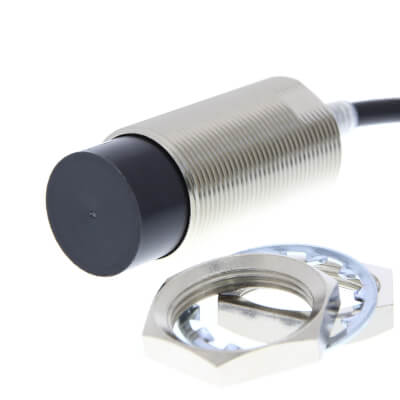
Omron E2E-X40MD2L30-R 5M Inductive Proximity Sensor
| Feature | Value |
|---|---|
| Sensor Type | Inductive Proximity Sensor |
| Series | E2E NEXT |
| Housing Size | M30 |
| Sensing Distance | 40 mm |
| Mounting Type | Non-flush |
| Output Type | DC 2-wire |
| Operation Mode | NC |
| Supply Voltage | 10 to 30 VDC |
| Housing Material | Nickel-plated Brass |
| Cable Length | 5 m Robot Cable |
| Thread Length | 50 mm |
| Overall Length | 82.3 mm |
| Protection Rating | IP67 / IP67G / IP69K |
The Omron E2E-X40MD2L30-R 5M Inductive Proximity Sensor is designed for reliable non-contact detection of metallic targets in industrial automation systems. As part of the E2E NEXT Series, this sensor combines long sensing distance capability with a durable mechanical design suitable for demanding production environments. The model incorporates a bending-resistant robot cable, making it particularly suitable for applications involving repetitive motion and cable movement.
Technical Overview
The Omron E2E-X40MD2L30-R 5M Inductive Proximity Sensor features a 40 mm sensing distance within an M30 cylindrical housing. Its nickel-plated brass body provides mechanical durability while maintaining resistance against industrial contaminants and harsh operating conditions.
The sensor uses a DC 2-wire configuration and operates in normally closed (NC) mode. The integrated oil-resistant PVC cable supports installation in environments where cutting fluids, lubricants, or machine oils are present.
The flexible robot cable version is engineered to withstand repeated bending cycles commonly encountered in robotic handling systems, automated transfer units, and moving machine assemblies.
Working Principle
The Omron E2E-X40MD2L30-R 5M Inductive Proximity Sensor operates by generating a high-frequency electromagnetic field at the sensing face. When a metallic object enters this field, eddy currents are induced within the target material.
These induced currents alter the oscillation characteristics of the sensor circuit. The internal electronics detect this change and switch the output state accordingly. Because the sensor relies on electromagnetic interaction rather than physical contact, wear-related mechanical failures are minimized.
This operating principle makes inductive sensing particularly suitable for detecting steel, iron, and other conductive metallic materials in automated machinery.
Typical Applications
- Robotic material handling systems
- Automated assembly lines
- Conveyor positioning systems
- Packaging machinery
- Automotive body production equipment
- Transfer and indexing mechanisms
- Metalworking machines
- Industrial storage systems
In applications where cable movement occurs continuously, the robot cable design helps improve installation reliability while reducing maintenance requirements.
Industrial Applications
Automotive Manufacturing
Production facilities frequently use the Omron E2E-X40MD2L30-R 5M Inductive Proximity Sensor for detecting metal fixtures, body components, and automated transfer positions. The flexible cable design is particularly valuable on robotic welding cells and automated handling stations.
Machine Tool Industry
Metalworking equipment often requires robust sensing devices capable of operating near cutting fluids and lubricants. The oil-resistant cable and high protection ratings support reliable operation in these environments.
Material Handling Systems
Automated storage and retrieval systems utilize proximity sensors to monitor pallet positioning, carriage movement, and transfer station alignment. The long sensing distance provides installation flexibility where mechanical tolerances vary.
Advantages
- Long 40 mm sensing distance
- Robot cable designed for repeated flexing
- IP67, IP67G, and IP69K environmental protection
- Oil-resistant cable construction
- Non-contact detection technology
- Nickel-plated brass housing for mechanical durability
- Suitable for industrial automation systems
- Compatible with various metallic target materials
The Omron E2E-X40MD2L30-R 5M Inductive Proximity Sensor is frequently selected where long sensing range and cable durability are important operational requirements.
Sector-Specific Usage Examples
- Detection of steel carriers in automotive assembly lines
- Monitoring transfer positions in robotic palletizing systems
- Position verification in automated warehouse equipment
- Metal part detection in stamping operations
- End-position sensing in industrial actuators
- Conveyor stop-point monitoring in logistics centers
Considerations When Selecting This Sensor
Before selecting the Omron E2E-X40MD2L30-R 5M Inductive Proximity Sensor, engineers should evaluate the available installation space, required sensing distance, target material characteristics, environmental exposure, and cable routing requirements.
Because this model uses a non-flush mounting design, sufficient clearance around the sensing surface should be maintained according to manufacturer recommendations. In moving equipment, the robot cable variant may offer improved service life compared to standard cable configurations.
For additional sensor options and related technologies, explore Omron sensor products.
Frequently Asked Questions
What is the sensing distance of this sensor?
The nominal sensing distance is 40 mm.
What type of targets can it detect?
The sensor is designed for detecting metallic objects through inductive sensing technology.
What does NC operation mean?
NC stands for normally closed, meaning the output state changes when a target enters the sensing zone.
Why does this model include an R designation?
The R version includes a bending-resistant robot cable intended for applications involving continuous cable movement.
Can it operate in wet environments?
Yes. The sensor supports IP67, IP67G, and IP69K protection ratings.
What housing material is used?
The body is constructed from nickel-plated brass.
Is the sensor suitable for robotic systems?
Yes. The flexible robot cable is specifically intended for robotic and dynamic machinery installations.
What supply voltage does the sensor require?
The sensor operates from a 10 to 30 VDC power supply.