
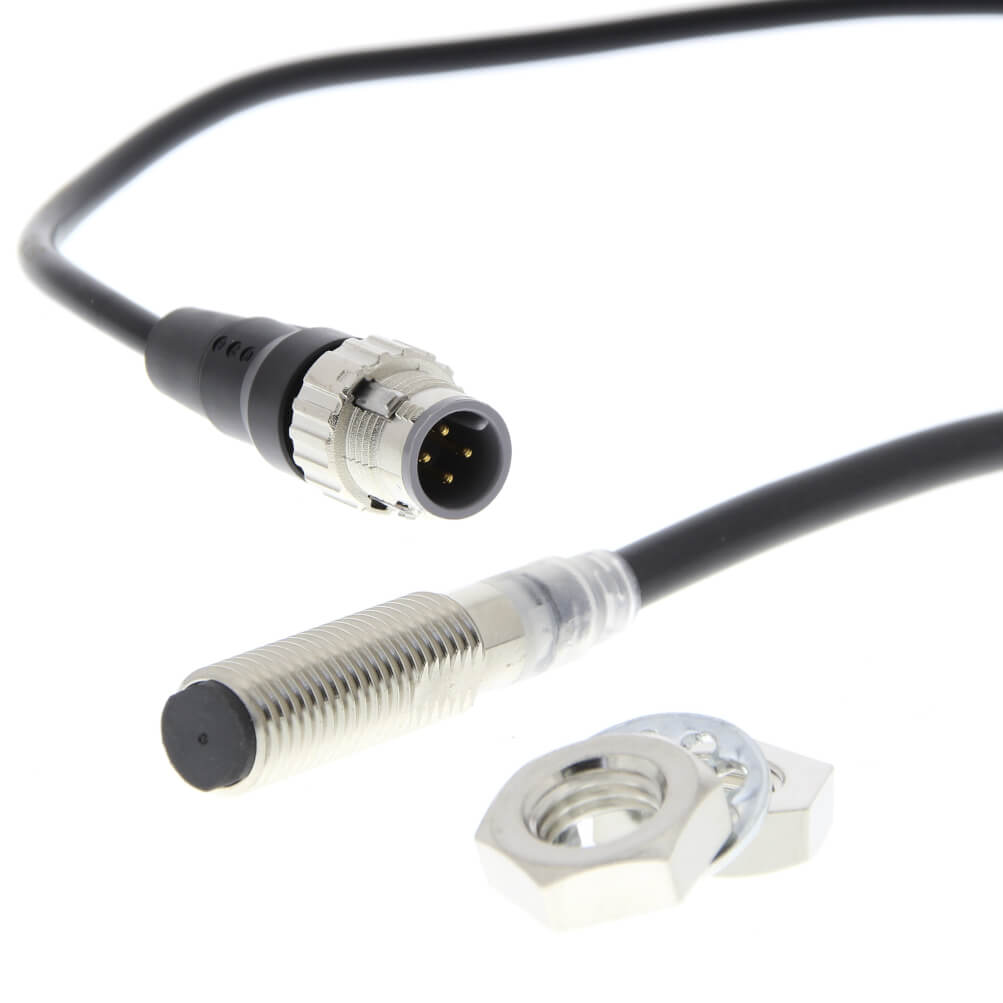
Omron E2E-X3D18-M1TGJ-T 0.3M Inductive Proximity Sensor
| Feature | Value |
|---|---|
| Sensor Type | Inductive Proximity Sensor |
| Sensing Distance | 3 mm |
| Housing Diameter | M8 |
| Housing Style | Threaded Cylindrical |
| Mounting | Shielded |
| Output Type | Normally Open (NO) |
| Electrical Configuration | DC 2-Wire |
| Supply Voltage | 10 to 30 VDC |
| Connection | M12 Smartclick Connector with 0.3 m Cable |
| Response Frequency | 350 Hz |
| Housing Material | Nickel-Plated Brass |
| Protection Rating | IP67, IP67G, IP69K |
| Operating Temperature | -25°C to +70°C |
| Protection Functions | Short-Circuit Protection |
The Omron E2E-X3D18-M1TGJ-T 0.3M is an inductive proximity sensor designed for reliable metallic target detection in industrial automation systems. Built within the E2E NEXT sensor family, this model combines compact dimensions, stable sensing performance, and robust environmental protection. It is commonly integrated into automated machinery, material transfer systems, assembly equipment, and manufacturing cells where accurate object detection is essential.
The sensor utilizes non-contact inductive sensing technology, allowing metallic objects to be detected without physical interaction. This operating principle reduces mechanical wear and supports long service life in continuously operating production environments.
Technical Description
The Omron E2E-X3D18-M1TGJ-T Inductive Proximity Sensor is equipped with a shielded sensing structure and a 3 mm sensing distance. The shielded design helps reduce interference from surrounding metallic components, making installation easier in compact machinery.
The sensor operates from a 10 to 30 VDC supply and uses a two-wire electrical configuration. Its M12 Smartclick connection system simplifies wiring and allows efficient replacement during maintenance procedures.
A nickel-plated brass housing protects the internal electronics against mechanical stress, vibration, oils, and contaminants commonly encountered in industrial facilities.
Omron E2E-X3D18-M1TGJ-T Operating Principle
The sensing mechanism is based on electromagnetic field generation. An oscillator circuit continuously produces a high-frequency magnetic field at the sensing face.
When a conductive metallic target enters the detection zone, eddy currents are induced within the target material. These currents absorb energy from the electromagnetic field and modify the oscillator characteristics.
The internal electronics monitor these changes and activate the output once the switching threshold is reached. Because no physical contact occurs, the sensor can perform millions of switching cycles without mechanical deterioration.
The Omron E2E-X3D18-M1TGJ-T Inductive Proximity Sensor is particularly suitable for applications requiring repeatable switching accuracy and stable long-term operation.
Omron E2E-X3D18-M1TGJ-T Typical Applications
Machine Position Monitoring
The sensor can confirm the location of moving machine components, ensuring correct sequencing within automated equipment.
Transfer Systems
Conveyor and transfer mechanisms often rely on inductive sensing to identify pallet positions, carriers, and metallic transport fixtures.
Assembly Automation
Automated production lines use proximity sensors to verify part presence before initiating assembly operations.
Robotic Equipment
Industrial robots may use sensor feedback to verify fixture positions and confirm tool status before executing programmed movements.
Industrial Applications
- Automotive production systems
- Packaging machinery
- Factory automation equipment
- Electronic assembly lines
- Material handling systems
- Metal processing machinery
- Food manufacturing equipment
- Automated storage systems
Within automated manufacturing environments, the sensor can be used to detect mechanical reference points, monitor machine positions, and support process control functions.
Advantages
- Compact M8 housing for restricted installation spaces.
- Reliable 3 mm sensing distance.
- High resistance to industrial contaminants.
- Non-contact detection technology.
- Integrated protection circuitry.
- Suitable for high-cycle automation processes.
- Multiple industrial protection ratings.
- Simplified maintenance through Smartclick connectivity.
The Omron E2E-X3D18-M1TGJ-T Inductive Proximity Sensor is engineered to maintain stable operation in environments exposed to washdown procedures, vibration, and frequent production cycles.
Sector-Specific Examples
Automotive Welding Cells
The sensor can verify fixture positions before robotic welding operations begin.
Packaging Equipment
Packaging machines use position detection to coordinate sealing, labeling, and indexing mechanisms.
Electronics Manufacturing
Automated handling systems can utilize proximity sensing to monitor carriers transporting electronic assemblies.
Metal Fabrication
Production equipment may rely on the sensor to detect tooling positions and machine reference points.
Selection Considerations
- Required sensing range.
- Available installation space.
- Target material composition.
- Electrical interface requirements.
- Environmental exposure levels.
- Ingress protection requirements.
- Connection preferences.
- Machine operating frequency.
For applications requiring compact installation and dependable metallic target detection, this model provides a balanced combination of sensing performance and environmental durability.
Additional sensor families can be explored through Omron sensor series.
Frequently Asked Questions
What is the sensing distance of this sensor?
The rated sensing distance is 3 mm.
What type of objects can it detect?
The sensor is designed to detect metallic objects through inductive sensing technology.
Does it require physical contact with the target?
No. Detection occurs through an electromagnetic field without direct contact.
What voltage range is supported?
The sensor operates between 10 and 30 VDC.
Is the sensor suitable for washdown environments?
Yes. The IP67, IP67G, and IP69K ratings support use in demanding industrial environments.
What housing material is used?
The housing is manufactured from nickel-plated brass.
Can the sensor be used in automated production lines?
Yes. It is commonly used in assembly, packaging, handling, and manufacturing systems.
What connection system does it use?
The model utilizes an M12 Smartclick connector with a 0.3 m cable.
Does the sensor include electrical protection?
Yes. Integrated short-circuit protection is included.