
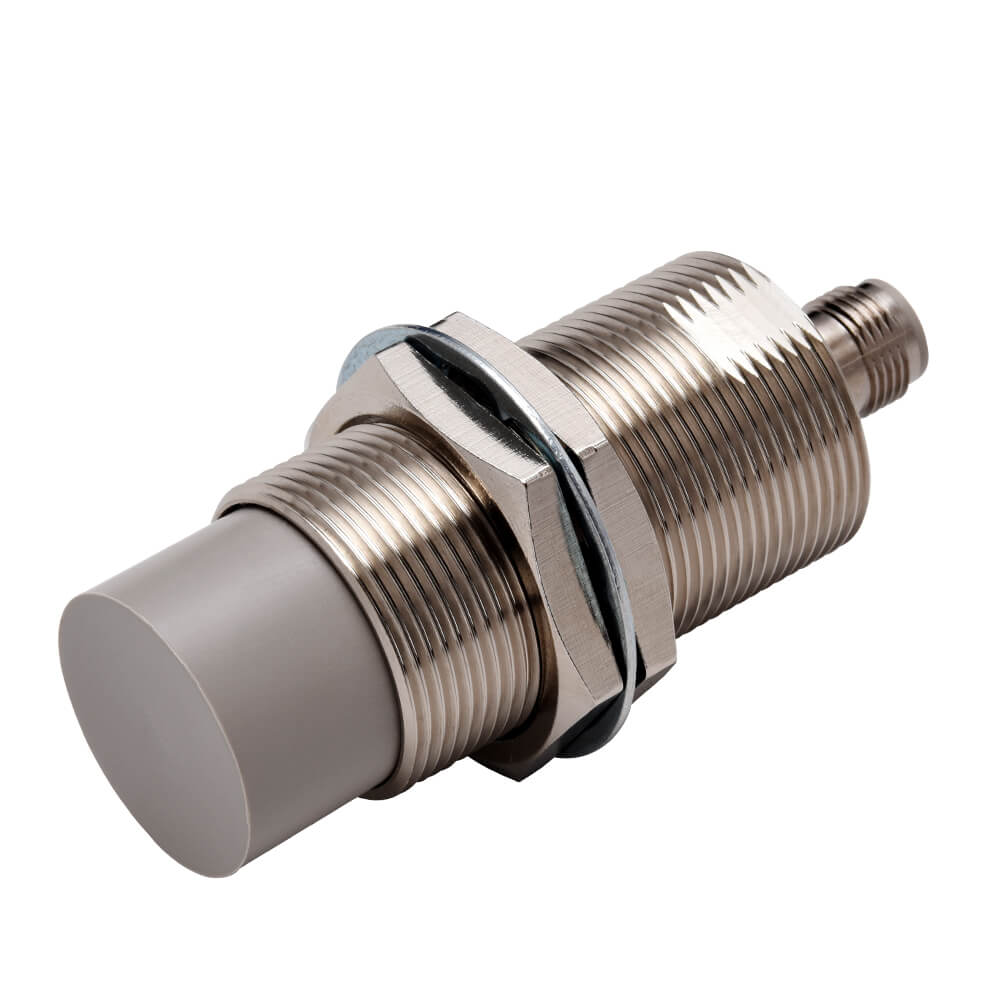
Omron E2E-X30MC2L30-M1 Inductive Proximity Sensor
| Feature | Value |
|---|---|
| Sensor Type | Inductive Proximity Sensor |
| Series | E2E NEXT |
| Sensing Distance | 30 mm |
| Housing Diameter | M30 |
| Mounting Type | Non-flush (Unshielded) |
| Output Type | NPN, Normally Open (NO) |
| Supply Voltage | 10 to 30 VDC |
| Response Frequency | 100 Hz |
| Connection Type | M12 Connector |
| Housing Material | Nickel-Plated Brass |
| Operating Temperature | -25°C to +70°C |
| Protection Rating | IP67, IP67G, IP69K |
| Indicator | Operation Indicator LED |
| Thread Size | M30 x 1.5 |
Industrial automation systems often require sensors that can provide reliable object detection while supporting flexible maintenance procedures. The Omron E2E-X30MC2L30-M1 Inductive Proximity Sensor is designed for long-range metallic object detection and incorporates a standard M12 connector interface that simplifies installation, replacement, and system integration. Its large M30 housing and extended sensing distance make it suitable for demanding industrial environments where robust sensing performance is required.
Technical Description
The Omron E2E-X30MC2L30-M1 Inductive Proximity Sensor belongs to the E2E NEXT product family and is engineered for non-contact detection of metallic objects. The sensor utilizes an M30 threaded housing constructed from nickel-plated brass, providing mechanical durability and resistance against industrial contaminants.
The device features a 30 mm sensing distance and a non-flush mounting design, allowing installation with increased sensing range compared to shielded sensor alternatives. This model incorporates an NPN normally open output and operates within a supply voltage range of 10 to 30 VDC.
The M12 connector configuration allows quick replacement and maintenance without requiring rewiring, making the sensor suitable for machine builders and maintenance-intensive production environments.
Working Principle
The Omron E2E-X30MC2L30-M1 Inductive Proximity Sensor generates an electromagnetic field at its sensing surface through an internal oscillator circuit. When a metallic target enters this field, eddy currents are induced within the conductive material.
The generation of eddy currents causes a reduction in oscillator energy. The sensor continuously monitors this variation and activates the output when the programmed detection threshold is reached.
Because sensing occurs without direct contact, the sensor can operate without mechanical wear, contributing to long service life and stable performance in continuous automation processes.
Application Areas
- Automated production equipment
- Conveyor monitoring systems
- Industrial transfer stations
- Machine position sensing
- Metal component verification
- Automated assembly systems
- Packaging machinery
- Warehouse automation systems
Engineers evaluating additional sensing technologies can explore Omron sensor products for a broader range of industrial automation applications.
Industrial Applications
Automated Production Lines
Production equipment frequently requires accurate monitoring of moving mechanical components. The sensor can provide reliable feedback signals for sequence control and machine synchronization.
Automated Warehousing
Warehouse automation systems utilize metallic carriers, shuttle mechanisms, and positioning assemblies that require continuous monitoring. The sensor can detect these components without physical contact.
Packaging Equipment
Packaging systems often depend on position verification of machine assemblies and transfer mechanisms. The sensor can support these functions while operating in environments exposed to dust and routine cleaning procedures.
Machine Manufacturing
The Omron E2E-X30MC2L30-M1 Inductive Proximity Sensor can be integrated into machinery used for material handling, production automation, and industrial processing where reliable metal detection is required.
Advantages
- Extended 30 mm sensing distance
- M12 connector for simplified installation
- Large M30 industrial housing
- Non-contact metal detection
- IP67, IP67G, and IP69K protection ratings
- Wide operating voltage range
- Robust nickel-plated brass construction
- Suitable for industrial automation environments
Omron E2E-X30MC2L30-M1 Sector-Specific Usage Examples
In automotive manufacturing facilities, the sensor can monitor fixture positions and transfer mechanisms during assembly operations.
In distribution centers, it may be used to detect metallic transport carriers within automated sorting systems.
Within metalworking plants, the Omron E2E-X30MC2L30-M1 Inductive Proximity Sensor can verify workpiece presence before machining processes are initiated.
In packaging and processing facilities, the sensor can monitor moving machine components used in automated product handling systems.
Factors to Consider During Sensor Selection
- Target material composition
- Required sensing distance
- Available installation space
- Output configuration requirements
- Connector compatibility
- Environmental protection requirements
- Machine operating conditions
- Maintenance accessibility
To achieve optimal sensing performance, installation guidelines for non-flush sensors should be followed carefully. Engineers should also verify that target dimensions are compatible with the specified sensing distance.
Omron E2E-X30MC2L30-M1 Frequently Asked Questions
What is the sensing distance of this sensor?
The nominal sensing distance is 30 mm.
What output type does the sensor provide?
The sensor uses an NPN normally open output configuration.
What connection method is used?
The sensor is equipped with a standard M12 connector.
What supply voltage is required?
The operating voltage range is 10 to 30 VDC.
What type of targets can be detected?
The sensor is designed for metallic object detection.
Where can the Omron E2E-X30MC2L30-M1 Inductive Proximity Sensor be used?
It is commonly used in conveyors, automated machinery, warehouse systems, assembly equipment, and packaging applications.
What environmental protection ratings are provided?
The sensor is rated IP67, IP67G, and IP69K.
Why choose an M12 connector version?
The connector design simplifies installation, maintenance, and replacement procedures.
Does the sensor require contact with the target object?
No. Detection occurs through electromagnetic induction without physical contact.
What is the primary advantage of the non-flush design?
The non-flush construction allows a longer sensing distance compared to shielded sensor configurations.