
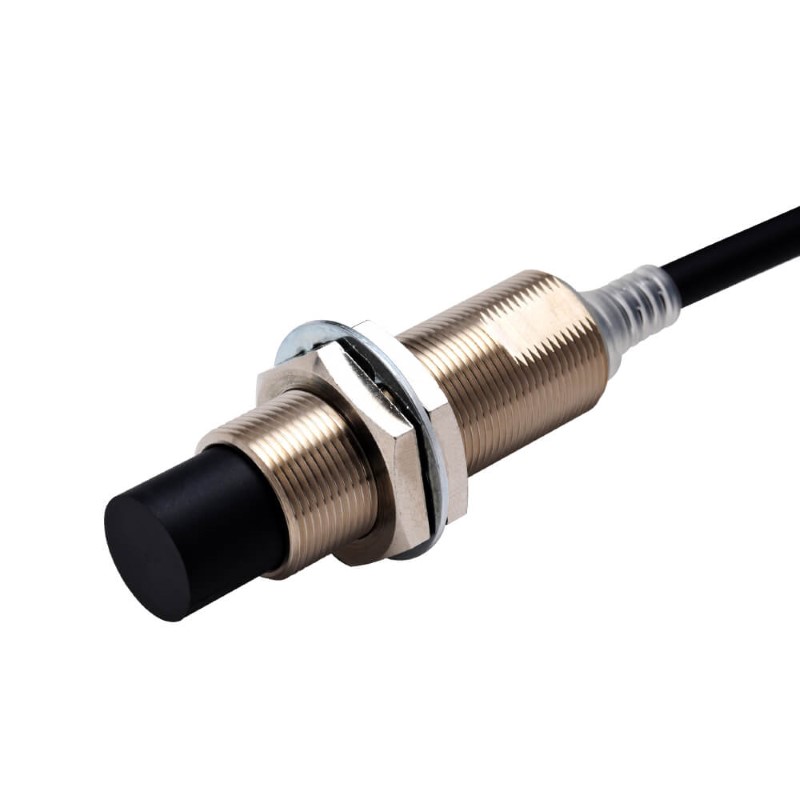
Omron E2E-X30MB1TL18-R 2M Inductive Proximity Sensor
| Feature | Value |
|---|---|
| Sensor Type | Inductive Proximity Sensor |
| Series | E2E NEXT |
| Housing Size | M18 |
| Mounting Type | Non-flush |
| Sensing Distance | 30 mm |
| Output Configuration | PNP Normally Open (NO) |
| Supply Voltage | 10 to 30 VDC |
| Connection Type | 2 m PVC Cable |
| Housing Material | Nickel-Plated Brass |
| Response Frequency | 200 Hz |
| Protection Rating | IP67 / IP69K |
| Operating Temperature | -25°C to +70°C |
| Thread Diameter | M18 |
| Detection Principle | Electromagnetic Induction |
Technical Overview
The Omron E2E-X30MB1TL18-R 2M Inductive Proximity Sensor is designed for non-contact detection of metallic objects in industrial automation systems. Built within the E2E NEXT product family, this model combines extended sensing capability with a permanently attached 2-meter cable, making it suitable for installations where connectorized wiring is not preferred.
Industrial machinery often requires reliable position feedback and object verification under demanding environmental conditions. The Omron E2E-X30MB1TL18-R 2M Inductive Proximity Sensor provides stable sensing performance while supporting machine builders, system integrators, and maintenance teams working with automated production equipment.
How the Sensor Operates
The sensing face generates a high-frequency electromagnetic field. When a conductive metallic object enters the detection zone, eddy currents are created within the target. These currents absorb energy from the oscillator circuit, resulting in a measurable reduction of oscillation amplitude.
The internal circuitry evaluates these changes and switches the output when the predefined threshold is reached. Because no mechanical contact occurs between the sensor and the detected object, wear is minimized and operational reliability is maintained throughout repeated switching cycles.
The Omron E2E-X30MB1TL18-R 2M Inductive Proximity Sensor is specifically engineered for metallic target detection and is commonly used in automated equipment where precision and repeatability are required.
Key Functional Characteristics
- 30 mm sensing distance for increased installation flexibility
- Reliable detection of metallic objects
- Integrated industrial-grade protection against dust and moisture
- Permanent 2-meter cable connection
- Nickel-plated brass housing construction
- Suitable for harsh production environments
- Stable switching performance
- Reduced maintenance requirements due to non-contact operation
Common Usage Areas
The Omron E2E-X30MB1TL18-R 2M Inductive Proximity Sensor can be integrated into numerous industrial processes where accurate detection of metal components is necessary.
- Automated conveyor lines
- Machine tool positioning systems
- Metal component verification stations
- Assembly automation equipment
- Industrial lifting systems
- Transfer and indexing mechanisms
- Packaging machinery
- Production line synchronization systems
Industrial Applications
Automotive Component Production
Production facilities frequently monitor metallic workpieces and fixtures during assembly and machining operations. Inductive sensors provide reliable feedback for process control systems.
Steel Processing Equipment
Material handling equipment uses proximity sensors to verify metal sheet positioning and transport system alignment.
Industrial Packaging Lines
Metal carriers and indexing mechanisms can be monitored throughout packaging operations to maintain production consistency.
Factory Automation Systems
Machine builders utilize inductive sensors to detect actuator positions, moving assemblies, and mechanical reference points.
Advantages in Engineering Applications
Engineers selecting sensors for automation projects often focus on installation flexibility, environmental durability, and sensing performance. The Omron E2E-X30MB1TL18-R 2M Inductive Proximity Sensor addresses these requirements through its extended sensing range and robust housing design.
- Reduced risk of mechanical wear
- Long cable length for flexible routing
- Compatibility with common industrial control systems
- Reliable operation in contaminated environments
- Improved machine design flexibility
Selection Considerations
Before integrating an inductive proximity sensor into an automation project, several engineering factors should be evaluated.
- Target material composition
- Required sensing distance
- Mounting arrangement
- Available wiring infrastructure
- Environmental exposure conditions
- Control system compatibility
- Required switching frequency
- Maintenance accessibility
The Omron E2E-X30MB1TL18-R 2M Inductive Proximity Sensor is often selected where a permanently connected cable simplifies installation and reduces connector-related considerations.
Engineers interested in related sensing technologies can review Omron sensor solutions for additional automation and detection applications.
Omron E2E-X30MB1TL18-R 2M Frequently Asked Questions
What sensing technology does this sensor use?
It uses inductive sensing technology based on electromagnetic induction.
What is the nominal sensing distance?
The sensor provides a nominal sensing distance of 30 mm.
Which objects can be detected?
The sensor is designed for detecting conductive metallic targets.
What output type is available?
The device provides a PNP normally open output configuration.
How is the sensor connected?
It includes a permanently attached 2-meter PVC cable.
Can it operate in wet environments?
Its IP67 and IP69K protection ratings support operation in demanding industrial environments where water exposure may occur.
What supply voltage is required?
The operating voltage range is 10 to 30 VDC.
Which industries commonly use this sensor?
Automotive manufacturing, machine building, packaging, logistics, metal processing, and factory automation are among the common application sectors.