
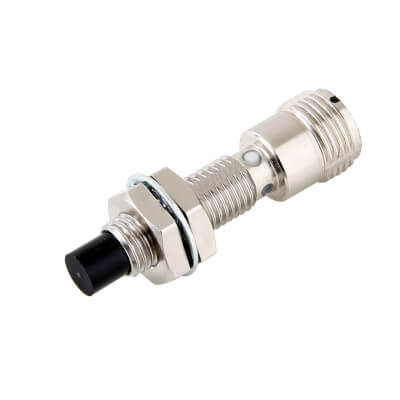
Omron E2E-X2MB28-M1 Inductive Proximity Sensor
| Feature | Value |
|---|---|
| Sensor Type | Inductive Proximity Sensor |
| Series | Omron E2E NEXT |
| Sensing Distance | 2 mm |
| Housing Diameter | M8 |
| Mounting Style | Flush (Shielded) |
| Output Type | PNP Normally Open (NO) |
| Connection Type | M12 Connector |
| Supply Voltage | 10 to 30 VDC |
| Response Frequency | 1.5 kHz |
| Housing Material | Stainless Steel |
| Protection Rating | IP67 / IP67G / IP69K |
| Operating Temperature | -40°C to +85°C |
| Connection Size | M12 Male Connector |
| Indicator | Operation LED |
| Thread Type | M8 Cylindrical Thread |
Modern automation systems increasingly require compact sensing devices that simplify installation while maintaining dependable performance under demanding operating conditions. The Omron E2E-X2MB28-M1 Inductive Proximity Sensor is designed for these requirements, combining inductive sensing technology, a compact M8 housing, and a connector-based electrical interface suitable for machine builders, panel integrators, and industrial maintenance teams.
Technical Description
The Omron E2E-X2MB28-M1 Inductive Proximity Sensor belongs to the E2E NEXT family of cylindrical inductive sensors. It provides a nominal sensing distance of 2 mm and utilizes a shielded sensing structure that allows flush mounting inside metallic machine frames and mounting brackets.
The sensor features a PNP normally open output and an M12 connector interface. Compared with permanently attached cable versions, the connector-based design can simplify replacement procedures, reduce maintenance time, and support modular machine architectures.
The stainless-steel housing provides resistance against mechanical impacts, industrial contaminants, and demanding environmental conditions commonly encountered in production facilities.
Operating Principle
The Omron E2E-X2MB28-M1 Inductive Proximity Sensor generates an electromagnetic field through an internal oscillation circuit located at the sensing surface. When a metallic object enters the sensing area, eddy currents are induced within the target material.
These currents alter the characteristics of the electromagnetic field and reduce the oscillation amplitude. The sensor electronics continuously monitor this variation and switch the output when the predefined detection threshold is reached.
Because detection occurs without physical contact, there are no moving components exposed to wear. This contributes to consistent operation throughout long production cycles.
Main Advantages
- Compact M8 cylindrical housing.
- Flush mounting capability.
- M12 connector for simplified installation.
- PNP normally open output.
- Stainless-steel construction.
- High switching frequency.
- Resistance to industrial contaminants.
- Wide operating temperature range.
- Non-contact sensing technology.
Common Application Areas
The Omron E2E-X2MB28-M1 Inductive Proximity Sensor is commonly integrated into industrial automation systems requiring reliable metallic object detection.
- Automated production equipment
- Assembly machinery
- Packaging systems
- Machine tools
- Conveyor automation
- Sorting systems
- Material transport equipment
- Industrial handling systems
Its connectorized design makes it particularly useful in applications where rapid sensor replacement is important for minimizing production interruptions.
Industrial Applications
Automated Assembly Equipment
Assembly systems often use inductive sensors to confirm fixture positions before automated fastening, insertion, or inspection processes begin.
Packaging Machinery
Packaging equipment relies on precise synchronization between moving machine elements. Inductive sensors monitor metallic mechanisms and position references throughout machine operation.
Machine Tool Systems
Industrial machining equipment uses proximity sensors to verify actuator positions, tooling locations, and machine states during automated production sequences.
Material Handling Operations
Conveyor and transport systems use proximity sensors to monitor stop gates, positioning mechanisms, and transfer devices throughout automated workflows.
Sector-Specific Examples
In pharmaceutical manufacturing facilities, compact inductive sensors can be used to monitor mechanical transport systems where installation space is limited. In electronics production lines, they help verify fixture positioning before assembly processes are executed.
The Omron E2E-X2MB28-M1 Inductive Proximity Sensor may also be integrated into automated warehouse systems for monitoring metallic transport components and positioning mechanisms.
Machine builders frequently specify the Omron E2E-X2MB28-M1 Inductive Proximity Sensor when modular sensor replacement and standardized connector infrastructure are important project requirements.
Selection Considerations
- Required sensing distance.
- Available installation space.
- Target material characteristics.
- Connector compatibility.
- Environmental exposure levels.
- Switching speed requirements.
- Maintenance accessibility.
- Control system input compatibility.
Engineers should verify connector type compatibility and available cable assemblies when selecting M12-connected sensors for industrial automation projects.
For additional industrial sensing technologies and related product families, visit Omron sensor products.
Frequently Asked Questions
What type of sensor is this?
It is an inductive proximity sensor designed for detecting metallic targets.
What is the nominal sensing distance?
The nominal sensing distance is 2 mm.
What output configuration is used?
The sensor provides a PNP normally open output.
Does it use a cable or connector?
This version uses an M12 connector connection.
Can the sensor be mounted flush?
Yes. Its shielded construction supports flush mounting.
What operating voltage is required?
The device operates from 10 to 30 VDC.
What protection ratings are available?
The sensor is rated IP67, IP67G, and IP69K.
Which industries commonly use this sensor?
It is widely used in manufacturing, packaging, logistics, machine building, and assembly automation.
What housing material is used?
The housing is manufactured from stainless steel.
Why choose a connector version instead of a cable version?
Connectorized sensors can simplify installation, maintenance, and replacement procedures in industrial environments.