
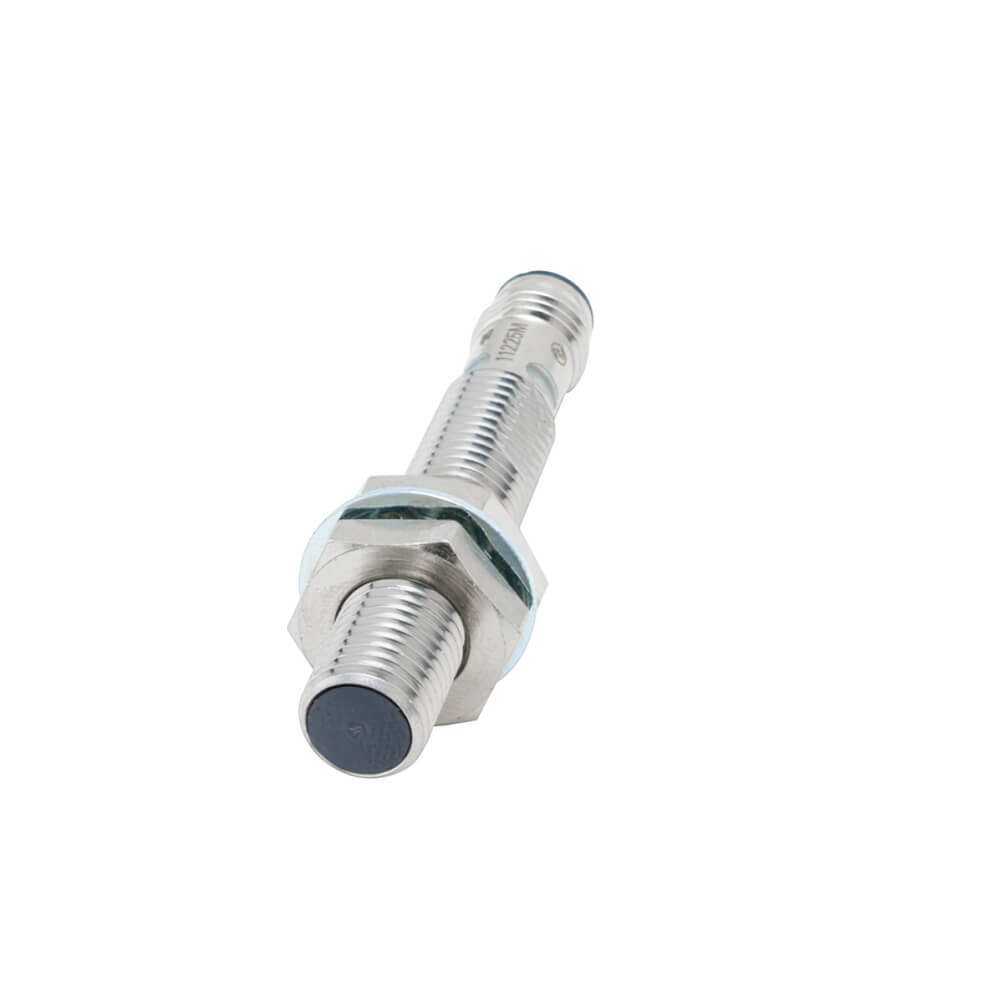
Omron E2E-X2B2L8-M5 Inductive Proximity Sensor
| Feature | Value |
|---|---|
| Sensor Type | Inductive Proximity Sensor |
| Series | E2E NEXT |
| Housing Size | M8 |
| Sensing Distance | 2 mm |
| Mounting Type | Flush (Shielded) |
| Output Type | PNP |
| Operation Mode | Normally Closed (NC) |
| Supply Voltage | 10 to 30 VDC |
| Connection Method | M8 3-pin Connector |
| Housing Material | Stainless Steel |
| Overall Length | 49 mm |
| Thread Length | 36 mm |
| Response Frequency | 1.5 kHz |
| Protection Rating | IP67 / IP69K |
| Operating Temperature | -25°C to +70°C |
The Omron E2E-X2B2L8-M5 Inductive Proximity Sensor is designed for reliable non-contact detection of metallic targets in industrial automation environments. As part of the E2E NEXT series, this sensor combines a compact M8 threaded housing with robust environmental protection, making it suitable for machinery, production lines, positioning systems, and material handling equipment.
The stainless-steel construction provides mechanical durability, while the shielded sensing design enables installation in applications where mounting space is limited. The sensor uses a PNP normally closed output and a standard M8 connector interface for integration into modern control systems.
Technical Description
The Omron E2E-X2B2L8-M5 Inductive Proximity Sensor is a DC-powered inductive sensor developed for detecting ferrous and conductive metallic objects. It features a 2 mm sensing distance and a shielded sensing face, allowing flush installation inside metal structures.
The sensor body is manufactured from stainless steel and incorporates protection levels of IP67 and IP69K, helping maintain operational reliability in environments exposed to dust, moisture, washdown procedures, and industrial contaminants.
Operating Principle
Inductive proximity sensors generate a high-frequency electromagnetic field at the sensing face. When a metallic object enters this field, eddy currents are induced within the target material. These currents alter the oscillation characteristics of the sensor’s internal circuit.
The electronics continuously monitor these changes and switch the output accordingly. The Omron E2E-X2B2L8-M5 Inductive Proximity Sensor uses a normally closed output configuration, meaning the output state changes when a metallic target enters the sensing zone.
Because no physical contact is required, the sensor avoids mechanical wear and minimizes maintenance requirements over extended operating periods.
Applications
- Position detection of machine components
- Metal part presence verification
- Conveyor automation systems
- Packaging machinery
- Pneumatic cylinder position monitoring
- Robotic end-effector positioning
- Transfer and indexing systems
- Assembly line automation
The Omron E2E-X2B2L8-M5 Inductive Proximity Sensor is particularly useful in installations where compact dimensions and high environmental resistance are required simultaneously.
Industrial Applications
Automotive Manufacturing
Production facilities use inductive sensors to verify metal body components, monitor fixture positions, and confirm part transfer between automated stations.
Packaging Equipment
Packaging machinery often requires precise detection of metallic carriers, guide mechanisms, and actuator positions. The compact M8 body supports installation in restricted machine spaces.
Material Handling Systems
Conveyor lines and transfer modules use proximity sensing technology to detect pallets, carriers, and positioning elements without physical contact.
Machine Building
OEM machine manufacturers integrate sensors for stroke-end verification, tool positioning, and automated sequence control.
Advantages
- Non-contact detection technology
- Compact M8 threaded housing
- Flush mounting capability
- Stainless-steel construction
- PNP output compatibility with industrial controllers
- IP67 and IP69K environmental protection
- Connector-based installation for simplified maintenance
- High switching frequency for dynamic applications
Industry-Specific Usage Examples
In food processing equipment, the sensor can monitor metallic machine components exposed to regular cleaning procedures. In logistics systems, it can detect carrier positions within automated sorting equipment. In metalworking machinery, it can verify workpiece location before machining operations begin.
Automated assembly stations may also employ the Omron E2E-X2B2L8-M5 Inductive Proximity Sensor to confirm fixture readiness and component placement before process execution.
Selection Considerations
When selecting an inductive proximity sensor, engineers should evaluate sensing distance, mounting arrangement, target material, environmental conditions, electrical interface requirements, and mechanical dimensions.
Applications using PNP-based PLC inputs can benefit from direct integration with the Omron E2E-X2B2L8-M5 Inductive Proximity Sensor. The IP67/IP69K protection level should also be considered for installations involving washdown processes or airborne contaminants.
Additional Omron sensor products may be reviewed when comparing sensing distances, output configurations, and mounting options for a specific project.
Omron E2E-X2B2L8-M5 Frequently Asked Questions
What type of objects can this sensor detect?
It is designed to detect metallic targets using inductive sensing technology.
What is the nominal sensing distance?
The sensor provides a rated sensing distance of 2 mm.
Is the sensor suitable for flush mounting?
Yes. The sensor is a shielded model intended for flush installation.
What output configuration does it use?
It provides a PNP normally closed (NC) output.
Which voltage range is supported?
The operating supply range is 10 to 30 VDC.
Can it be used in wet environments?
Yes. IP67 and IP69K ratings support operation in demanding industrial conditions.
How is electrical connection established?
The sensor uses a standard M8 three-pin connector interface.
What industries commonly use this sensor?
Automotive, packaging, logistics, machine building, material handling, and manufacturing industries frequently use inductive proximity sensors.
Does the sensor require physical contact with the target?
No. Detection occurs through an electromagnetic field, eliminating mechanical contact.
Why choose a stainless-steel housing?
Stainless steel improves resistance to corrosion, mechanical impact, and industrial contaminants.