
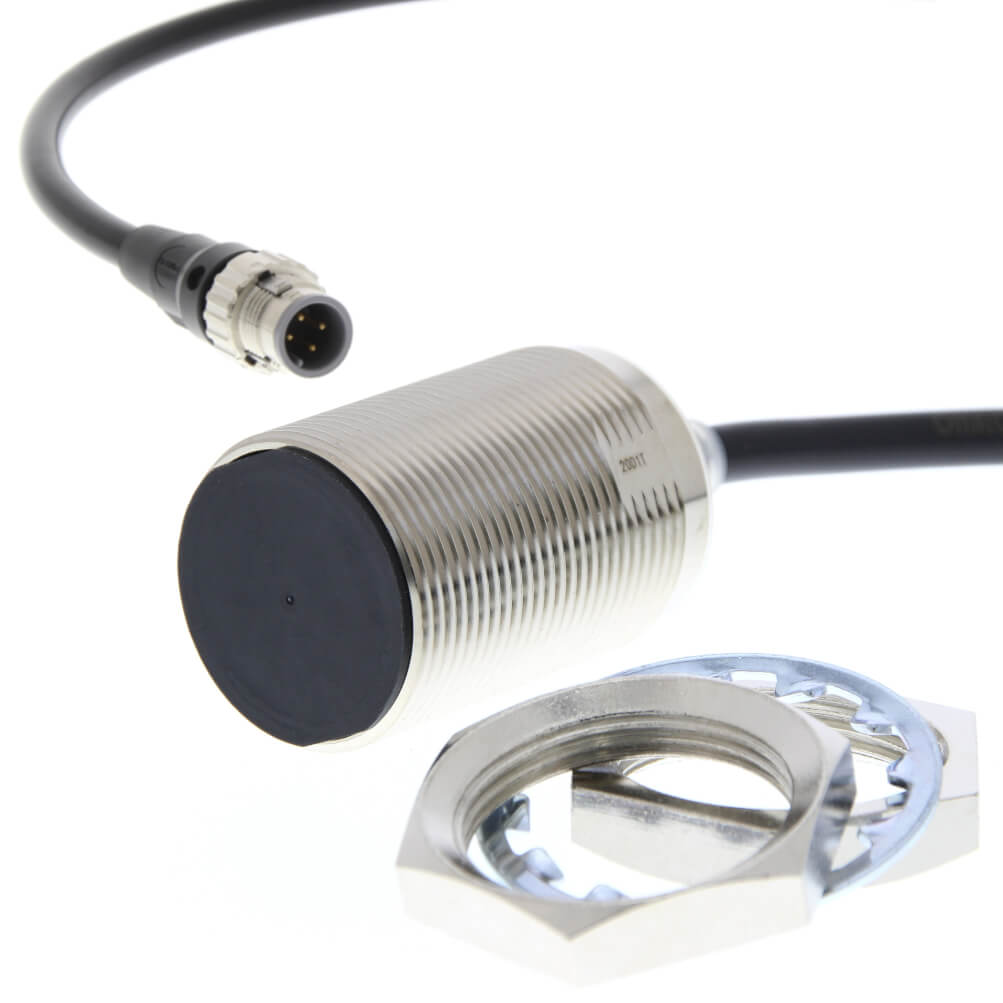
Omron E2E-X23B1T30-M1TJ 0.3M Inductive Proximity Sensor
| Feature | Value |
|---|---|
| Sensor Type | Inductive Proximity Sensor |
| Series | E2E NEXT |
| Sensing Distance | 23 mm |
| Housing Size | M30 |
| Mounting Type | Shielded (Quasi-Flush) |
| Output Type | PNP Normally Open (NO) |
| Communication | IO-Link COM3 (230.4 kbps) |
| Supply Voltage | 10 to 30 VDC |
| Connection Method | M12 Smartclick Pigtail Connector |
| Cable Length | 0.3 m |
| Housing Material | Nickel-Plated Brass |
| Protection Rating | IP67 / IP67G / IP69K |
| Operating Temperature | -25°C to +70°C |
| Response Frequency | 200 Hz |
| Overall Length | 60.3 mm |
Technical Overview
The Omron E2E-X23B1T30-M1TJ 0.3M Inductive Proximity Sensor is a cylindrical M30 sensing device designed for reliable metal target detection in industrial automation environments. As part of the E2E NEXT sensor family, it combines a long sensing distance with IO-Link communication capabilities, allowing both switching and diagnostic data to be integrated into modern control systems.
The sensor features a shielded sensing structure and a 23 mm sensing distance, enabling stable operation in applications where installation space is limited. Its nickel-plated brass housing provides mechanical durability, while IP67, IP67G, and IP69K protection ratings support operation in demanding industrial conditions.
Working Principle
The Omron E2E-X23B1T30-M1TJ 0.3M Inductive Proximity Sensor operates by generating a high-frequency electromagnetic field at the sensing face. When a conductive metal object enters this field, eddy currents are induced within the target material. These currents alter the oscillator characteristics inside the sensor.
The internal detection circuitry continuously monitors these changes and activates the PNP normally open output once the target reaches the specified sensing range. In addition to standard switching functionality, IO-Link communication allows access to sensor status information, diagnostics, and parameter settings through compatible master devices.
Key Features and Design Characteristics
- 23 mm sensing distance for metal object detection
- M30 threaded housing for industrial installations
- PNP normally open output configuration
- Integrated IO-Link COM3 communication
- M12 Smartclick pigtail connector with 0.3 m cable
- Nickel-plated brass construction
- IP67, IP67G, and IP69K environmental protection
- Operating temperature range from -25°C to +70°C
- 200 Hz response frequency
Omron E2E-X23B1T30-M1TJ 0.3M Application Areas
The Omron E2E-X23B1T30-M1TJ 0.3M Inductive Proximity Sensor is commonly used for non-contact detection of metallic components in automated manufacturing systems. Its sensing capability supports machine builders and system integrators working with production lines that require consistent position monitoring.
- Material handling systems
- Packaging equipment
- Assembly automation
- Conveyor tracking applications
- Machine tool monitoring
- Automotive production systems
- Metal fabrication machinery
- Industrial robotics
Omron E2E-X23B1T30-M1TJ 0.3M Industrial Applications
In automated conveyor systems, the sensor can detect metal carriers and workpiece holders without physical contact. In robotic cells, it is frequently used to verify component presence before gripping or assembly operations begin.
Packaging machines utilize the sensor to monitor moving mechanical parts and ensure synchronized operation between stations. In metalworking facilities, it can be integrated into positioning systems that require reliable feedback under vibration and contamination exposure.
Advantages in Automation Systems
One advantage of the Omron E2E-X23B1T30-M1TJ 0.3M Inductive Proximity Sensor is its combination of extended sensing range and compact body dimensions. The integrated IO-Link interface enables predictive maintenance strategies by providing access to operational data and device diagnostics.
Its robust enclosure supports installation in environments exposed to water spray, dust, lubricants, and cleaning procedures. The Smartclick connection system can also simplify installation and maintenance activities.
For additional sensor technologies and related solutions, engineers may review Omron sensor products.
Considerations When Selecting This Sensor
- Verify that the target material is metallic.
- Confirm compatibility with the available supply voltage.
- Check available installation space for M30 threaded mounting.
- Evaluate whether IO-Link communication is required.
- Consider environmental protection requirements.
- Review cable routing and connector accessibility.
- Confirm response frequency suitability for machine speed.
The Omron E2E-X23B1T30-M1TJ 0.3M Inductive Proximity Sensor is particularly suitable for applications requiring long sensing distances and advanced communication capabilities. The Omron E2E-X23B1T30-M1TJ 0.3M Inductive Proximity Sensor can also support condition monitoring strategies through its integrated IO-Link functionality.
Omron E2E-X23B1T30-M1TJ 0.3M Frequently Asked Questions
What type of sensor is this product?
It is a shielded inductive proximity sensor designed for detecting metallic objects without physical contact.
What is the sensing distance?
The nominal sensing distance is 23 mm.
Does the sensor support IO-Link?
Yes. It includes IO-Link COM3 communication with a baud rate of 230.4 kbps.
What output configuration is provided?
The sensor uses a PNP normally open (NO) output.
What is the housing size?
The device features an M30 threaded cylindrical housing.
Can it operate in washdown environments?
Its IP69K protection rating supports operation in environments exposed to intensive cleaning procedures and water spray.
What industries commonly use this sensor?
Automotive manufacturing, packaging, logistics, machine building, robotics, and metal processing industries frequently use this type of sensor.
What is the operating temperature range?
The specified operating temperature range is from -25°C to +70°C.
What is the connection method?
The sensor uses an M12 Smartclick pigtail connector with a 0.3 m oil-resistant cable.
What materials can be detected?
The sensor is intended for detecting conductive metallic targets within its specified sensing range.