
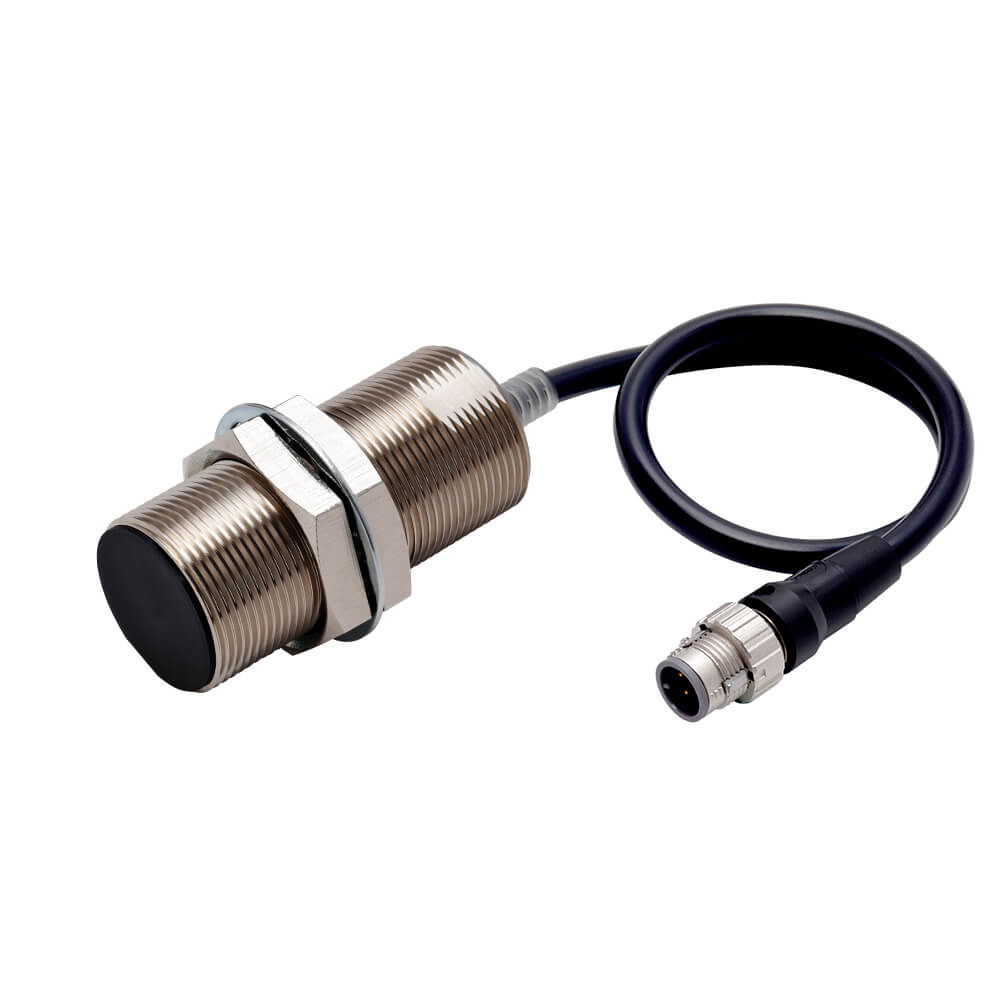
Omron E2E-X22B1TL30-M1TJ 0.3M Inductive Proximity Sensor
| Feature | Value |
|---|---|
| Sensor Type | Inductive Proximity Sensor |
| Series | E2E NEXT |
| Housing Size | M30 |
| Mounting Type | Shielded |
| Sensing Distance | 22 mm |
| Output Type | NPN Normally Open (NO) with IO-Link |
| Supply Voltage | 10 to 30 VDC |
| Communication Interface | IO-Link COM3 |
| Connection Type | M12 Smartclick Connector with 0.3 m Cable |
| Housing Material | Nickel-plated Brass |
| Protection Rating | IP67 / IP67G / IP69K |
| Operating Temperature | -25°C to +70°C |
| Overall Length | 60.3 mm |
Technical Description
Modern industrial automation increasingly relies on intelligent field devices capable of delivering both detection signals and diagnostic information. The Omron E2E-X22B1TL30-M1TJ 0.3M Inductive Proximity Sensor addresses these requirements by combining traditional inductive sensing technology with IO-Link communication capabilities in a compact M30 housing.
The Omron E2E-X22B1TL30-M1TJ 0.3M Inductive Proximity Sensor belongs to the E2E NEXT series, a family developed for stable detection performance in demanding industrial environments. Featuring a 22 mm sensing distance, shielded construction, and Smartclick connector system, this sensor supports efficient installation and integration into modern automation architectures.
Working Principle
The sensor operates by generating a high-frequency electromagnetic field from its sensing face. When a conductive metallic target enters the active detection area, eddy currents are induced in the target material. These currents modify the oscillation characteristics of the sensor circuit.
The internal electronics analyze these changes and activate the NPN normally open output once the detection threshold is reached. Through the integrated IO-Link interface, operational data can also be exchanged with compatible controllers and IO-Link masters for advanced monitoring and device management.
Key Technical Features
Integrated IO-Link Communication
The IO-Link COM3 interface enables bidirectional communication between the sensor and automation systems. Users can access diagnostic information, device identification data, parameter settings, and maintenance-related information without additional hardware.
Smartclick Connectivity
The integrated M12 Smartclick connection system simplifies installation and replacement procedures while ensuring secure electrical connections in industrial environments.
Enhanced Environmental Protection
With IP67, IP67G, and IP69K protection ratings, the sensor can operate in environments exposed to water, dust, cleaning processes, and industrial contaminants.
Applications and Usage Areas
- Smart manufacturing systems
- Industrial automation equipment
- Robotic production cells
- Automated assembly lines
- Packaging machinery
- Material handling systems
- Conveyor monitoring systems
- Automated warehousing equipment
For additional sensing technologies and automation solutions, explore Omron sensor solutions.
Industrial Applications
In digital manufacturing environments, the sensor can provide both object detection and diagnostic information to supervisory control systems. Automotive production facilities may use it for monitoring fixture positions, metal component verification, and assembly line synchronization.
Packaging equipment manufacturers often integrate IO-Link-enabled sensors to improve machine diagnostics and reduce maintenance downtime. In logistics facilities, the sensor can monitor transfer systems, storage mechanisms, and automated transport equipment.
Machine builders increasingly adopt IO-Link sensors to simplify commissioning processes and support predictive maintenance strategies through real-time device monitoring.
Advantages
- 22 mm sensing distance
- Integrated IO-Link COM3 communication
- Reliable NPN output operation
- Compact M30 shielded housing
- Smartclick connection technology
- High environmental protection ratings
- Support for diagnostic monitoring
- Suitable for Industry 4.0 infrastructures
Sector-Specific Usage Examples
Automotive Manufacturing
Used for metal component verification and fixture monitoring throughout automated assembly processes.
Logistics Automation
Provides position monitoring for automated transfer systems, shuttles, and warehouse equipment.
Packaging Industry
Supports machine synchronization and status monitoring functions within automated packaging lines.
Industrial Machinery
Delivers reliable position feedback and diagnostic information for machine control systems.
Important Selection Considerations
When selecting an IO-Link-enabled inductive sensor, engineers should evaluate sensing distance requirements, communication compatibility, environmental conditions, installation constraints, and maintenance objectives.
The Omron E2E-X22B1TL30-M1TJ 0.3M Inductive Proximity Sensor is particularly suitable for applications requiring both reliable metallic object detection and advanced communication functionality within industrial automation networks.
The Omron E2E-X22B1TL30-M1TJ 0.3M Inductive Proximity Sensor can also contribute to improved asset visibility by providing operational data through standardized IO-Link communication channels.
Frequently Asked Questions
1. What sensing technology does this device use?
It uses inductive sensing technology for non-contact detection of metallic objects.
2. What is the nominal sensing distance?
The sensor provides a nominal sensing distance of 22 mm.
3. Does the sensor support IO-Link?
Yes, it supports IO-Link COM3 communication.
4. What output configuration is available?
The device provides an NPN normally open output.
5. What connection method is used?
The sensor utilizes an M12 Smartclick connector with a 0.3-meter cable.
6. Is the sensor suitable for harsh industrial environments?
Yes, its IP67, IP67G, and IP69K ratings support operation in demanding environments.
7. Which industries commonly use this sensor?
It is commonly used in automotive manufacturing, packaging, logistics, robotics, and industrial machinery applications.
8. What benefits does IO-Link provide?
IO-Link enables diagnostics, parameterization, device identification, condition monitoring, and simplified maintenance procedures.