
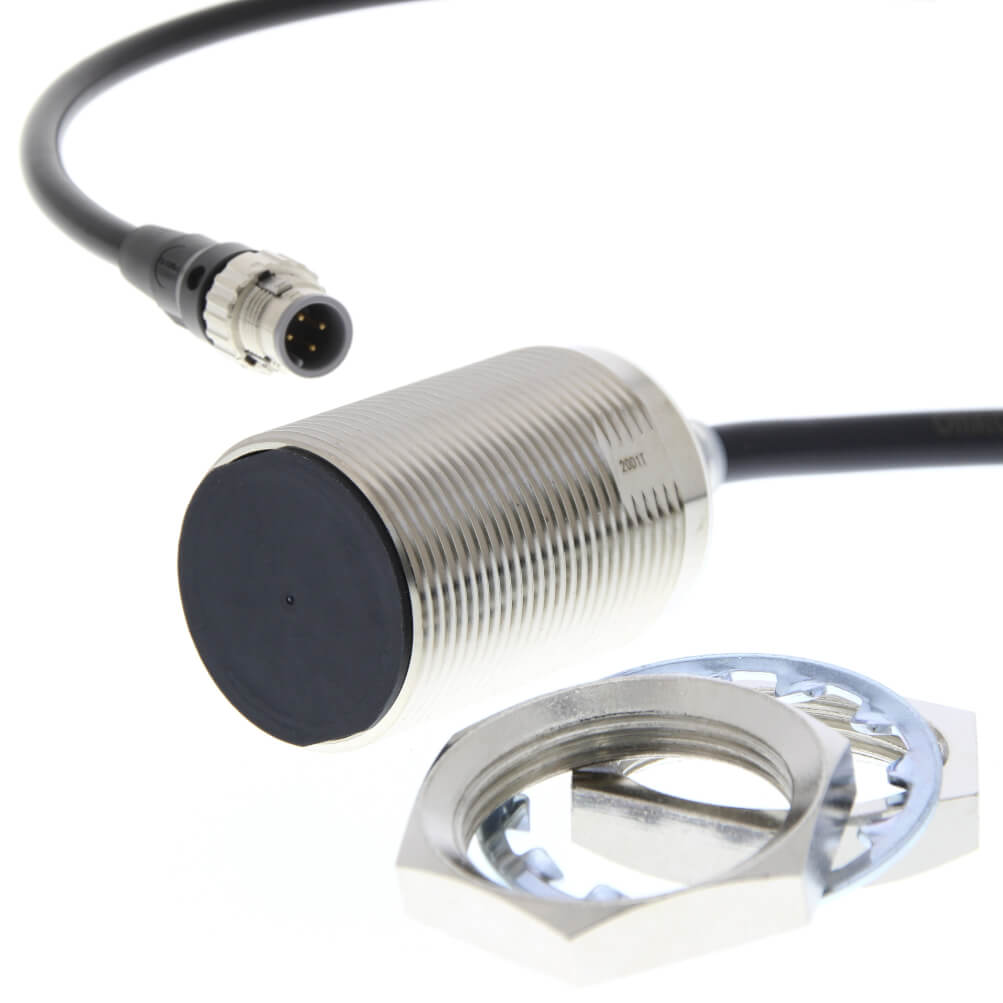
Omron E2E-X20D130-M1TGJ 0.3M Inductive Proximity Sensor
| Feature | Value |
|---|---|
| Product Type | Inductive Proximity Sensor |
| Series | E2E NEXT |
| Housing Size | M30 |
| Sensing Distance | 20 mm |
| Mounting Style | Quasi-Flush (Shielded) |
| Output Type | DC 2-Wire |
| Operation Mode | Normally Open (NO) |
| Connection Method | M12 Smartclick Pigtail Connector |
| Cable Length | 0.3 m |
| Housing Material | Nickel-Plated Brass |
| Thread Length | 38 mm |
| Overall Length | 60.3 mm |
| Protection Rating | IP67 / IP67G / IP69K |
The Omron E2E-X20D130-M1TGJ Inductive Proximity Sensor is designed for non-contact detection of metallic objects in industrial automation systems. As part of the E2E NEXT family, it combines extended sensing distance with a compact M30 cylindrical housing, making it suitable for machine builders, production lines, and material handling equipment.
The Omron E2E-X20D130-M1TGJ Inductive Proximity Sensor utilizes electromagnetic field generation to detect conductive metal targets without physical contact. This operating principle minimizes mechanical wear and supports long-term operation in demanding industrial environments.
Technical Description
This sensor features a shielded sensing structure with a nominal sensing distance of 20 mm. The nickel-plated brass housing provides mechanical durability while maintaining resistance against industrial contaminants. The integrated M12 Smartclick pigtail connection simplifies installation and replacement procedures.
The DC 2-wire configuration allows integration into a wide range of control architectures, including PLC-based automation systems, conveyor controls, and machine monitoring circuits.
Working Principle
The sensing coil inside the sensor creates a high-frequency electromagnetic field. When a metallic object enters the sensing zone, eddy currents are induced within the target material. These currents alter the oscillator characteristics inside the sensor, triggering the switching output.
Because detection occurs without physical contact, the sensor can operate in applications where mechanical switches would experience excessive wear.
Typical Applications
- Conveyor position detection
- Machine tool automation
- Packaging machinery
- Assembly line monitoring
- Metal component presence verification
- Transfer system control
- Industrial sorting equipment
Industrial Use Cases
Automotive Manufacturing
Production systems use the sensor to verify the presence of metal brackets, chassis components, and fixture positions during assembly operations.
Packaging Equipment
Metal guide mechanisms and machine actuators can be monitored continuously to support process synchronization.
Material Handling Systems
Warehouse conveyors and automated transport equipment utilize proximity sensors for position confirmation and object tracking.
Advantages
- 20 mm sensing distance for flexible installation
- Non-contact metal detection
- Compact M30 threaded housing
- IP67, IP67G, and IP69K protection ratings
- Oil-resistant cable construction
- Fast installation through Smartclick connector technology
- Suitable for harsh industrial environments
Considerations When Selecting the Sensor
Engineers should evaluate target material characteristics, available installation space, environmental exposure, wiring requirements, and control system compatibility before selecting a proximity sensor.
Applications requiring quick replacement and modular wiring may benefit from the M12 pigtail connection used by the Omron E2E-X20D130-M1TGJ Inductive Proximity Sensor.
Additional information about Omron sensor products can be reviewed when comparing sensing technologies and installation methods.
Omron E2E-X20D130-M1TGJ Frequently Asked Questions
What type of objects can this sensor detect?
It is designed to detect metallic targets through inductive sensing technology.
What is the sensing distance?
The nominal sensing distance is 20 mm.
Is the sensor shielded?
Yes, it uses a quasi-flush shielded construction.
What output configuration does it use?
The device operates as a DC 2-wire sensor with a normally open output.
Can it be used in washdown environments?
The IP69K protection rating supports operation in demanding cleaning environments.
What is the housing material?
The housing is manufactured from nickel-plated brass.
Does the sensor require physical contact with the target?
No. Detection occurs through an electromagnetic field.
Where is this sensor commonly used?
It is frequently installed in conveyors, packaging machines, production equipment, and automated handling systems.