
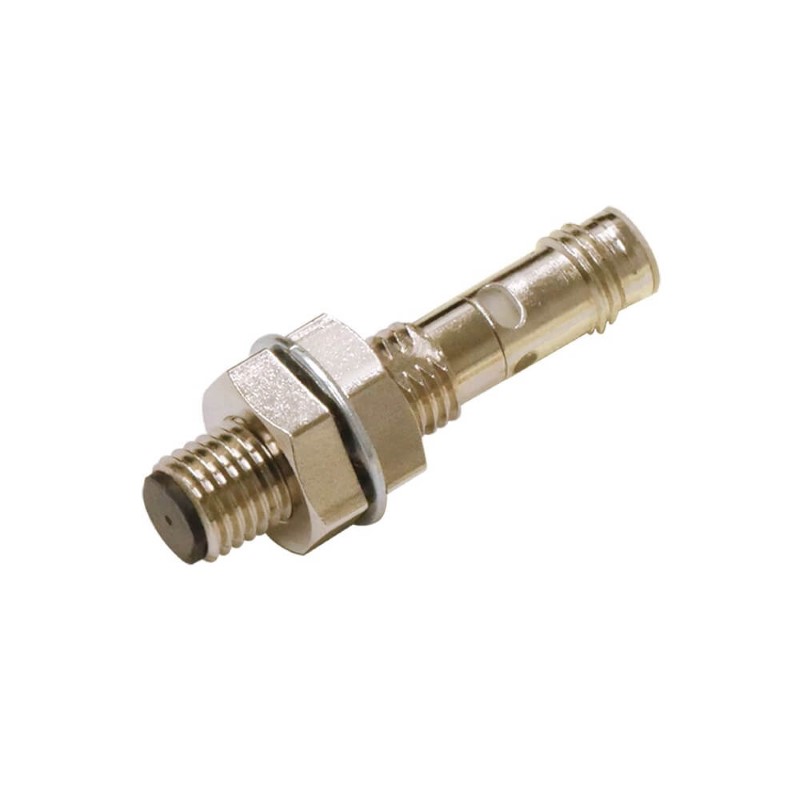
Omron E2E-X1R5B28-M3 Inductive Proximity Sensor
| Feature | Value |
|---|---|
| Sensor Type | Inductive Proximity Sensor |
| Series | E2E NEXT |
| Housing Diameter | M8 |
| Mounting Style | Flush Mount |
| Sensing Distance | 1.5 mm |
| Output Type | PNP, Normally Open (NO) |
| Wiring Method | 3-wire DC |
| Supply Voltage | 10 to 30 VDC |
| Connection Type | M8 Connector |
| Response Frequency | 2 kHz |
| Housing Material | Stainless Steel |
| Protection Rating | IP67, IP69K |
| Operating Temperature | -40°C to +85°C |
| Overall Length | 43 mm |
Modern automation systems often require compact sensing devices capable of detecting metallic components without physical contact. The Omron E2E-X1R5B28-M3 Inductive Proximity Sensor is designed to meet these requirements in applications where installation space is limited and consistent switching performance is essential.
As part of the E2E NEXT sensor family, the Omron E2E-X1R5B28-M3 Inductive Proximity Sensor combines a miniature M8 threaded housing with a 1.5 mm sensing range. Its PNP normally open output supports integration into PLC-controlled systems, production equipment, and machine automation architectures.
Technical Description
This inductive proximity sensor is engineered for the detection of metallic targets using electromagnetic field technology. The sensor body is manufactured from stainless steel, providing mechanical resistance and long-term durability in industrial environments exposed to vibration, contamination, and frequent cleaning procedures.
The flush-mounted design minimizes installation protrusion while maintaining reliable sensing characteristics. Connector-based wiring simplifies installation and replacement during maintenance operations.
Operating Principle
The sensor continuously generates an electromagnetic field at the sensing face. When a conductive metal object enters the detection zone, eddy currents are induced within the target material. These currents alter the oscillation characteristics of the sensor’s internal circuit.
The internal electronics detect this variation and activate the output signal. Since operation relies entirely on electromagnetic interaction, no mechanical contact is required between the sensor and the detected object.
Typical Areas of Use
- Automated assembly machines
- Metal part positioning systems
- Transfer stations
- Production conveyors
- Machine tool monitoring
- Automated inspection equipment
- Packaging machinery
- Robotic handling systems
Industrial Applications
In electronics manufacturing facilities, inductive sensors are frequently used to verify fixture positions and detect metallic carriers throughout production sequences. Automated assembly systems employ sensors such as the Omron E2E-X1R5B28-M3 Inductive Proximity Sensor to monitor machine states and confirm workpiece presence.
Packaging equipment can use the sensor for position verification of metallic actuators and moving components. In logistics automation, metal trays and transport fixtures can be detected without introducing physical wear to the sensing system.
Advantages
- Compact M8 threaded construction
- Reliable metal detection without contact
- High switching frequency for fast processes
- Wide operating temperature range
- Resistance to water and dust ingress
- Connector-based installation for easier servicing
- Suitable for demanding industrial environments
Sector-Specific Examples
Machine Building
The sensor can monitor moving machine elements and verify actuator positions during automated cycles.
Food Processing Equipment
Its high protection ratings support use on machinery exposed to regular washdown procedures.
Automated Warehousing
Metal transport carts and positioning mechanisms can be monitored during material movement operations.
Factors to Consider During Selection
When selecting an inductive proximity sensor, engineers should evaluate target material properties, sensing distance requirements, output configuration, environmental exposure, mounting style, and connection preferences. The Omron E2E-X1R5B28-M3 Inductive Proximity Sensor is particularly suitable for installations requiring a compact footprint and normally open PNP output operation.
Engineers looking for additional sensing technologies can review Omron sensor series to compare available solutions for different automation requirements.
Frequently Asked Questions
What is the nominal sensing distance?
The sensor provides a sensing distance of 1.5 mm.
Which output configuration is available?
It uses a PNP normally open (NO) output.
Can the sensor detect aluminum and steel?
Yes. It is designed for detecting conductive metallic materials.
What supply voltage is required?
The operating voltage range is 10 to 30 VDC.
Is the sensor suitable for compact equipment?
Yes. The M8 housing supports installation in limited spaces.
What environmental protection ratings are supported?
The sensor is rated IP67 and IP69K.
What type of connection does it use?
An M8 connector is used for electrical connection.
Where is the Omron E2E-X1R5B28-M3 Inductive Proximity Sensor commonly applied?
It is widely used in machine automation, material handling, packaging systems, and production equipment.
Does the sensor require physical contact with the target?
No. Detection is performed through an electromagnetic sensing field.
What maintenance is generally required?
Periodic inspection of mounting integrity, cable condition, and sensing surface cleanliness is typically sufficient.