
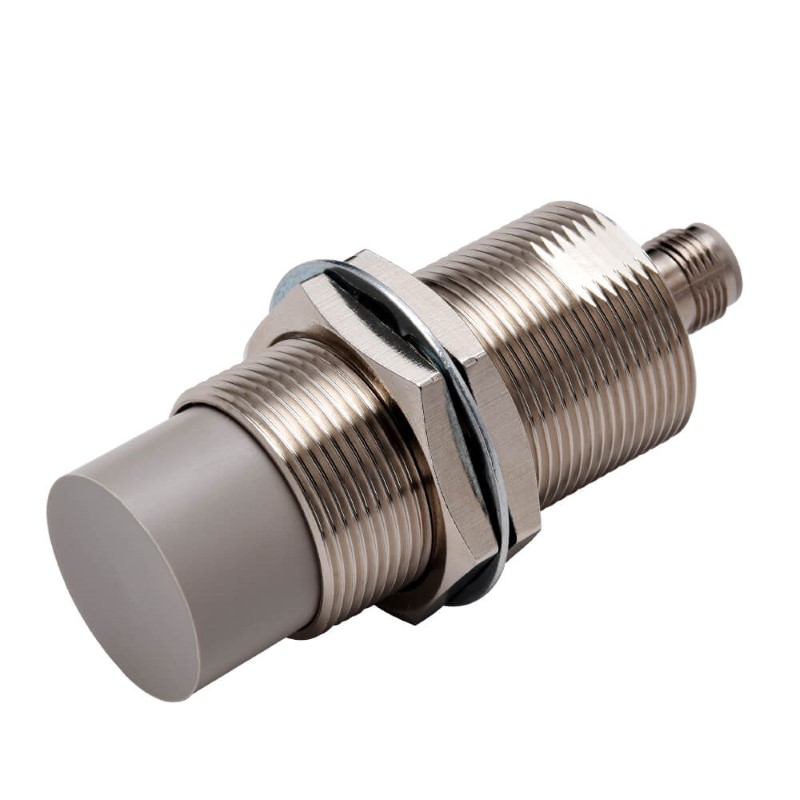
Omron E2E-X18MB2L30-M1 Inductive Proximity Sensor
| Feature | Value |
|---|---|
| Sensor Type | Inductive Proximity Sensor |
| Series | E2E NEXT |
| Housing Size | M30 |
| Mounting Type | Non-flush (Unshielded) |
| Sensing Distance | 18 mm |
| Output Type | PNP Normally Closed (NC) |
| Wiring Method | 3-wire DC |
| Supply Voltage | 10 to 30 VDC |
| Connection Type | M12 Connector |
| Housing Material | Nickel-Plated Brass |
| Protection Rating | IP67, IP69K |
| Operating Temperature | -40°C to +85°C |
| Response Frequency | 100 Hz |
| Body Length | 58 mm |
Technical Description
Reliable position detection is an essential requirement in modern automation systems. The Omron E2E-X18MB2L30-M1 Inductive Proximity Sensor has been designed to provide stable metallic object detection while supporting flexible installation through its M12 connector interface.
As a member of the E2E NEXT family, the Omron E2E-X18MB2L30-M1 Inductive Proximity Sensor incorporates an M30 cylindrical housing and a non-flush sensing structure capable of detecting metallic targets at distances up to 18 mm. The sensor utilizes a PNP normally closed output suitable for a wide range of industrial control systems.
Working Principle
The sensor generates an electromagnetic field from the sensing surface. When a metallic object enters this field, eddy currents are induced within the target material. These currents alter the oscillator characteristics of the sensor, causing the output circuit to switch.
This contactless sensing approach allows the sensor to operate without mechanical wear while maintaining reliable detection throughout long operating periods.
Key Features
- 18 mm sensing distance
- M30 threaded housing
- PNP normally closed output
- M12 connector connection
- 3-wire DC operation
- IP67 and IP69K protection ratings
- Nickel-plated brass housing
- Wide operating temperature range
Application Areas
The Omron E2E-X18MB2L30-M1 Inductive Proximity Sensor can be integrated into numerous industrial processes requiring accurate metallic object detection.
Automated Manufacturing
The sensor is suitable for machine position verification, tooling detection, and process monitoring applications.
Material Handling Systems
Conveyors and transport systems use inductive sensors to detect carriers, pallets, and transfer mechanisms.
Packaging Automation
Packaging equipment employs proximity sensors to supervise mechanical positions and machine sequences.
Process Equipment
Industrial processing systems benefit from reliable position monitoring and equipment status verification.
Industrial Applications
- Assembly automation
- Robotic manufacturing cells
- Warehouse automation
- Machine building projects
- Conveyor systems
- Packaging machinery
- Automotive production equipment
- Industrial handling systems
Engineers can review more Omron sensor solutions when designing larger automation systems.
Advantages
- Connector-based installation simplifies maintenance
- Reliable metallic target detection
- Strong environmental protection
- Durable housing construction
- Long operational service life
- Suitable for continuous industrial operation
Selection Considerations
When specifying the Omron E2E-X18MB2L30-M1 Inductive Proximity Sensor, engineers should evaluate installation space, target material characteristics, environmental conditions, and control system requirements.
Proper mounting clearance is necessary to achieve the rated sensing performance of the non-flush sensor design.
Frequently Asked Questions
What is the sensing distance?
The rated sensing distance is 18 mm.
What output configuration is available?
The sensor uses a PNP normally closed output.
What connection type does the sensor use?
An M12 connector is provided for electrical connection.
Can the sensor detect non-metallic objects?
No. The sensor is intended for metallic target detection.
What voltage range is supported?
The operating voltage range is 10 to 30 VDC.
Is the sensor suitable for industrial environments?
Yes. The sensor provides IP67 and IP69K environmental protection.
Where is the Omron E2E-X18MB2L30-M1 Inductive Proximity Sensor commonly used?
It is commonly used in manufacturing systems, conveyors, robotic cells, and packaging machinery.
How does inductive sensing improve reliability?
Because no physical contact occurs between the sensor and the target, mechanical wear is minimized.