
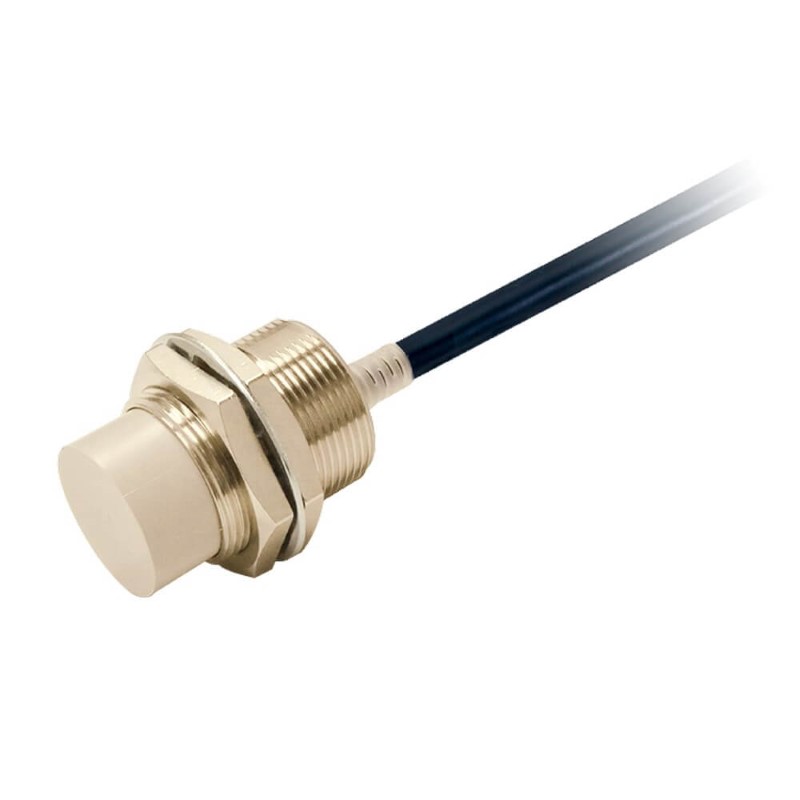
Omron E2E-X18MB230 2M Inductive Proximity Sensor
| Feature | Value |
|---|---|
| Sensor Type | Inductive Proximity Sensor |
| Series | E2E NEXT |
| Sensing Distance | 18 mm |
| Housing Diameter | M30 |
| Mounting Style | Non-flush |
| Output Type | NPN Normally Open |
| Supply Voltage | 10 to 30 VDC |
| Connection Method | 2 m PVC Cable |
| Response Frequency | 100 Hz |
| Housing Material | Nickel-Plated Brass |
| Operating Temperature | -40°C to +85°C |
| Protection Rating | IP67 / IP67G / IP69K |
Technical Description
The Omron E2E-X18MB230 2M Inductive Proximity Sensor is designed for non-contact detection of metallic targets in automated machinery and industrial production systems. The sensor belongs to the E2E NEXT family and combines long sensing distance with a durable mechanical structure suitable for demanding operating environments.
With an 18 mm sensing range and an M30 threaded housing, the Omron E2E-X18MB230 2M Inductive Proximity Sensor provides stable switching performance while supporting installation flexibility. The integrated NPN normally open output allows straightforward integration into a wide variety of industrial control architectures.
Working Principle
The sensor operates by generating an electromagnetic field at the sensing surface. When a metallic object enters the detection zone, eddy currents are induced in the target material. These currents influence the internal oscillation circuit, causing the output state to change and signal object presence.
This sensing method eliminates physical contact between the sensor and the target, reducing mechanical wear and increasing operational reliability.
Industrial Usage Areas
- Automated conveyor systems
- Metal processing equipment
- Machine tool automation
- Assembly line monitoring
- Packaging machinery
- Industrial transfer systems
- Position verification applications
Advantages in Automation Systems
- Long 18 mm sensing distance
- Robust nickel-plated brass housing
- Resistance to dust, moisture, and industrial contaminants
- Wide operating temperature range
- Simple NPN output integration
- Suitable for continuous operation environments
Industry-Specific Applications
Machine Tool Manufacturing
The sensor can verify spindle positioning, tooling status, and workpiece presence during machining operations.
Logistics Facilities
Automated transport systems use inductive sensors to monitor carrier positions and transfer points.
Metalworking Plants
Detection of steel components and machine positions can be achieved without physical contact, supporting efficient production processes.
Factors to Consider During Selection
Sensor selection should account for target material properties, mounting requirements, environmental conditions, cable routing considerations, and electrical interface compatibility.
The Omron E2E-X18MB230 2M Inductive Proximity Sensor is particularly suitable for installations requiring a long sensing distance and reliable metallic object detection under challenging industrial conditions.
Omron E2E-X18MB230 2M Additional information regarding Omron sensor products may help engineers evaluate related sensing technologies and configurations.
Omron E2E-X18MB230 2M Frequently Asked Questions
What type of targets can this sensor detect?
The sensor is designed to detect metallic objects using inductive sensing technology.
What is the nominal sensing distance?
The sensing distance is 18 mm.
Which output type is provided?
The sensor features an NPN normally open output configuration.
What voltage range is supported?
The operating voltage range is 10 to 30 VDC.
How long is the cable?
This version includes a 2-meter PVC cable.
Can it be used in harsh industrial environments?
Its IP67, IP67G, and IP69K ratings support use in demanding industrial applications.
Which industries commonly use this sensor?
Manufacturing, logistics, packaging, metal processing, and machinery industries frequently use inductive proximity sensors of this type.
Does the sensor require physical contact with the target?
No. Detection is performed through an electromagnetic field without direct contact.