
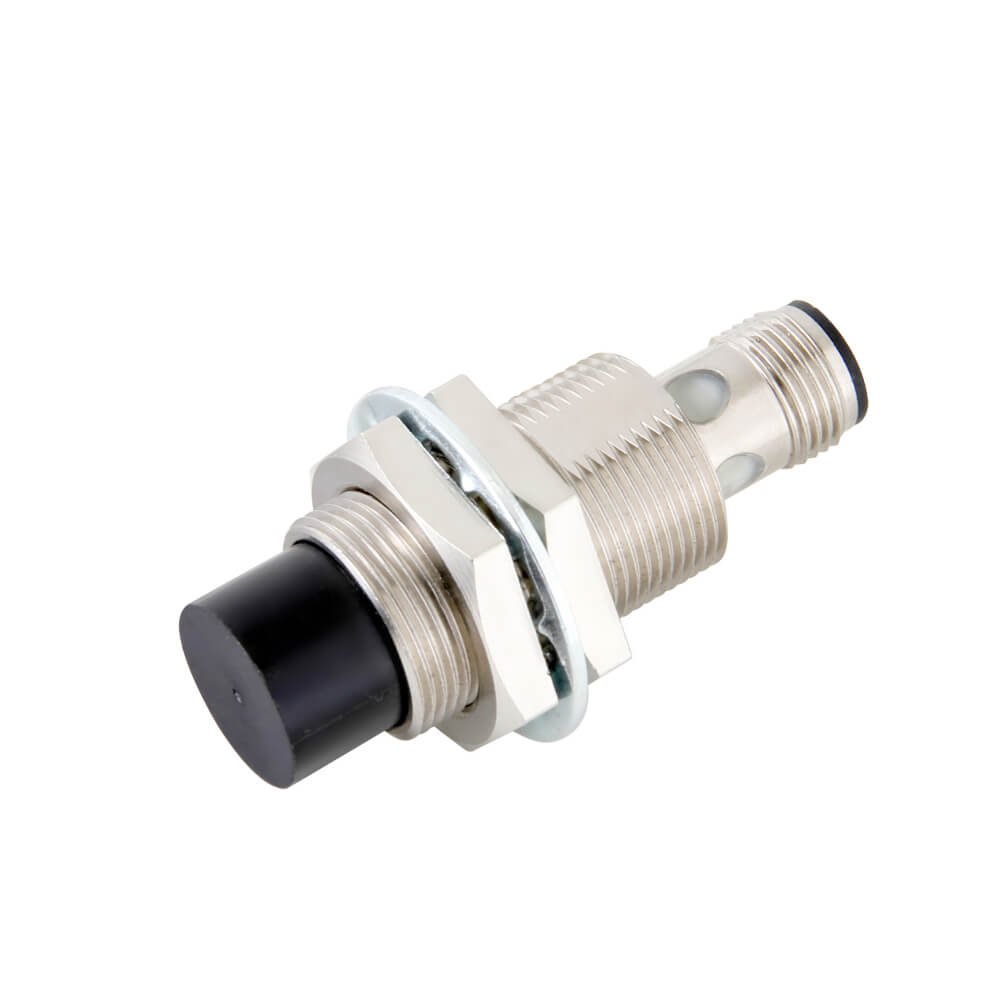
Omron E2E-X16MB1T18-M1 Inductive Proximity Sensor
| Feature | Value |
|---|---|
| Sensor Type | Inductive Proximity Sensor |
| Series | E2E NEXT |
| Housing Size | M18 |
| Mounting Type | Non-flush |
| Sensing Distance | 16 mm |
| Output Type | PNP Normally Open (NO) |
| Connection Type | M12 Connector |
| Wiring Configuration | 3-wire DC |
| Supply Voltage | 10 to 30 VDC |
| Response Frequency | 400 Hz |
| Housing Material | Nickel-Plated Brass |
| Protection Rating | IP67, IP69K |
| Operating Temperature | -40°C to +85°C |
Modern production systems often require sensors that can be replaced quickly without modifying field wiring. The Omron E2E-X16MB1T18-M1 Inductive Proximity Sensor addresses this requirement through its M12 connector interface while maintaining reliable metal detection performance. Its combination of extended sensing distance and industrial-grade protection makes it suitable for a broad range of automation tasks.
Technical Description
The Omron E2E-X16MB1T18-M1 Inductive Proximity Sensor belongs to the E2E NEXT family of cylindrical inductive sensors. It features an M18 threaded housing and a 16 mm sensing distance achieved through a non-flush installation design.
The sensor is equipped with a PNP normally open output and an integrated M12 connector, enabling simplified installation, replacement, and maintenance. The rugged nickel-plated brass housing is designed to withstand demanding industrial environments where vibration, dust, moisture, and mechanical stress are present.
Working Principle
The sensor operates by generating a high-frequency electromagnetic field from the sensing face. When a metallic object enters the sensing zone, eddy currents are induced within the target.
These eddy currents reduce the oscillator amplitude inside the sensor. The internal electronic circuitry continuously monitors this variation and activates the output signal when the switching threshold is reached.
Because detection occurs without physical contact, the sensing process remains consistent over extended operating periods while minimizing wear-related failures.
Primary Usage Areas
- Industrial machine automation
- Production line monitoring
- Metal component detection
- Transfer system positioning
- Automated assembly equipment
- Conveyor control systems
- Packaging machinery
Industrial Applications
Machine Building
Machine manufacturers frequently use connectorized sensors to simplify assembly and reduce installation time during equipment production.
Automated Production Cells
The sensor can verify the presence and positioning of metallic workpieces before robotic or mechanical operations begin.
Maintenance-Oriented Facilities
M12 connector versions support rapid sensor replacement without rewiring, reducing downtime during maintenance activities.
Material Transport Systems
The sensor can monitor carrier positions, actuator travel limits, and transfer mechanisms within automated logistics equipment.
Advantages
- 16 mm sensing distance for flexible installation
- M12 connector enables quick replacement
- Reduced maintenance complexity
- IP67 and IP69K environmental protection
- Wide temperature operating range
- Robust nickel-plated brass construction
- Compatibility with standard PLC architectures
Sector-Specific Use Cases
In pharmaceutical packaging systems, connectorized sensors are often selected to simplify routine maintenance procedures. Automotive production facilities use inductive sensors for fixture detection, transfer line positioning, and automated tooling verification. In warehouse automation projects, sensors can monitor the location of metallic transport elements moving through conveyor networks.
The Omron E2E-X16MB1T18-M1 Inductive Proximity Sensor is particularly useful in applications where sensor replacement speed is important and minimizing machine downtime is a key operational requirement.
For broader sensing system design considerations, engineers may review Omron sensor products that complement inductive detection technologies.
Considerations Before Selecting the Sensor
- Confirm that the target material is metallic.
- Ensure M12 connector compatibility with existing wiring infrastructure.
- Verify available space for non-flush mounting.
- Review controller compatibility with PNP outputs.
- Consider environmental exposure and cleaning procedures.
- Evaluate sensing distance requirements relative to target dimensions.
Frequently Asked Questions
What type of connector does this sensor use?
The sensor uses a standard industrial M12 connector interface.
What objects can be detected?
The sensor is designed for metallic target detection through inductive sensing technology.
What is the nominal sensing distance?
The specified sensing distance is 16 mm.
Can the sensor be connected directly to PLC inputs?
Yes, the PNP output is compatible with many industrial PLC input modules.
Why choose a connectorized version instead of a cable version?
M12 connectors simplify installation, replacement, and maintenance procedures.
Is the sensor suitable for washdown environments?
Its IP67 and IP69K ratings provide protection against dust and high-pressure cleaning conditions.
What voltage range does the sensor require?
The operating voltage range is 10 to 30 VDC.
Does the sensor require physical contact with the target?
No. Detection occurs through electromagnetic field interaction without contact.
Where is the Omron E2E-X16MB1T18-M1 Inductive Proximity Sensor commonly used?
The Omron E2E-X16MB1T18-M1 Inductive Proximity Sensor is commonly used in automated machinery, production cells, and industrial transport systems.
What is the main benefit of the Omron E2E-X16MB1T18-M1 Inductive Proximity Sensor?
The Omron E2E-X16MB1T18-M1 Inductive Proximity Sensor combines long sensing distance with fast connector-based installation and maintenance.