
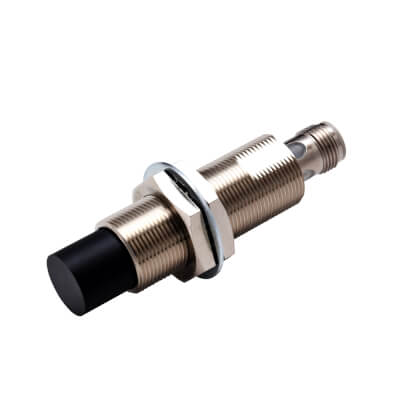
Omron E2E-X10MC1L18-M1 Inductive Proximity Sensor
| Feature | Value |
|---|---|
| Sensor Type | Inductive Proximity Sensor |
| Series | E2E NEXT |
| Housing Size | M18 |
| Mounting Type | Non-flush (Unshielded) |
| Sensing Distance | 10 mm |
| Output Type | NPN Normally Open (NO) |
| Supply Voltage | 10 to 30 VDC |
| Connection Type | M12 Connector |
| Response Frequency | 400 Hz |
| Housing Material | Nickel-plated Brass |
| Protection Rating | IP67 / IP69K |
| Operating Temperature | -40°C to +85°C |
| Thread Size | M18 × 1 |
Technical Description
The Omron E2E-X10MC1L18-M1 Inductive Proximity Sensor is an industrial sensing device developed for non-contact detection of metallic targets. Featuring a standardized M12 connector interface, this model simplifies installation, maintenance, and replacement procedures in automated machinery and process control systems.
Designed within the E2E NEXT product family, the sensor combines a 10 mm sensing range with robust environmental protection and stable switching performance. The unshielded sensing structure enables an extended detection distance while maintaining reliable operation in production environments where equipment uptime and repeatable sensing are important.
The Omron E2E-X10MC1L18-M1 Inductive Proximity Sensor is commonly integrated into modular automation architectures where quick sensor replacement and connector-based wiring are preferred over permanently attached cables.
Working Principle
The sensor operates by generating an oscillating electromagnetic field from the sensing face. When a metallic object enters the active sensing zone, induced eddy currents absorb energy from the oscillator circuit.
The resulting change in oscillation amplitude is processed by the sensor electronics. Once the switching threshold is reached, the NPN normally open output changes state and transmits a signal to connected control equipment.
This contactless sensing method supports long service life because no mechanical interaction occurs between the sensor and the target object.
Application Areas
- Machine automation systems
- Automated assembly stations
- Material transfer equipment
- Industrial conveyor systems
- Packaging machinery
- Metal component positioning
- Robotic handling equipment
- Production monitoring systems
Industrial Applications
Assembly Automation
The sensor can verify the presence and position of metallic fixtures, clamps, and tooling components used during automated assembly operations.
Electronics Manufacturing
Used within production equipment to monitor metallic carriers and mechanical indexing mechanisms.
Industrial Robotics
Provides positional feedback for gripper assemblies, transfer mechanisms, and robotic end-of-arm tooling systems.
Production Equipment
Supports machine status monitoring by detecting moving mechanical elements and actuator positions.
Advantages
- M12 connector simplifies wiring and replacement.
- 10 mm sensing distance supports flexible installation.
- IP67 and IP69K environmental protection.
- Wide operating temperature capability.
- High resistance to vibration and industrial conditions.
- Non-contact operation minimizes wear.
- 400 Hz response frequency supports dynamic machinery.
- Durable nickel-plated brass housing.
Industry Usage Examples
In automated assembly facilities, the sensor can confirm fixture positioning before production cycles begin.
In logistics systems, it may detect metal carriers moving between conveyor sections and transfer points.
In packaging plants, the device can monitor actuator positions to support synchronized machine movements.
Within robotic work cells, it can provide reliable feedback for mechanical positioning tasks and sequence control.
Selection Considerations
- Verify compatibility with NPN control inputs.
- Confirm that metallic targets are being detected.
- Consider required sensing distance and installation clearance.
- Evaluate connector-based maintenance requirements.
- Review environmental protection needs.
- Assess operating temperature conditions.
- Ensure suitable M12 cable assemblies are available.
Additional Omron Sensor Options
Engineers evaluating alternative sensing technologies can review Omron sensor products for applications involving object detection, positioning, inspection, and industrial automation.
Omron E2E-X10MC1L18-M1 Frequently Asked Questions
1. What is the primary benefit of the M12 connector version?
The connector design enables faster installation, maintenance, and replacement compared to permanently attached cable versions.
2. What sensing technology is used?
The sensor uses inductive sensing technology for non-contact metallic object detection.
3. What is the nominal sensing distance?
The rated sensing distance is 10 mm.
4. Which output configuration is provided?
The sensor features an NPN normally open output.
5. Is the sensor suitable for harsh industrial environments?
Yes. IP67 and IP69K protection ratings support operation in demanding industrial conditions.
6. What voltage range is supported?
The operating voltage range is 10 to 30 VDC.
7. Where is the Omron E2E-X10MC1L18-M1 Inductive Proximity Sensor typically installed?
It is commonly used in machinery, conveyor systems, robotics, assembly equipment, and automated production lines.
8. Does the sensor require physical contact with the target?
No. The Omron E2E-X10MC1L18-M1 Inductive Proximity Sensor detects metallic objects through an electromagnetic field without touching the target.