
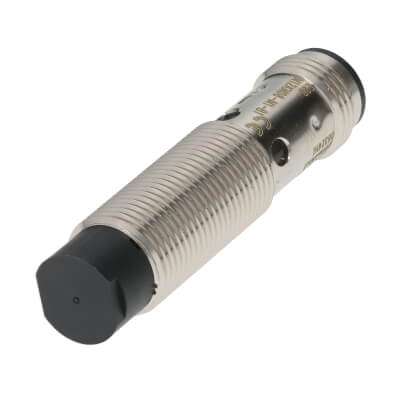
Omron E2B-M12KN08-M1-B1-20 Inductive Proximity Sensor
| Feature | Value |
|---|---|
| Sensor Type | Inductive Proximity Sensor |
| Series | E2B |
| Housing Size | M12 |
| Mounting Style | Non-flush (Unshielded) |
| Sensing Distance | 8 mm |
| Output Type | PNP |
| Output Configuration | Normally Open (NO) |
| Connection Type | M12 4-Pin Connector |
| Wiring System | 3-Wire DC |
| Housing Material | Nickel-Plated Brass |
| Overall Length | 51 mm |
| Thread Length | 24 mm |
| Protection Rating | IP67 |
The Omron E2B-M12KN08-M1-B1-20 Inductive Proximity Sensor is designed for reliable metal target detection in automated industrial environments. As part of the E2B sensor family, this model combines a compact M12 cylindrical housing with an extended 8 mm sensing distance, allowing engineers to detect metallic objects without physical contact.
Its non-flush sensing structure provides greater sensing capability compared to shielded alternatives of the same size. The sensor is equipped with a PNP normally open output and an M12 connector interface, making integration into industrial control systems straightforward and consistent with modern machine design practices.
Technical Description
The Omron E2B-M12KN08-M1-B1-20 Inductive Proximity Sensor belongs to the E2B cylindrical inductive sensor range. It is intended for the detection of ferrous and conductive metallic objects used in manufacturing equipment, automation cells, transfer systems, and machine tools.
The sensor incorporates a nickel-plated brass housing that provides mechanical durability while maintaining resistance against common industrial contaminants. The M12 threaded body allows secure installation into machine frames, mounting brackets, and positioning assemblies.
Key technical characteristics include:
- 8 mm sensing distance
- PNP normally open switching output
- M12 connector connection method
- Compact cylindrical design
- Nickel-plated brass housing
- IP67 environmental protection
- 3-wire DC operation
- Unshielded sensing configuration
Working Principle
The Omron E2B-M12KN08-M1-B1-20 Inductive Proximity Sensor operates using an electromagnetic oscillation circuit. The sensor continuously generates an electromagnetic field in front of its sensing face.
When a metallic target enters the detection zone, eddy currents are induced within the metal surface. These currents absorb energy from the oscillator, causing a measurable reduction in oscillation amplitude. Internal electronics monitor this change and activate the output when the threshold is reached.
This operating principle enables contactless object detection, eliminating mechanical wear and improving long-term reliability in repetitive industrial processes.
Typical Areas of Use
The sensor is commonly installed in applications where reliable metal detection is required under demanding operating conditions.
- Conveyor automation systems
- Machine tool positioning
- Automated assembly stations
- Packaging equipment
- Transfer mechanisms
- Robotic work cells
- Material handling equipment
- Production line monitoring systems
The Omron E2B-M12KN08-M1-B1-20 Inductive Proximity Sensor is frequently used where compact dimensions and increased sensing distance are important design considerations.
Industrial Applications
Automotive Production Lines
Used to verify fixture positions, monitor mechanical movement, and detect metal carriers moving through assembly processes.
Metal Processing Facilities
Supports positioning verification of workpieces and machine components during machining and fabrication operations.
Packaging Automation
Provides position confirmation for actuators, transport systems, and indexing equipment used throughout packaging operations.
Logistics and Warehousing
Detects metallic transport structures, pallets, and handling equipment integrated into automated conveyor systems.
Advantages
- Extended 8 mm sensing range for an M12 sensor
- Non-contact operation minimizes wear
- Connector-based installation simplifies maintenance
- Robust nickel-plated brass housing
- Suitable for demanding industrial environments
- Reliable switching performance during continuous operation
- Compatible with standard PLC input systems
- Compact form factor for space-constrained installations
Many machine builders select the Omron E2B-M12KN08-M1-B1-20 Inductive Proximity Sensor when a compact sensor with a longer sensing distance is required without increasing housing size.
Industry-Specific Examples
- Monitoring shuttle positions in automated storage systems
- Detecting metal carriers in assembly conveyors
- Position verification on robotic grippers
- Monitoring pneumatic cylinder travel positions
- Detecting indexing plates in packaging machinery
- Confirming metal fixture locations in welding systems
Considerations When Selecting This Sensor
Proper sensor selection improves overall machine reliability and system performance.
- Verify compatibility with PNP input circuitry
- Ensure sufficient installation space for an unshielded sensor
- Confirm that the 8 mm sensing distance meets application requirements
- Evaluate environmental exposure conditions
- Check connector compatibility with existing cabling
- Review target material characteristics
Engineers evaluating different sensing technologies can review additional Omron sensor series for alternative housing sizes, sensing distances, and output configurations.
Frequently Asked Questions
What type of objects can this sensor detect?
The sensor is designed for detecting metallic objects without physical contact.
What is the rated sensing distance?
The nominal sensing distance is 8 mm.
What output type does the sensor provide?
The device uses a PNP normally open output configuration.
Is this a shielded or unshielded sensor?
This model uses a non-flush, unshielded sensing design.
How is the sensor connected?
It uses a standard M12 4-pin industrial connector.
Can the sensor operate in dusty environments?
Yes. The IP67 protection rating helps protect against dust and water ingress.
Where is this sensor commonly installed?
It is widely used in conveyors, packaging machines, robotic cells, machine tools, and assembly systems.
Why choose an unshielded sensor design?
Unshielded sensors typically provide a greater sensing distance than shielded models of the same housing size.