
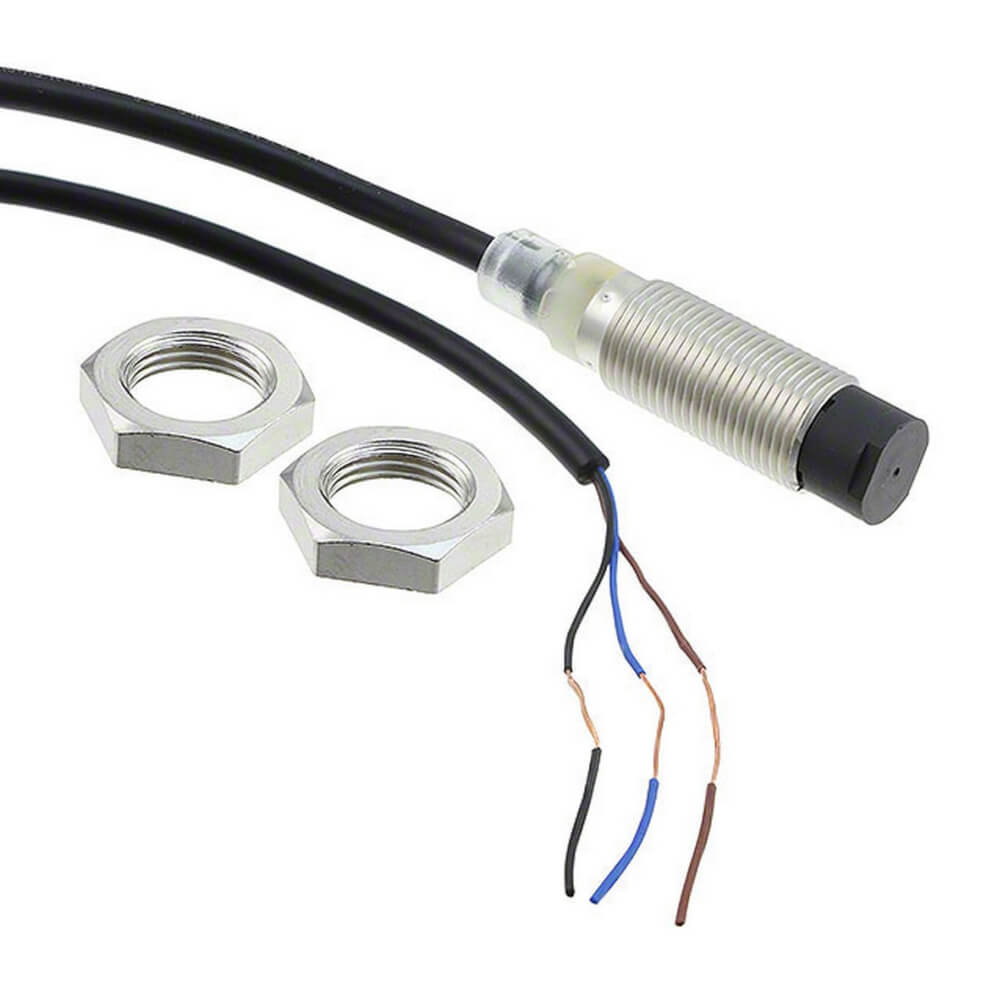
Omron E2B-M12KN05-WP-B2 2M Inductive Proximity Sensor
| Feature | Value |
|---|---|
| Sensor Type | Inductive Proximity Sensor |
| Series | E2B |
| Housing Diameter | M12 |
| Sensing Distance | 5 mm |
| Mounting Style | Non-flush |
| Output Type | PNP Normally Closed |
| Supply Voltage | 10 to 30 VDC |
| Connection Type | 2 m PVC Cable |
| Response Frequency | 800 Hz |
| Housing Material | Nickel-Plated Brass |
| Protection Rating | IP67 |
| Operating Temperature | -25°C to +70°C |
| Overall Length | 51 mm |
Technical Description
The Omron E2B-M12KN05-WP-B2 2M Inductive Proximity Sensor is intended for reliable detection of metallic objects in automated industrial systems. The sensor combines a 5 mm sensing range with a PNP normally closed output configuration, making it suitable for control strategies that require a closed-state output under normal operating conditions.
Its cylindrical M12 housing enables installation in compact equipment designs, while the integrated 2-meter cable supports direct wiring into control cabinets and machine systems.
Working Principle
The Omron E2B-M12KN05-WP-B2 2M Inductive Proximity Sensor uses electromagnetic induction to identify metallic targets. The sensing element generates a high-frequency field at the sensor face. When a metal object enters the sensing area, the field is disturbed and the sensor switches its output state.
Because there are no moving mechanical contacts involved in the detection process, the sensor can operate reliably in applications requiring frequent switching cycles.
Applications
- Machine safety interlock monitoring
- Automated positioning systems
- Conveyor automation
- Industrial handling equipment
- Packaging machinery
- Machine tool systems
- Transfer line automation
- Production equipment monitoring
Industrial Applications
The Omron E2B-M12KN05-WP-B2 2M Inductive Proximity Sensor is commonly used in machinery that relies on normally closed logic configurations. Engineers often integrate this model into diagnostic circuits, machine monitoring functions, and automated position verification systems.
In manufacturing environments, the sensor can help supervise machine states, actuator positions, and the presence of metallic components throughout production processes.
Advantages
- Normally closed output configuration
- Reliable metal object detection
- Compact M12 housing
- Integrated cable connection
- IP67 environmental protection
- Suitable for demanding industrial environments
- High switching frequency
- Durable nickel-plated brass construction
Sector-Specific Usage Examples
Packaging Systems
Used for monitoring mechanical positions and machine sequence transitions.
Automotive Production
Detects fixture positions and metallic components moving through automated stations.
Industrial Conveyors
Provides feedback signals for routing and positioning mechanisms.
Assembly Automation
Supports machine coordination and process verification tasks.
Considerations When Selecting This Product
The Omron E2B-M12KN05-WP-B2 2M Inductive Proximity Sensor should be selected based on control system requirements, mounting conditions, target material characteristics, and desired output behavior. The normally closed output configuration may be preferred in specific machine logic architectures.
Proper installation clearance and adherence to non-flush mounting requirements are important to maintain consistent sensing performance.
Omron E2B-M12KN05-WP-B2 2M Engineers seeking related industrial sensing technologies can review Omron sensor products.
Omron E2B-M12KN05-WP-B2 2M Frequently Asked Questions
What sensing distance does this model provide?
5 mm.
What output type is available?
PNP normally closed.
What cable length is supplied?
2 meters.
Can the sensor operate in dusty environments?
Its IP67 protection rating supports operation in demanding industrial environments.
What voltage range is supported?
10 to 30 VDC.
What materials can be detected?
Metallic targets designed for inductive sensing applications.
Where is the Omron E2B-M12KN05-WP-B2 2M Inductive Proximity Sensor typically installed?
It is commonly installed in automation machinery, conveyors, and production equipment.
How should the sensor be maintained?
Regular inspection of cable condition, mounting integrity, and sensing face cleanliness is recommended.