
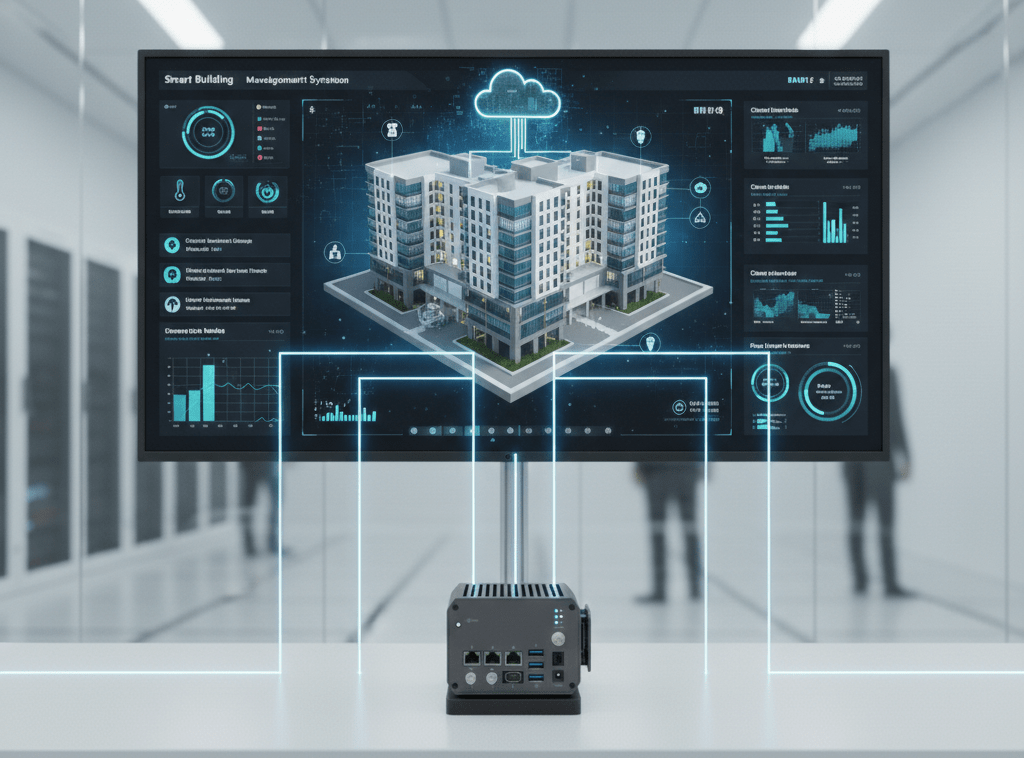
IoT Gateway Applications for Smart Building and BMS
Modern commercial buildings contain hundreds of interconnected systems – HVAC equipment maintaining climate comfort, lighting controls optimizing energy usage, access control securing entrances, fire safety systems protecting occupants, and energy meters monitoring consumption. Building Management Systems (BMS) traditionally operated as isolated silos with proprietary protocols and closed architectures. Advantech IoT gateways transform conventional building automation into smart, connected infrastructure by integrating legacy BACnet and Modbus equipment with modern cloud platforms, enabling predictive maintenance, energy optimization, and occupant comfort analytics previously impossible with conventional BMS.
The UNO-1372G serves as the ideal BMS integration gateway with its compact DIN-rail form factor fitting existing electrical rooms and MDF closets without space constraints. Four configurable serial ports connect to older building controllers using BACnet MS/TP, Modbus RTU, or LonWorks protocols, while dual Gigabit Ethernet interfaces handle BACnet/IP and Modbus TCP communications with newer equipment. A commercial office building might have 40-year-old pneumatic controls retrofitted with BACnet gateways, 20-year-old DDC controllers using BACnet MS/TP, 10-year-old VAV controllers on BACnet/IP, and modern LED lighting using DALI – the UNO-1372G aggregates all these systems into unified data streams accessible via standard IT protocols.
BACnet Protocol Support and Device Integration
BACnet remains the dominant protocol in commercial building automation, with ASHRAE Standard 135 defining standard objects, properties, and services for HVAC and building control. The ADAM-3600 implements a complete BACnet stack supporting both BACnet/IP and BACnet MS/TP interfaces simultaneously. As a BACnet client (B-OWS), the gateway reads data from existing BACnet field controllers, room sensors, and mechanical equipment. Simultaneously operating as a BACnet server (B-ASC), it exposes aggregated data to BMS supervisory systems and third-party analytics platforms using standardized BACnet objects.
The gateway discovers BACnet devices automatically through network broadcasts (Who-Is/I-Am) and segmentation protocols, building comprehensive device databases without manual configuration. Once discovered, the gateway browses each device’s object list, learning available data points – temperatures, setpoints, occupancy states, alarm conditions, equipment statuses. Comprehensive trending capabilities log historical data locally, while change-of-value (COV) subscriptions ensure immediate notification of critical state changes like equipment failures or alarm conditions. Schedule coordination synchronizes operations across multiple controllers based on central time sources.
Energy Monitoring and Demand Response
Commercial buildings account for 40% of total energy consumption in developed economies, making energy optimization a priority for facility managers and corporate sustainability initiatives. The UNO-2271G integrates power meters, environmental sensors, and HVAC controllers to provide comprehensive energy visibility. Real-time power monitoring tracks consumption by floor, department, or equipment type, identifying inefficient operations like HVAC running in unoccupied spaces or lights remaining on overnight. Historical analysis reveals usage patterns, peak demand periods, and opportunities for load shifting.
Demand response integration enables automated load shedding during utility peak pricing periods or grid stress events. When the local utility signals high demand conditions, the gateway automatically adjusts HVAC setpoints by 2-3°F, dims non-critical lighting, and delays non-urgent equipment operation. These temporary reductions can decrease building power consumption by 15-25% without significantly impacting occupant comfort. Participation in demand response programs generates revenue credits often totaling thousands of dollars monthly for large commercial buildings. The gateway logs all demand response events for audit and compliance verification.
Occupancy-Based HVAC Optimization
Traditional building automation operates on fixed time schedules – HVAC systems start at 6 AM for 8 AM occupancy, run all day until 6 PM, then shut down. This approach wastes energy conditioning spaces during periods of low or zero occupancy. The UNO-1372G integrates occupancy sensors, access control systems, and calendar data to optimize HVAC operation dynamically. Conference rooms condition only when bookings exist in scheduling systems. Open office areas adjust ventilation based on actual headcount from people counting cameras or CO2 sensors. This occupancy-driven control reduces HVAC energy consumption 20-40% compared to fixed schedules while improving comfort by responding to actual space usage rather than assumptions.
Machine learning models running on the gateway predict occupancy patterns based on historical data, enabling pre-conditioning strategies that balance comfort and efficiency. The system learns that conference room 3B has 90% occupancy probability on Wednesday mornings, starting HVAC earlier for comfort. Friday afternoons show low occupancy with many employees leaving early, allowing aggressive setback strategies. Holiday schedules, weather impacts on occupancy, and seasonal variations all influence predictive models, continuously improving accuracy over months of operation.
Fault Detection and Diagnostics
Equipment failures in commercial buildings often go undetected until occupant complaints or complete breakdowns occur. By then, minor issues have escalated into expensive emergency repairs and uncomfortable spaces. The ADAM-3600 implements automated fault detection and diagnostics (AFDD) algorithms monitoring equipment performance continuously. Anomaly detection identifies deviations from normal operation – a chiller drawing excessive power might indicate refrigerant leaks or fouled heat exchangers. Air handler supply temperatures failing to reach setpoints despite valve positioning suggests damper failures or coil issues.
Rule-based diagnostics codify expert knowledge about common failures. If return air temperature remains constant despite outdoor air dampers opening, the system suspects damper actuator faults. Supply fan current spikes combined with decreasing airflow indicate filter clogging requiring maintenance. These automated diagnostics generate work orders in building maintenance management systems, enabling proactive repairs during normal business hours rather than emergency after-hours service. Studies show AFDD reduces HVAC energy waste by 10-30% by ensuring equipment operates at design efficiency.
Integration with Cloud-Based Analytics Platforms
While building automation controllers handle local control loops, cloud platforms provide advanced analytics, benchmarking, and enterprise-wide visibility impossible with on-premises BMS. The UNO-2372G publishes building data to platforms like Siemens Building X, Honeywell Forge, Johnson Controls OpenBlue, and generic IoT clouds via MQTT or REST APIs. These platforms aggregate data from entire building portfolios, identifying best-performing facilities and opportunities for replicating successful strategies across the organization.
Machine learning models in the cloud analyze weather data, occupancy patterns, utility pricing, and equipment performance to generate optimization recommendations. Cloud dashboards provide mobile access for facility managers monitoring multiple sites, with alerts routed to smartphones for immediate response to critical issues. Multi-site energy benchmarking compares buildings of similar size and function, highlighting underperformers requiring attention. These insights drive capital planning decisions – analytics might reveal certain chiller models consume 30% more energy than alternatives, informing equipment replacement priorities.
Access Control and Security System Integration
Modern smart buildings integrate physical security with building automation for enhanced security and operational efficiency. The UNO-1372G connects to access control panels from manufacturers like HID, Lenel, AMAG, and Software House, receiving badge scan events and door position status. This integration enables sophisticated automation – unlocking main entrances triggers HVAC startup and lighting activation in common areas. After-hours badge scans in specific zones condition only required spaces rather than entire floors. Emergency lockdown commands from security systems automatically shut down HVAC to prevent smoke or contaminant circulation.
Video surveillance integration provides visual verification of security events and operational anomalies. Temperature alarms in server rooms trigger camera recording for visual fault diagnosis. Tailgating detection at secure entrances combines camera analytics with access control data, alerting security personnel to unauthorized entries. These integrated systems provide situational awareness impossible with standalone security and automation platforms operating in silos.
Real-World Deployment: Corporate Campus Retrofit
A technology company retrofitted their 15-building corporate campus with Advantech IoT gateways to modernize a 1990s vintage Siemens APOGEE BMS. Each building received 2-3 UNO-2372G gateways interfacing with existing BACnet MS/TP controllers while adding new wireless sensors for occupancy and environmental monitoring. The gateways publish data to Microsoft Azure IoT for cloud analytics and maintain local control loops for resilient operation during internet outages. Results after 12 months: 28% reduction in HVAC energy consumption through occupancy-driven optimization, 40% decrease in maintenance costs through predictive diagnostics, and improved occupant satisfaction scores from 67% to 84% through responsive comfort control. The project achieved 2.1-year payback from energy savings alone, with additional benefits from reduced maintenance and improved space utilization.
Frequently Asked Questions
What building automation protocols do Advantech gateways support?
Gateways support BACnet/IP, BACnet MS/TP, Modbus RTU/TCP, LonWorks, KNX, DALI lighting control, and many proprietary HVAC manufacturer protocols. This comprehensive support enables integration of multi-vendor building systems into unified platforms.
Can these gateways replace existing BMS controllers?
The gateways complement rather than replace field controllers. They aggregate data from existing controllers for cloud integration, analytics, and cross-system coordination. For new installations, the ADAM-3600 provides both gateway and I/O controller functions, reducing equipment counts.
How do IoT gateways improve building energy efficiency?
Gateways enable occupancy-based control, demand response automation, equipment fault detection, and cloud-based analytics that optimize HVAC operations beyond traditional time-of-day scheduling. Typical energy reductions range from 15-30% depending on baseline system performance and optimization strategies implemented.
What about cybersecurity for building automation networks?
Gateways provide network segmentation isolating building automation from corporate IT networks. Firewalls filter traffic, VPNs encrypt cloud communications, and certificate authentication verifies system identities. Regular security updates address vulnerabilities. These features align with standards like NIST Cybersecurity Framework for building automation security.
Can gateways integrate with existing BMS?
Yes, gateways coexist with existing BMS as data aggregators and cloud connectors. They don’t require replacing functional BMS investments. Over time, legacy BMS functions may migrate to cloud platforms, but integration preserves existing operational workflows during transitions.
How difficult is gateway installation in existing buildings?
Installation typically requires 2-4 hours per gateway for mounting, network connections, and basic configuration. BACnet auto-discovery simplifies device setup. Most integrators complete building retrofits during normal business hours without requiring building shutdowns or control interruptions.
What maintenance do IoT gateways require?
Gateways require minimal maintenance – occasional firmware updates via remote management platforms. No moving parts means high reliability. LED indicators and web interfaces simplify troubleshooting. Typical Mean Time Between Failures (MTBF) exceeds 100,000 hours.
Can these gateways monitor renewable energy systems?
Yes, gateways integrate with solar inverters, battery storage systems, and wind turbines common in green buildings. Renewable energy monitoring combines with building load data for optimizing self-consumption and peak demand management, maximizing return on renewable investments.