
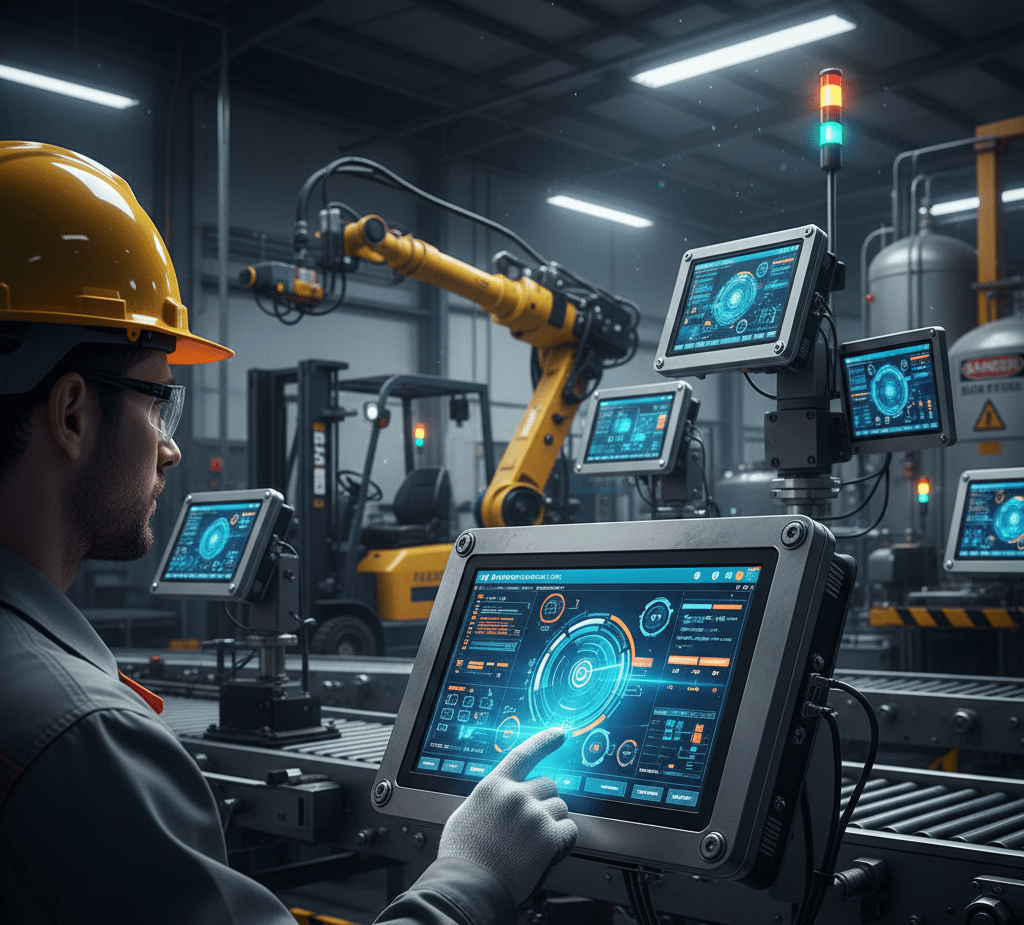
Industrial Touch Panel PC Systems
Human-Machine Interface (HMI) evolution from physical button panels to graphical touchscreens transformed industrial control system usability, enabling intuitive operation, rich data visualization, and flexible interface reconfiguration without hardware changes. Advantech industrial touch panel PCs integrate computing, display, and touch input in ruggedized packages designed for continuous operation in demanding factory environments where commercial computers and consumer tablets fail within weeks.
Industrial touchscreens differ fundamentally from consumer devices through enhanced durability, extended temperature operation, and resistance to contaminants. Projected capacitive (P-Cap) touch technology used in smartphones proves inadequate for industrial applications where operators wear gloves, screens accumulate contamination, or environments experience extreme temperatures. Industrial touch panel PCs employ resistive or industrial-grade P-Cap touch sensors maintaining functionality through gloves, with liquids on screens, and across -20°C to 60°C temperature ranges impossible for consumer touch technologies.
Touch Technology Selection
Resistive touchscreens detect pressure applied to flexible overlay pressing against underlying screen layers. This pressure-based detection works reliably with gloved hands, styluses, or any pointing object regardless of electrical conductivity. Chemical and moisture resistance suits harsh environments where screens contact oils, solvents, or cleaning chemicals. However, resistive screens require harder presses than capacitive alternatives, reducing operator comfort during extended use. Light transmission through the resistive overlay slightly reduces display brightness and clarity compared to capacitive alternatives.
Industrial projected capacitive touchscreens overcome consumer P-Cap limitations through thicker cover glass, enhanced EMI filtering, and sophisticated controllers maintaining functionality through thin gloves and light moisture. Multi-touch gestures enable zoom, rotate, and swipe interactions familiar from smartphones. Superior optical clarity and lighter touch response improve operator experience. The primary limitation involves incompatibility with thick gloves or conductive contamination on screens – applications involving heavy gloves or wet processes may require resistive alternatives.
Surface Acoustic Wave and Infrared Touch
Surface Acoustic Wave (SAW) touch detects touch events through ultrasonic wave interruption across the screen surface. Excellent optical clarity, durability, and glove compatibility suit many industrial applications. However, SAW proves sensitive to surface contaminants like water droplets or heavy dust affecting wave propagation. Infrared (IR) touch employs LED/photodiode arrays around the screen perimeter detecting touch through beam interruption. This bezel-mounted technology works with any object including gloves and styli, suits outdoor applications with excellent sunlight readability, but requires careful mounting preventing false touches from dust or insects interrupting beams.
Display Technologies and Specifications
TFT LCD (Thin Film Transistor Liquid Crystal Display) dominates industrial panel PCs through mature manufacturing, good color reproduction, and adequate brightness for most applications. Industrial LCDs specify higher brightness (450-1000 nits) than commercial monitors (250-350 nits) ensuring visibility in brightly lit factories or outdoor installations. LED backlighting provides uniform illumination with 50,000+ hour lifetimes reducing maintenance. Wide viewing angles (160-170 degrees) accommodate operators viewing screens from non-perpendicular positions common in machinery operation.
Sunlight-readable displays incorporate extremely high brightness (1000-1500 nits), optical bonding eliminating internal reflections, and anti-reflective coatings reducing glare. These specifications enable outdoor installations or greenhouse automation where direct sunlight would render standard displays unreadable. The brightness and optical enhancements significantly increase cost – applications should verify sunlight-readable specifications are necessary rather than over-specifying for indoor installations where standard industrial brightness suffices.
Panel PC Form Factors and Mounting
Panel mount installation integrates displays directly into equipment panels, control cabinets, or machinery providing clean aesthetics with only the display face visible. Panel cutouts accommodate specific display sizes; mounting clips or screws secure panel PCs from behind. IP65 front panel ratings seal against dust and liquid ingress protecting internal electronics. This integration suits equipment where computing and display must occupy minimal space while maintaining NEMA 4/4X or IP65 environmental protection.
Open frame mounting exposes panel PC edges allowing integration into custom enclosures. This flexibility suits OEM equipment builders incorporating panel PCs into proprietary machinery designs. Wall or arm mounting via VESA patterns enables flexible positioning on articulating arms or adjustable brackets. Operators can position displays optimally for their working positions then lock in place. Some panel PCs include carrying handles for portable applications moving between workstations or mobile equipment.
Processing Power and Industrial Software
Panel PC computing platforms range from ARM-based processors running embedded Linux to Intel Core processors running Windows 10 IoT Enterprise. ARM solutions offer lower power consumption, fanless operation, and cost advantages for simple HMI applications displaying process status and accepting basic operator inputs. Intel x86 platforms provide compatibility with extensive Windows software ecosystem including sophisticated SCADA systems, databases, and custom applications requiring substantial processing power.
Industrial panel PCs ship with Windows 10 IoT Enterprise rather than consumer Windows versions. IoT Enterprise provides 10-year Long-Term Servicing Channel (LTSC) support without forced feature updates disrupting production environments, lockdown features preventing unauthorized software installation or system configuration changes, and embedded licensing valid for the panel PC’s operational lifetime. These enterprise features justify slightly higher costs through reduced IT support requirements and operational stability essential for 24/7 industrial deployments.
Connectivity and I/O Expansion
Industrial panel PCs provide comprehensive connectivity accommodating diverse automation equipment. Multiple Ethernet ports enable plant network connections plus direct equipment communication. Serial ports (RS-232/422/485) connect to legacy PLCs, instruments, and controllers common in mature facilities. USB ports attach peripherals like barcode scanners, printers, or mass storage. Some models include CAN bus for automotive or mobile equipment applications, or specialized fieldbus interfaces (Profinet, EtherCAT) for direct industrial network integration.
Isolated digital I/O enables direct sensor reading and actuator control without intermediate PLCs. Panel PCs function as combined HMI and control platforms for small applications where dedicated PLC costs prove unjustified. Expansion slots or modules add capabilities as requirements evolve – wireless connectivity, additional serial ports, or specialized interface cards. This expandability protects initial investments by accommodating future requirements without replacing entire panel PCs.
Environmental Ratings and Certifications
IP (Ingress Protection) ratings specify dust and moisture protection levels critical for equipment selection. IP65 front panels protect against dust ingress and water jets from any direction, suitable for food processing washdown or outdoor installations. IP66 increases water jet pressure resistance. Complete IP65/IP66 rating (front and rear) requires careful cable entry sealing but enables installation in extremely harsh environments. Applications should specify minimum required IP ratings avoiding over-specification increasing costs unnecessarily.
NEMA ratings (North American standard) roughly correlate to IP ratings: NEMA 4 approximates IP65, NEMA 4X adds corrosion resistance. UL/cUL listings verify safety compliance for North American installations. CE marking indicates European conformity. Hazardous location certifications (Class I Division 2, ATEX, IECEx) address installations in potentially explosive atmospheres requiring specialized enclosures and intrinsic safety barriers. Food-grade certifications suit pharmaceutical and food processing requiring NSF or EHEDG compliance.
Real-World Application Examples
Pharmaceutical manufacturing deployed 15-inch panel PCs at tablet compression machines, capsule fillers, and packaging lines providing operators with recipe management interfaces, batch record documentation, and equipment status monitoring. 21 CFR Part 11 compliant software running on panel PCs captures electronic signatures, maintains audit trails, and enforces data integrity controls meeting FDA regulatory requirements. IP65 front panel ratings withstand cleanroom sanitization procedures. The installations replaced aging button-based panels reducing operator errors by 65% through intuitive graphical interfaces while maintaining regulatory compliance.
Food processing facilities use 12-inch panel PCs with stainless steel enclosures at mixing, filling, and packaging stations. IP69K ratings withstand high-pressure, high-temperature washdown procedures mandatory for food safety. Resistive touchscreens function reliably despite moisture from cleaning and condensation in refrigerated areas. The panel PCs run recipe management software, provide process visualization, and interface with PLCs controlling equipment. Operators wearing nitrile gloves successfully operate touchscreens, critical for maintaining food safety protocols.
Frequently Asked Questions
What screen size should I choose for industrial applications?
Common sizes range from 7 inches (simple status displays, mobile equipment) to 21+ inches (complex SCADA workstations). Consider viewing distance, information density, and available mounting space. Operators standing 1-2 meters away typically need 12-15 inch displays; close-proximity machine operators work effectively with 10-12 inches. Larger displays suit control rooms with complex multi-window SCADA interfaces.
Should I choose resistive or capacitive touchscreens?
Choose resistive for thick gloves, harsh chemicals, extreme temperatures, or wet environments. Choose industrial capacitive for lighter gloves, multi-touch gestures, superior optical clarity, and better user experience. If operators alternate between gloved and bare-hand operation, capacitive usually provides better overall experience with thin glove compatibility.
Can panel PCs operate in outdoor installations?
Yes, with appropriate specifications. Sunlight-readable displays (1000+ nits brightness), wide temperature operation (-20°C to 60°C+), weatherproof enclosures (IP65/IP66), and appropriate mounting hardware enable outdoor deployments. Verify operating temperature ranges accommodate local climate extremes. Consider shading or enclosures for extreme environments.
What operating system is best for industrial panel PCs?
Windows 10 IoT Enterprise provides maximum software compatibility for SCADA, HMI, and industrial applications. Embedded Linux suits custom applications, lower costs, and reduced licensing complexity. Windows offers easier integration with existing IT infrastructure; Linux provides greater customization and lighter resource requirements. Choose based on application software requirements and IT support capabilities.
How long do industrial panel PCs typically last?
Industrial panel PCs commonly operate 7-10 years in continuous 24/7 service. LCD backlight degradation represents the primary age-related issue, with brightness decreasing 30-50% over 50,000-100,000 hours. Solid-state storage, fanless cooling, and industrial components extend lifespans beyond commercial equipment lasting 3-5 years. Proper installation, adequate ventilation, and clean environments maximize operational lifetimes.
Do panel PCs require special programming skills?
Depends on application. Commercial HMI/SCADA software (Wonderware, Ignition, iFIX) provides graphical development without traditional programming. Custom applications require appropriate skills in C++, C#, or web technologies. Many integrators specialize in panel PC application development. Simpler applications might use pre-configured templates or vendor-provided software requiring minimal customization.
Can I connect panel PCs to existing PLCs?
Yes, panel PCs communicate with virtually all industrial PLCs through Ethernet, serial ports, or fieldbus interfaces. Most HMI/SCADA software includes driver libraries for major PLC brands (Siemens, Allen-Bradley, Mitsubishi, Schneider). OPC UA provides standardized industrial communication. System integrators routinely deploy panel PCs interfacing with legacy and modern PLCs.
What maintenance do industrial panel PCs require?
Minimal maintenance for fanless models – periodic touchscreen cleaning, firmware updates via USB or network, and visual inspections of mounting hardware and cable connections. Fan-equipped models require filter cleaning/replacement every 3-6 months depending on environment. Software updates and backups follow normal IT practices. Clean environments and proper installation significantly reduce maintenance requirements.